

ROOSEVELT SENDS TROOPS TO ICELAND, CARIBBEAN
Washington, D.C. · July 7, 1941
Long before the U.S. entered World War II, President Franklin D. Roosevelt began unraveling Congressional legislation that had hindered his aiding Great Britain and other Western democracies in their armed conflict with Nazi tyranny. Four successive Neutrality Acts from the 1930s were undone with “help” from 2 German U‑boat attacks on U.S. Navy ships in the North Atlantic off Iceland, together with FDR’s Lend-Lease bill, approved by Congress on March 11, 1941, which began “lending” arms and material to the British—at war with Germany since September 3, 1939—even though the U.S. technically remained neutral.
On this date in July 1941 Roosevelt dispatched American forces to occupy the Caribbean island of Trinidad, British Guiana in South America, and the Danish dependency of Iceland in the North Atlantic. The 2 British possessions, Trinidad and British Guiana, were strategically significant because of Venezuelan oil fields in the southeast and the U.S.-owned Panama Canal in the southwest. Iceland, viewed as part of America’s defense of the Western Atlantic, approved the arrangement whereby troops of a neutral nation—that is, the U.S.—would be permitted to station armed forces on its soil in place of troops from a belligerent country. The belligerent country was Great Britain, which had stationed troops in Iceland and patrolled Icelandic waters to prevent Germany from overrunning the island after the latter had overrun Iceland’s mother country, Denmark, the year before. Three months earlier, in April 1941, FDR had sent troops to occupy the Danish dependency of Greenland, the lightly settled landmass east of Canada.
These occupations were made under the imaginative guise that the territories fell under the protective umbrella of the century-old U.S. Monroe Doctrine. The American move was to prevent, in the words of the president (who also happened to be military commander-in-chief), the occupation by Nazi Germany of strategic outposts that could be used as air or naval bases for eventual attack against nations in the Western Hemisphere. American air and naval assets on Greenland and Iceland moved the U.S. closer to supporting Great Britain in its Battle of the Atlantic—which became the longest-running (6 years), most complex campaign of the war—because now U.S. Navy warships could extend their patrols to these 2 island territories, both laying along the fragile oceanic lifeline between the U.S. and Britain.
The U.S. Navy on the Eve of War with Germany, 1941
 |
 |
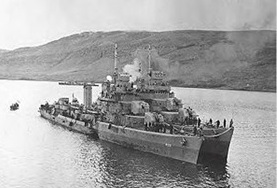
Left: USS Kearny at Reykjavík, Iceland, 2 days after being torpedoed by U‑568 on October 17, 1941. The USS Monssen is alongside. The torpedo hole is visible in Kearny’s starboard side (dark smudge midship in photo). The Kearny, assisting 3 other U.S. destroyers, came to the rescue of a beleaguered convoy whose Canadian escorts were being mauled by a U‑boat wolf pack when it too came under attack. Casualties among Kearny’s crew included 11 dead and 22 injured. Roosevelt told the American public that “we do not propose to take this [attack] lying down.” He asked Congress to authorize the arming of American merchant ships, one of many mileposts he planted on the road to mobilizing the nation for war in 1941.
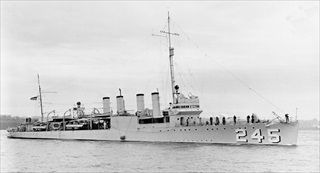
Right: The USS Reuben James—a 4-funnel, post-World War I destroyer—was the second U.S. Navy ship sunk by hostile action in World War II. (The first was the USS Panay, a Yangtze (China) river gunboat sunk by Japanese aircraft on December 12, 1937.) The sinking of the Reuben James off Iceland on October 30, 1941, with the loss of 115 lives, prompted Congress, on November 17, 1941, to lift the last provisions of the archaic 1930s Neutrality Laws. The U.S. was 3 weeks short of being drawn into war with Imperial Japan, Nazi Germany, and Fascist Italy.
Battle of the Atlantic, 1939–1945

World War II was the single most devastating and horrific event in the history of the world, causing the death of some 70 million people, reshaping the political map of the twentieth century and ushering in a new era of world history. Every day The Daily Chronicles brings you a new story from the annals of World War II with a vision to preserve the memory of those who suffered in the greatest military conflict the world has ever seen.