

RESIDENTS WITNESS LIBERATION BY FIRELIGHT
Sainte-Mère-Église, Liberated France · June 5, 1944
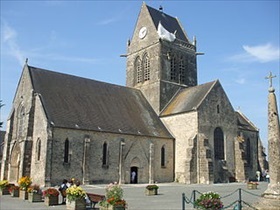
On this date in 1944 the people of Sainte-Mère-Église on the Cotentin Peninsula in Normandy, France, retired to their beds on the eve of the largest air- and seaborne invasion in history—Operation Overlord. As early as 1942, U.S. military planners had been eying this crossroads town. If the Allies could gain control of this town, they could deny German reinforcements the most likely route to Utah and Omaha landing beaches. It would also cut the road and rail link to the vital deep-water port of Cherbourg. Roughly 30 paratroopers of the U.S. 82nd and 101st Airborne Divisions landed at Sainte-Mère-Église in the wee hours of June 6, reinforced at daybreak by another infantry unit. The lightly armed soldiers held the town until reinforced by armor from nearby Utah Beach in the afternoon of June 7. Today hanging from the church steeple is a life-size effigy of Pvt. John Steele, whose canopy snagged the spire, leaving him dangling for two hours as one of two witnesses to the carnage below, lighted by a house fire. (Steele pretended to be dead.) The effigy is a permanent memorial to the brave Americans who liberated the first town in France. Although the 82nd Airborne had taken its chief objective, it had landed close to German units and would suffer numerous counterattacks. Meanwhile, the sizeable bridgehead established by the Allies’ precisely timed air, naval, and amphibious “shock and shatter” attacks overwhelmed the static German coastal defenses. The three British and Canadian beaches were joined together on June 7 and a day later linked up with Omaha Beach. By June 12 Utah Beach was incorporated within the 50‑mile front. However, the Norman bocage and its maze of tall hedgerows behind the beaches bogged down follow-on operations, not helped by an increasingly determined German defense that slowed Allied progress in the West. In the East the Soviets launched their major summer offensive, Operation Bagration, throwing 2.5 million men, 5,200 tanks, and 5,300 aircraft at German Army Group Center. On July 1, Adolf Hitler’s chief of staff at German Supreme Headquarters in Berlin, Field Marshal Wilhelm Keitel, telephoned Field Marshal Gerd von Rundstedt, commander in chief of German forces in France, seeking advice on what to do. Von Rundstedt’s advice: “The writing [is] on the wall, make peace you fools.”
[fblike]
[amazon_carousel widget_type=”ASINList” width=”600″ height=”200″ title=”Recommended Reading” market_place=”US” shuffle_products=”False” show_border=”False” asin=”1935149881,1932033319,006073129X,0760339058,0760337373,098471510X,0425239586,0760339147,0306820234,1612000916″ /]
Sainte-Mère-Église: First French Town Liberated on D-Day
 |
 |
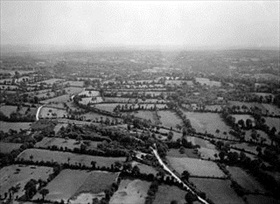
Left: Bocage country on Normandy’s north-jutting Cotentin Peninsula, France. Bocage terrain is a mixture of woodland and pasture, with fields and winding country lanes sunken between narrow low ridges and banks of ancient, thick hedgerows that break the wind but also limit visibility. Bocage country (hedgerow country) made progress against German defenders difficult and dangerous for the Allies. Aerial bombing, bulldozers, and tanks outfitted with “teeth” welded to their fronts (former German tank obstacles scavenged from the Normandy beachhead) were used to slice through the vexing hedgerows.
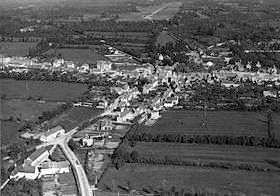
Right: Aerial view of Sainte-Mère-Église, Normandy, June 1944. For the Germans, Sainte-Mère-Église was the gateway to Utah Beach. At 10 a.m., June 6, the German attacks on the town began with a fury, and by early afternoon enemy armored columns were slamming the 505th Parachute Infantry Regiment of the 82nd Airborne Division (the All Americans) from three directions in an attempt to reach the vulnerable invasion beaches.
 |
 |
Left: This church in Sainte-Mère-Église, with its parachute memorial (the white drape on the roof of the bell tower), recalls the famous incident involving 31‑year-old John Steele of the 505th Parachute Infantry Regiment, whose chute caught on one of the back steeples of the church bell tower. Taken prisoner by the Germans, Steele later escaped and rejoined his division. Another paratrooper, 17‑year-old Ken Russell was also snagged by the roof, though his story is not as well known. Both witnessed their comrades, among them a sergeant who attempted to rescue them, being killed in the firefight that erupted early on June 6. Steele was awarded the Bronze Star for valor and the Purple Heart for being wounded later in combat. Upon completing operations in the Sainte-Mère-Église area, the 505th Parachute Infantry Regiment was awarded the Presidential Unit Citation.
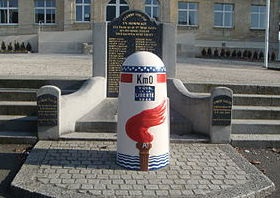
Right: This marker in Sainte-Mère-Église, Km 0, is recognized by Frenchmen as the commencement point for their country’s liberation from Nazi Germany (Borne 0, point de départ de la voie de la Liberté).
Vichy French Newsreel (German Footage) of the Normandy Invasion (in French)

World War II was the single most devastating and horrific event in the history of the world, causing the death of some 70 million people, reshaping the political map of the twentieth century and ushering in a new era of world history. Every day The Daily Chronicles brings you a new story from the annals of World War II with a vision to preserve the memory of those who suffered in the greatest military conflict the world has ever seen.