

RAF KICKS OFF “BATTLE OF BERLIN”
London, England · November 18, 1943
On this date in 1943 the Royal Air Force Bomber Command under Arthur “Bomber” Harris launched the airborne Battle of Berlin, which lasted through March 1944. Harris believed the aerial assault on Berlin—if it came anywhere close to Hamburg’s terrifying destruction the previous July (Operation Gomorrah)—could be the blow that broke German resistance. “It will cost us between 400 and 500 aircraft. It will cost Germany the war,” he predicted. The campaign period was not limited to attacks solely on the nerve center of the Nazi regime, which endured 16 massive attacks. Other major German cities were attacked, too, to prevent the concentration of defenses in Berlin.
The November 18 raid by 444 RAF bombers did little damage to the German capital, but the second major raid on the night of November 22/23 proved to be the most effective raid on Berlin of the war. Hundreds of British and Canadian Lancasters, Stirlings, and Halifaxes dropped 2,300 tons of bombs in 30 minutes, killing 2,000 Berliners and rendering 175,000 homeless. It was during this raid that the landmark Kaiser Wilhelm Memorial Church was destroyed. The following night’s raid killed 1,000 and rendered 100,000 homeless. Regular raids in December 1943 and January 1944 destroyed hundreds of lives each night, leaving 20,000 to 80,000 homeless each time.
That said, reducing Germany’s largest city to a pile of rubble from the air never delivered the war’s knockout blow that RAF Bomber Command predicted it would. After a cumulative loss of nearly eleven hundred aircraft, almost all of them four-engine bombers (5.1 percent of the sorties dispatched), Harris called off his air offensive. In words of the official RAF history, “In an operational sense the Battle of Berlin was more than a failure, it was a defeat.”
American bombers picked up the slack by making hours-long daylight raids on Berlin in the face of weak Luftwaffe defenses. Daytime raids especially frightened Berliners because most were at work and thus some distance from their usual cellars and their loved ones. Civilians literally ran for their lives to escape destruction as bombs collapsed buildings around them. On February 3, 1945, the center of Berlin was subjected to a daylight drubbing of unprecedented fury. But reducing the capital of Hitler’s Thousand-Year Reich to utter rubble was left to the Red Army and its remorseless heavy artillery shelling in April 1945.
[fblike]
[amazon_carousel widget_type=”ASINList” width=”600″ height=”200″ title=”Recommended Reading” market_place=”US” shuffle_products=”False” show_border=”False” asin=”0451228715,1782741356,0330392042,0465028551,0760338981,1844152103,1853676918,0451230086,0306811693,0691120102″ /]
Scenes of Devastation from the Nazis’ Reich Capital, Berlin
 |
 |
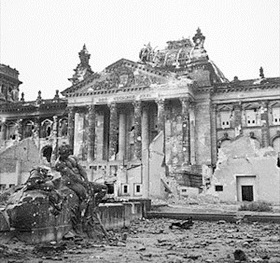
Left: The German Reichstag shows the scars of battle in mid-1945. The parliament building had not been restored by the Nazis since the 1933 fire that gutted the interior. The Red Army considered it a prime target in the April 16 to May 2, 1945, Battle of Berlin (aka the Berlin Strategic Offensive Operation as the Soviets called the final assault on Berlin), and artillery and tank fire each took its toll on the building.
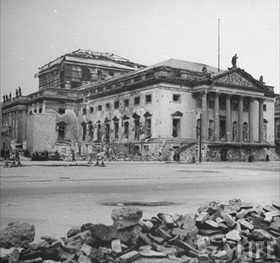
Right: The Staatsoper Unter den Linden (Berlin State Opera) was bombed in early 1941 but reopened in mid-December, only to close again in August 1944 when the Gauleiter of Berlin, Joseph Goebbels (also Propaganda Minister), closed down Berlin and the rest of Germany in the name of “Total War.” The Staatsoper was once again destroyed on February 3, 1945, in a ferocious daylight raid that left much of Berlin’s city center a mass of rubble.
 |
 |
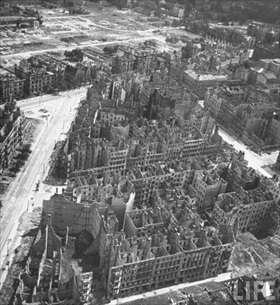
Left: An aerial photo of Berlin shows the legacy of destruction left by the war. By April 1945 Berlin had become a moonscape of ruined buildings and cratered streets.
Right: Danish journalist Paul von Stemann remembered the end days of Berlin as a time of “dullness, anticipation, fear and continuous bombing. . . The war seemed perpetual. . . The flowers had gone, the books had been burnt, the pictures had been removed, the trees had been broken, there were no birds singing, no dogs barking, no children shrieking . . . there was no laughter and no giggling. . . [The sky] was often effaced by the stinking and greasy carpets of voluminous black smoke.” Quoted in Moorhouse, Berlin at War, pp. 346–47.
 |
 |
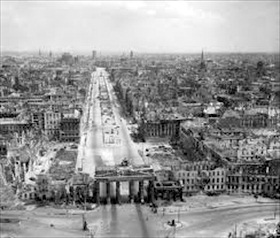
Left: Berlin’s premier boulevard Unter den Linden in 1945 presented a grim contrast with its prewar splendor. The once tree-lined boulevard stretched from the royal palace (now gone), through the Brandenburg Gate, to the Tiergarten, the 520-acre inner-city park. View is to the east, to the royal palace.
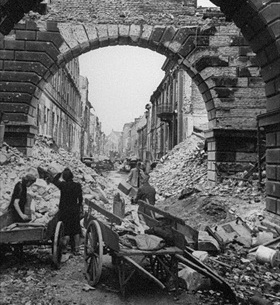
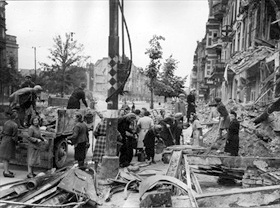
Right: Berliners had learned to clear streets following Allied bombing raids in the early days of the war. During the Battle of Berlin, many streets and sidewalks were turned into rubble-fields and thousands of citizens were conscripted afterwards to make them passable.
The Air Battle of Berlin, November 1943 to March 1944

World War II was the single most devastating and horrific event in the history of the world, causing the death of some 70 million people, reshaping the political map of the twentieth century and ushering in a new era of world history. Every day The Daily Chronicles brings you a new story from the annals of World War II with a vision to preserve the memory of those who suffered in the greatest military conflict the world has ever seen.