

QUISLING IMPOSES DICTATORSHIP ON NORWAY
Oslo, Occupied Norway • February 7, 1942
On this date in 1942 in German-occupied Norway, Minister President Vidkun Quisling abolished the Norwegian constitution and established a dictatorship 1 year after ascending to the presidency. Quisling had been a reserve officer in the Norwegian Army and served as the Norwegian Minister of Defense from 1931 to 1933. It was after his stint as a cabinet minister that he founded Nasjonal Samling (National Unity), a political party with an ideology similar to Nazism. Its platform was pan-German, anti-Soviet, anti-British, and anti-Semitic.
Three months after Hitler invaded Poland in 1939 Quisling, strictly in the role of party chief (fører), visited Berlin to offer the German Wehrmacht (armed forces) “the necessary bases” that would forestall the British and French, now at war with Germany, from gaining a foothold in neutral Norway. Grand Admiral Erich Raeder, who was privy to Quisling’s extraordinary offer, recognized that a British presence in Norway could possibly jeopardize Germany’s naval position in the Baltic, interrupt the free flow of Swedish iron ore through the ice-free Norwegian port of Narvik, and prevent the Kriegsmarine from gaining access to the North Atlantic.
Twice in mid-December 1939 Hitler received Quisling, the first time in the company of the highest officers of the Wehrmacht. Four months later, when Hitler’s armed forces invaded Norway and seized its capital, Oslo, on April 9, 1940, as part of Operation Weseruebung, an emboldened Quisling took to the airwaves to pronounce himself head of a new national government, ordered all resistance to end (it didn’t), and threatened to take action against those who did not obey. The next day the German minister to Norway demanded King Haakon VII name Quisling Norway’s new prime minister. The government rejected the demand. The king and his ministers became fugitives in their own country with a German price on their head. Eventually the king, his son and heir Crown Prince Olav, and a few members of the government escaped to England to establish a Norwegian government-in-exile. Quisling remained “head of government” for 6 days after the German invasion until Hitler dumped him in an effort to quell Norwegian resistance to the German invasion.
In time German-occupation authorities found they had a need for Quisling, and for his treachery he remained at the helm of a puppet government until Crown Prince Olav and British representatives accepted the surrender of German forces in Norway on May 8, 1945. “Quisling” appears in dictionaries as synonyms for traitor, treachery, deception, and dishonor. After the war a Norwegian court convicted Quisling of treason, murder, and theft and ordered his execution by firing squad on October 24, 1945.
Norway Under German Occupation, 1940–1945
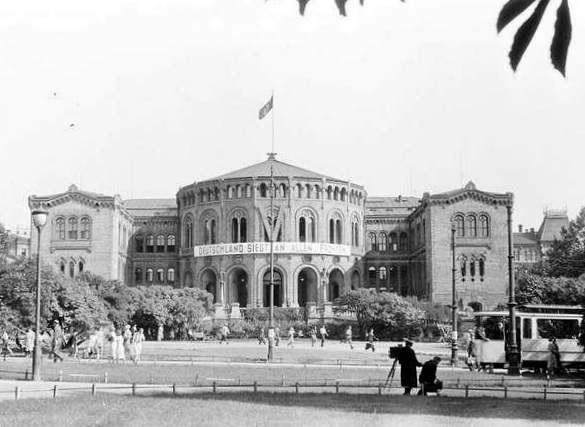 |
Above: Norway’s Parliament Building flying the Swastika, 1941. The banner decorating the front of the building reads, “Deutschland siegt an allen Fronten” (“Germany is victorious on all fronts”).
 |
 |
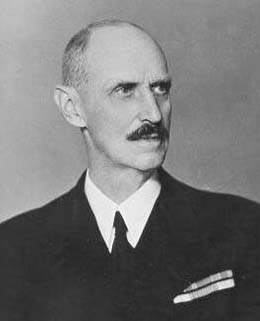
Left: King Haakon VII (1872–1957) and his family chose exile in England in lieu of accepting German surrender terms. (Haakon was 1 of 8 European monarchs who found themselves on the wrong side of Hitler; Haakon’s brother King Christian X remained in German-occupied Denmark throughout the war years.) An elected monarch (November 1905), Haakon won the respect and affection of his people and played a pivotal role in uniting the Norwegian nation in its resistance to the Nazi invasion and subsequent 5‑year-long occupation of his country. The Norwegian embassy in London became the seat of the Norwegian government-in-exile. Here Haakon attended weekly cabinet meetings and worked on the speeches that were regularly broadcast by the BBC World Service to listeners in Norway. He symbolized Norway’s freedom and independence to his imprisoned nation. After the end of the war, Haakon and the Norwegian royal family returned to Norway on June 7, 1945, exactly 5 years after they had been fled their country.
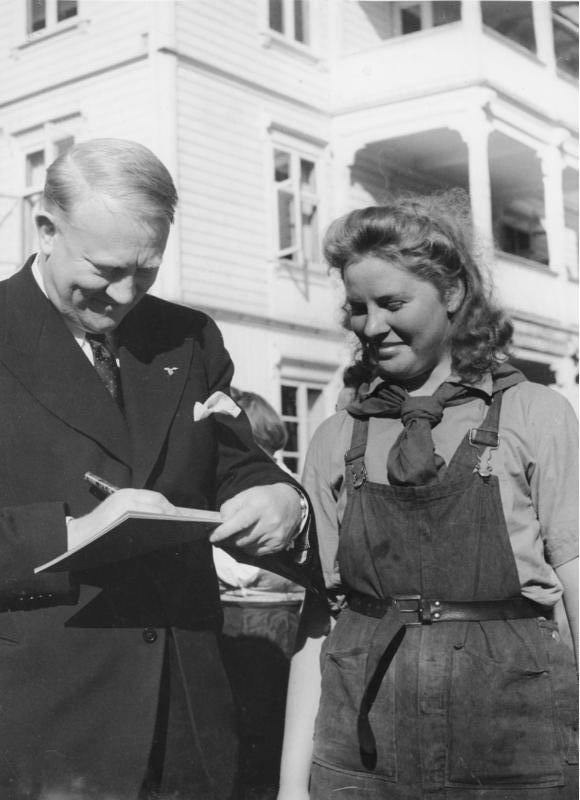
Right: Norwegian Minister President Vidkun Quisling was pleased to provide this admirer his autograph in 1943 at Skaugum, the former residence of Crown Prince Olav in exile in England. Among most Norwegians the Quisling regime had next to no support, partly because of Quisling’s coup attempt on April 9, 1940, and partly because his collaborationist government was in conflict with Norway’s constitution and political traditions.
Vidkun Quisling: The Man Who Sold His Country to the Third Reich (Skip the first 90 seconds)

World War II was the single most devastating and horrific event in the history of the world, causing the death of some 70 million people, reshaping the political map of the twentieth century and ushering in a new era of world history. Every day The Daily Chronicles brings you a new story from the annals of World War II with a vision to preserve the memory of those who suffered in the greatest military conflict the world has ever seen.