

QUISLING, GERMAN OCCUPIERS SURRENDER IN NORWAY
Oslo, Norway • May 8, 1945
On May 5, 1945, five days after Adolf Hitler’s suicide in the catacombs beneath his Reich capital, Gen. Dwight D. Eisenhower, Supreme Commander of Allied Forces in Europe, sent a telegram to resistance leaders in Norway, who passed it to the hardline commander in chief of German armed forces in Norway, Gen. Franz Boehme. The telegram detailed how Boehme was to get in touch with Allied headquarters. Two days later Boehme, who had once boasted “In Norway we can acccept any battle,” ordered his 100,000 troops in Norway to stand down. Immediately some 40,000 Norwegian resistance fighters (Milorg) in the country mobilized and occupied the Royal Palace and public places, including Oslo’s main police station.
A pre-planned Norwegian administration was in place on this date—Victory in Europe (VE) Day—when an Allied military mission arrived to accept the surrender of 400,000 German service personnel. Surrender terms required the arrest of all Nazi Party members, German and Norwegian alike, and the internment of all paramilitary troops belonging to the SS—short for the German Schutzstaffel (“Protection Squadron”). Handing himself over to Norwegian police was Nazi collaborator and “Minister President” Vidkun Quisling (in office 1942–1945), leader of Nasjonal Samling, the Norwegian fascist party that had encouraged and supported the German occupation of his country. (Five months before the German invasion of Norway in April 1941, Quisling had thrice conferred with Hitler, outlining his own plans for a coup against Norway’s constitutional government and falsely assuring Hitler that he had the support of the Norwegian military.)
The Norwegian government under returned exile King Haakon VII wanted to avoid lynchings and other extrajudicial punishment for Nazi collaborators; for example, those Norwegians who had volunteered for service with the German military, especially the Germanic-SS, as well as police officers in the Sikkerhetspolitiet and Norwegian members of the German Gestapo (Secret State Police) who may have been involved in torture, executions, and other mistreatment of prisoners. Though extrajudicial retaliation was largely avoided, 28,750 individuals were placed in custody during the first few days. Most of these were quickly released, but over a year later 5,000–6,000 were still in custody, many charged with treason, membership in the Nasjonal Samling (which was made a crime by the London-based Norwegian government-in-exile in December 1944), and subject to various kinds of penalties; these included fines, loss of civil privileges, and prison sentences.
Close to 10,300 Norwegians lost their lives during the war or imprisonment, and roughly 50,000 were arrested during the German occupation. Of these, 9,000 were consigned to prison camps outside Norway. Among the unfortunates who ran afoul of the occupiers were 1,300 Norwegian teachers who defied Nazi efforts to take over their children’s education. Nearly 500 of them wound up in a concentration camp in the Arctic with Soviet POWs. Some 50,000 Norwegians escaped to neighboring Sweden, a neutral nation, during the war.
Nazi Marionettist Reichskommissar Josef Terboven, 1940–1945
 |
 |
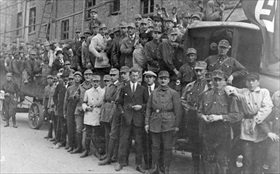
Left: At the age of 25, future Reich Commissioner for the Occupied Norwegian Territories Josef Terboven (dark civilian clothes, white shirt and tie in middle of this 1926 picture) joined the Nazi Party and participated in Adolf Hitler’s abortive 1923 Munich Beer Hall Putsch. In 1928 Terboven helped establish the party in Essen, the fifth largest city in Germany and an important coal and steel center in the industrial Ruhr Valley; there he became Gauleiter (Nazi Party leader). Terboven was appointed Reich Commissioner for Norway on April 24, 1940, even before the military occupation of that country was complete on June 7, 1940.
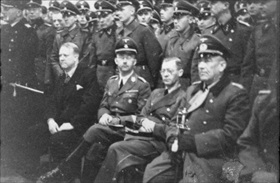
Right: Vidkun Quisling (left), Reichsfuerher-SS Heinrich Himmler, Josef Terboven, and Gen. Nikolaus von Falkenhorst, commander of German forces in Norway on the occasion of Himmler’s visit to Norway in May 1941. Few people were more deserving of death by hanging or a firing squad than Terboven. Mostly ignoring Quisling’s fascist puppet government, head Nazi marionettist Terboven established a regime of terror in Norway, personally commanding a force of roughly 6,000 goons, of whom 800 were part of the secret police. Terboven’s men were separate from the 400,000 regular German armed forces stationed in Norway. On May 8, 1945, the day of German capitulation, he and the commander of the Norwegian SS committed suicide, Terboven by blowing himself up in a bunker at his official residence.
Pathetic Life and Times of Norwegian Fascist and Nazi Collaborator Vidkun Quisling, 1887–1945

World War II was the single most devastating and horrific event in the history of the world, causing the death of some 70 million people, reshaping the political map of the twentieth century and ushering in a new era of world history. Every day The Daily Chronicles brings you a new story from the annals of World War II with a vision to preserve the memory of those who suffered in the greatest military conflict the world has ever seen.