

POLISH GHETTO MODEL FOR HOLLAND
Warsaw, Occupied Poland · November 4, 1939
On this date in 1939 in Nazi-occupied Poland, newly appointed Governor-General Hans Frank established the Warsaw ghetto and began forcing the city’s Jews into a single area. Ten days later Frank and his deputy Arthur Seyss-Inquart ordered Jews in Poland to wear a white bracelet bearing a hexagonal Star of David, long a Jewish symbol. Like Frank, Seyss-Inquart was an unwavering anti-Semite and assisted Frank in the “pacification” of Poland’s underground resistance movement, or Polish Underground State.
Following the capitulation of the Netherlands, Belgium, and Luxembourg to the German Wehrmacht (armed forces) in May 1940, Seyss-Inquart assumed the office of Reichskommissar for the Occupied Netherlands. Within months of his arrival, Seyss-Inquart banned all political parties except the Dutch fascist party, the National Socialist Movement in the Netherlands (NSB), which operated a paramilitary wing. His administration established a forced labor program that put around 530,000 Dutch civilians to work for the occupiers, of whom 250,000 were sent to factories in Germany. Camp Erika at Ommen (Eastern Netherlands) collected Dutchmen who refused to perform forced labor.
Answering directly to Adolf Hitler, Seyss-Inquart took measures to remove Jews from the Dutch government, the press, and leading positions in industry. Anti-Jewish measures intensified from 1941: roughly 140,000 Jews were registered on a special roll, a ghetto behind barbed wire (Jodenbuurt) was created in Amsterdam, and several “Jewish assembly camps,” or transit camps, were set up, one at Amersfoort in Central Holland and one near Westerbork in Northeastern Holland. Subsequently, in February 1941, 600 Jews were dispatched to concentration camps at Buchenwald in Germany and Mauthausen in Austria. Later, 101,000 Dutch Jews and about 5,000 German Jews (including Anne Frank and her family) were deported from Westerbork to Auschwitz-Birkenau (Oświęcim in present-day Poland), Sobibór (Poland), Bergen-Belsen (Northwestern Germany), and Theresienstadt (Terezín, Czech Republic), where most died from deprivations, exhaustion, or disease or were gassed. As Allied forces approached Westerbork in September 1944, the remaining Jews were removed to Theresienstadt. Of 140,000 registered Jews in Holland, only 30,000 survived the war, many of them hidden by the Dutch underground.
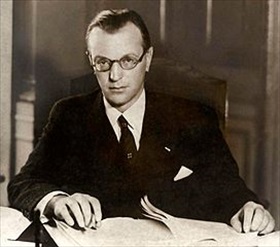
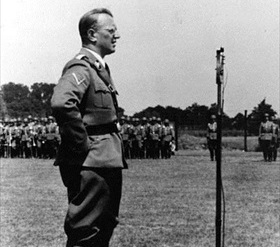
Arthur Seyss-Inquart: Hitler’s Reichskommisar in Occupied Netherlands
 |
 |
Left: Austrian lawyer Arthur Seyss-Inquart (1892–1946), shown here in Vienna in 1940, was a devotee of Heinrich Himmler and his concepts of racial purity. In February 1938 Austrian Chancellor Kurt Schuschnigg appointed Seyss-Inquart Minister of the Interior after Adolf Hitler had threatened Schuschnigg with military action against his country in the event of noncompliance. Following the German invasion of Poland, Seyss-Inquart became a deputy to Hans Frank, Governor-General of the administrative unit known as the “General Government,” or that part of Poland not incorporated into the Third Reich. He fully supported Frank’s heavy-handed policies, including the brutal persecution of Poland’s Jews.
Right: In this photo Seyss-Inquart is seen addressing German Ordnungspolizei (Orpo, short for Order Police) in the Dutch capital, The Hague, 1940. The Orpo reported to Heinrich Himmler, Reichsfuehrer-SS and Chief of German Police. Following the capitulation of the Low Countries, Seyss-Inquart was appointed Reichskommisar for the Occupied Netherlands in May 1940. Until July 1944 Seyss-Inquart administered the country himself. Up until Dutch liberation in May 1945, Seyss-Inquart authorized the execution of around 800 Dutch people (although some reports put the total at over 1,500), which included the reprisal executions of 117 Dutchmen for the attack on an SS police chief. At the Nuremberg Trials, the court weighed Seyss-Inquart’s involvement in the harsh suppression of Nazi opponents during his years in government service, atrocities perpetrated against the Jews, and his reign of terror in the Netherlands. He was found guilty of crimes against humanity and sentenced to death in 1946.
Reichskommissar Seyss-Inquart Reviewing a Parade in Groningen’s Grote Markt Square, June 1940 (in Dutch and German)

World War II was the single most devastating and horrific event in the history of the world, causing the death of some 70 million people, reshaping the political map of the twentieth century and ushering in a new era of world history. Every day The Daily Chronicles brings you a new story from the annals of World War II with a vision to preserve the memory of those who suffered in the greatest military conflict the world has ever seen.