

POLES FIRM: NO CONCESSIONS TO HITLER
Warsaw, Poland • May 5, 1939
In 1923 Poland’s Baltic neighbor to the north, Lithuania, unlawfully annexed Memel Territory (now Klaipėda Region in present-day Lithuania) that had been, up to 1918, part of Prussia under Kaiser Wilhelm II. Like the Danzig enclave in Poland and the former Territory of the Saar Basin that had briefly been sandwiched between France and Germany (Saarlanders voted overwhelmingly to rejoin Germany in January 1935), Memel Territory had started out as a League of Nations mandate. On March 20, 1939, Germany demanded Lithuania return Memel directly to Germany; otherwise, vowed German Foreign Minister Joachim von Ribbentrop, it “will be taken by other means.” Tiny Lithuania prudently complied.
The saber-rattling Memel drama caught world leaders by surprise. Not so the long-festering drama in former Prussian Danzig and the so-called “Polish Corridor.” Ever since the 1919 Versailles Peace Treaty, the “Free City of Danzig” had provided Poland, newly independent after 123 years of foreign occupation, access to the Baltic Sea. The problem was, both the corridor and Danzig (present-day Gdańsk), chiefly populated by ethnic Germans, split Prussia in two (see map below). Encouraged by British Prime Minister Neville Chamberlain and French Premier Édouard Daladier to negotiate a German transit route across the corridor, the Polish foreign minister, nationalist Gen. Józef Beck, responded on this date, May 5, 1939: “We in Poland do not know the concept of peace at any price.” The allusion was a diplomatic slap in the face, as both Chamberlain and Daladier were complicit in negotiating Adolf Hitler’s land-grab of Czechoslovakia’s ethnic-German Sudetenland in September 1938 in Munich.
Chamberlain, on returning from the Munich Conference attended by the leaders of Great Britain, France, Italy, and Germany, infamously asserted that he and his French counterpart Daladier had bought “peace for our time” by appeasing Hitler and averting war over Czech Sudentenland. (Actually, the French premier, the more realistic of the 2 Western statesmen, believed that the Sudentenland giveaway had bought the West little more than breathing room.) Polish foreign minister Gen. Beck’s May 5th hubris may have been based in part on vague Anglo-French assurances of support for his country against potential German aggression following the Wehrmacht’s occupation of Prague, the Czech capital, several months earlier (March 15, 1939). These assurances had the most far-reaching and unintended consequences, for they delivered the destinies of Britain and France into Polish hands. By stubbornly refusing to make concessions to Germany over the status of the Danzig enclave and an overland transit route through the Polish Corridor, Poland and the Western democracies moved closer to the flashpoint day of September 1, 1939, when Hitler unleashed his legions not only on Poland, but soon on the whole continent, where they sowed devastation, impoverishment, enslavement, and genocide practically everywhere.
Countdown to War, 1938–1939: Sudetenland, Czechoslovakia, Memel, Danzig, and Polish Corridor
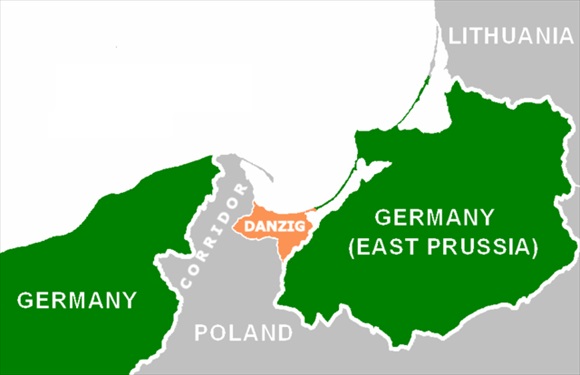 |
Above: Interwar land corridor to the Baltic Sea and the semi-autonomous “Free City of Danzig,” 1920–1939. Both geopolitical creations were carved from former German territory (West Prussia) so that newly independent Poland would not be dependent on German ports for its import/export trade. In May 1933, less than 4 months after his appointment as Chancellor of Germany, Hitler and his Nazi party gained control of the Danzig Senate. Like the ethnic Germans in Czechoslovakia’s Sudetenland in the mid‑1930s, Danzig’s large ethnic German community strongly agitated to be incorporated into the Fatherland.
 |
 |
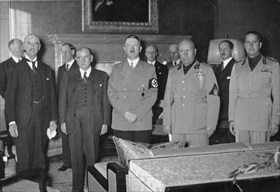
Left: Posing stiffly for posterity are British Prime Minister Neville Chamberlain (left), French Prime Minister Édouard Daladier, German Chancellor Adolf Hitler, Italian Prime Minister Benito Mussolini, and Italian Foreign Minister Galeazzo Ciano. On September 30, 1938, leaders of the 4 European powers signed the Munich Agreement, which handed Czechoslovakia’s German-speaking Sudetenland to Germany. Nazi propagandists packaged and sold the Munich Agreement to the German populace as one of Hitler’s successful peace policies when in fact it was Chamberlain’s and Daladier’s misperceptions, miscomprehension, and misjudgments that smoothed the way for Hitler’s repeated diplomatic successes in the late 1930s.
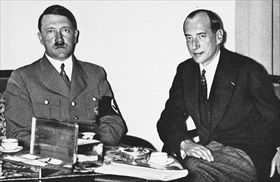
Right: Hitler and Polish Foreign Minister Józef Beck in 1937. On January 5, 1939, Hitler told Beck, who was visiting the German leader at the Berghof, Hitler’s palatial Bavarian retreat above Berchtesgaden, that Germany would guarantee Poland’s frontiers were a “final settlement” reached over the status of the League of Nations-administered “Free City of Danzig.” Beck rejected Hitler’s demands for Danzig’s return, an act that perhaps cost Beck an opportunity to snag a Nobel Peace Prize, which French and German diplomats had earned for concluding the 1925 Locarno Pact. That treaty required both France and Germany to recognize the inviolability of the borders of Western Europe, including Great Britain, but not those of Eastern Europe. Beck rejected Hitler again on March 26, 1939, after the German chancellor gratuitously offered Slovakia (which had proclaimed independence from its western Czech half days earlier) to Poland in exchange for Danzig and German control of overland routes between the German heartland and East Prussia.
Silent German Propaganda Film “Liberation” of Danzig and Wehrmacht’s Assault on Poland, September 1939

World War II was the single most devastating and horrific event in the history of the world, causing the death of some 70 million people, reshaping the political map of the twentieth century and ushering in a new era of world history. Every day The Daily Chronicles brings you a new story from the annals of World War II with a vision to preserve the memory of those who suffered in the greatest military conflict the world has ever seen.