

PLEA TO RESCUE POWS IN GERMANY
Stockholm, Sweden • February 5, 1945
Within 5 months from the start of the German conquest of Norway in April 1940 the first Norwegian political prisoners, initially Jews, communists, and prominent political opponents, were deported to Germany, first by Adolf Hitler’s Norwegian Reichskommisar, or Governor-General, Josef Terboven, then by the Norwegian government of Nazi collaborator Vidkun Quisling. Two years later, in September 1943, the first deportations of Danish prisoners and Jews to Nazi Germany began after German civil and military authorities assumed direct administration of the country owing to growing sociopolitical resistance to German occupation that was expressed through small acts of sabotage or defiance. (Prior to August 29, 1943, the Danish government, parliament, and court system had functioned within the framework of a so-called “German protectorate.” Unique among the Nazi-occupied states of Europe, Denmark’s protectorate status was a consequence of the tiny nation not declaring war against its invaders, a war that lasted all of 4 hours, and the shared belief that Germans and Danes were racial “cousins.”)
As the number of Scandinavian prisoners increased, various groups organized relief efforts for them. The Norwegian seamen’s priests, for instance, visited prisoners in Germany, brought them food, and brought back letters to their families in Norway and Denmark. Other Scandinavians like the Norwegian civilian internees at Gross Kreutz castle outside Berlin compiled extensive lists of prisoners and their location (8,000 Norwegian and 6,000 Danish prisoners in Germany at the start of 1945) and sent the lists to the Swedish embassy in Berlin. (Sweden was a neutral nation during the war.) The Swedish embassy in turn sent the lists to London and the International Red Cross headquarters in Geneva, Switzerland.
On this date, February 5, 1945, Niels Christian Ditleff, a Norwegian refugee in Sweden, approached the Swedish government about organizing an expedition to rescue concentration camp inmates in the ever-shrinking areas under Nazi control and transport them to Sweden. Heading up the effort was the vice-chairman (and effective head) of the Swedish Red Cross, Count Folke Bernadotte. (Bernadotte, a nephew of Sweden’s King Gustav V, had already earned an international reputation by negotiating exchanges of disabled German, British, and American prisoners of war.) Although initially targeted at saving Norwegian and Danish POWs, the “White Buses” program—known for its buses painted entirely white except for either the Red Cross emblem or the flags of either nation on the sides and roof—rapidly expanded to include citizens of other countries. By May 1, 1945—essentially the end of the war—over 15,000 prisoners had been rescued from German camps; of these 8,000 were Scandinavian and 7,000 non-Scandinavian (French, Polish, Czech, British, American, etc.). Among the Scandinavians were 423 Danish Jews rescued from the Theresienstadt concentration camp inside German-occupied Czechoslovakia (today’s Czechia, aka Czech Republic). The White Buses program proved to be one of the most extraordinary humanitarian efforts of the war and one of the least known.
Swedish Red Cross and Danish Government “White Buses” Program in Spring 1945
 |
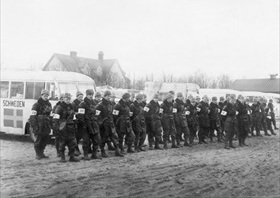 |
Left: In early April 1945 the Danish Red Cross was able to muster 33 buses, 14 ambulances, 7 trucks, and 4 private vehicles to transport prisoners to freedom. The buses were painted white and identified with red crosses to avoid confusion and potential destruction with German military vehicles painted shades of green and gray.
Right: Swedish Red Cross buses and drivers transported prisoners from, among other camps, Neuengamme southeast of Hamburg, Sachsenhausen and Ravensbrueck north of Berlin, Dachau north of Munich, Mauthausen east of Linz (Austria), and Theresienstadt, near the Czech city of Terezín. A Danish prisoner recounted his arrival at Neuengamme, which served as a transit camp for POWs evacuated from other concentration camps. A 30‑man prisoner-orchestra “welcomed” the fresh arrivals to Neuengamme, he said. “It made an indescribable impression on us with this cheerful sounding music and then the hundreds of pale, emaciated faces pressed up against the iron fence following us with their eyes.” Of the 4,800 Danes who passed through Neuengamme during the war, less than half returned to their homeland.
 |
 |
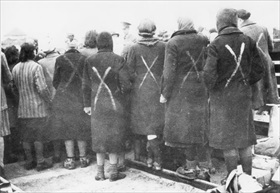
Left: Chalk marks on the backs of female prisoners in the Ravensbrueck concentration camp show that they have been selected for transport by the Swedish Red Cross buses. The only major Nazi concentration camp for women, Ravensbrueck was located in Northern Germany, a little more than 50 miles/80 kilometers north of Berlin.
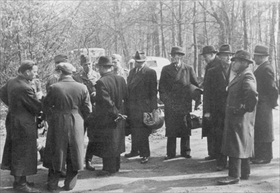
Right: Gestapo officers “escorted” the Red Cross transports. German authorities demanded that every second vehicle have a German officer on board.
Women Inmates at Ravensbrueck Concentration Camp

World War II was the single most devastating and horrific event in the history of the world, causing the death of some 70 million people, reshaping the political map of the twentieth century and ushering in a new era of world history. Every day The Daily Chronicles brings you a new story from the annals of World War II with a vision to preserve the memory of those who suffered in the greatest military conflict the world has ever seen.