

PACIFIST SHIDEHARA BECOMES JAPAN PRIME MINISTER
Tokyo, Japan · October 9, 1945
On this date in 1945 in Tokyo, Baron Kijūrō Shidehara became Prime Minister of Japan at the head of a constitutional government committed to pursuing a peaceful future. Before the war Shidehara had been a prominent Japanese diplomat and a leading proponent of pacifism in Japan. On the same date, October 9, the American occupation authorities repealed the May 1925 Peace Preservation Law, which had given the Imperial Japanese government and its Thought Police within the Home Ministry carte blanche to outlaw any form of political and religious dissent, as well as arrest over 70,000 people between 1925 and 1945. The American authorities also removed from their posts roughly 200,000 persons who were deemed responsible for leading the war effort.
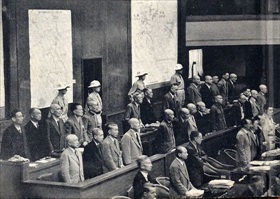
The 1946–1948 International Military Tribunal for the Far East, or Tokyo Trials—equivalent to the Nuremberg Trials in postwar Germany—sentenced 16 former ministers, generals, and ambassadors in Japan’s military-dominated government to imprisonment. Seven former military and political leaders were sentenced to death, chief among them wartime prime minister and war minister Hideki Tōjō, who was hanged in 1948. Japanese Emperor Hirohito (posthumously referred to as Emperor Shōwa) and all members of the Imperial family, such as Prince Yasuhiko Asaka who was implicated in the 1937 Nanking Massacre in China’s capital city, were not prosecuted for involvement in any war crimes—both the Truman administration and Gen. Douglas MacArthur, Supreme Commander for the Allied Powers in Japan, gave Hirohito a free lifetime “Get Out of Jail” card, believing that occupation reforms would be implemented more smoothly if, instead of deposing and prosecuting the emperor, they used him to legitimize their changes.
American and Japanese leaders moved almost as one to whitewash Hirohito’s wartime role to justify keeping him on his throne—this had been the chief sticking point in moving Japan to accept unconditional surrender. By colluding, the U.S. occupation regime and the postwar Japanese government contributed to the memory loss of the Japanese people for the horrific role their nation played in the first half of the 20th century, a memory loss that the sons and daughters of Japan’s neighbors must deal with as Japan lays claim to a leadership role in Asia and the Pacific.
I know there remains an element of controversy in the prewar and wartime role of Japanese Emperor Hirohito, who had taken the auspicious reign-title “Shōwa” (“illustrious peace”) in 1926. Was he a passive ruler reluctantly manipulated by an elite group of Japanese militarists who controlled the levers of power or was he himself a co-manipulator? Could he legitimately be described as a war criminal like those who reported to him were found to be in postwar military tribunals? Herbert P. Bix, in his Pulitzer Prize winning book Hirohito and the Making of Modern Japan, settles the issue for me and I believe the majority of us: Hirohito, as commander in chief, bears the strongest share of political, legal, and moral responsibility for the criminal behavior of his armed forces in the Asia Pacific Theater in the 1930s and ’40s, and he certainly bears direct responsibility for sanctioning the bombing of Chinese cities and Japan’s use of poison gas on Chinese soldiers and civilians. Bix demonstrates to my satisfaction that Hirohito was a repeat violator of international peace, starting with Japan’s illegal seizure of Manchuria in 1931, continuing for more than a dozen years for people swept up in the gruesome maelstrom, and ending only in August 1945 when he and his cronies could find no way out of the tragic mess they had made. Hirohito was the missing person in the docket during the Tokyo Trials of 1946–1948.—Norm Haskett
Gen. Hideki Tōjō and His Emperor
 |
 |
Left: Defendants at the International Military Tribunal for the Far East (1946–1948). Gen. Hideki Tōjō (1884–1948), former war minister and prime minister of Japan, is fifth from left in first row of the defendants’ dock. Alluding to Emperor Hirohito’s success in dodging indictment as a war criminal, Judge Henri Bernard of France concluded that the war in the East “had a principal author who escaped all prosecution and of whom in any case the present Defendants could only be considered as accomplices.”
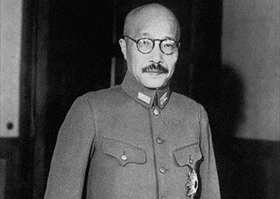
Right: Tōjō in military uniform. On July 22, 1940, Tōjō was appointed Army Minister. During most of the Pacific War, from October 17, 1941, to July 22, 1944, Tōjō served as Prime Minister of Japan. In that capacity he was directly responsible for the attack on Pearl Harbor. After the war Tōjō was arrested, sentenced to death for war crimes during the Tokyo Trials, and hanged on December 23, 1948.
 |
 |
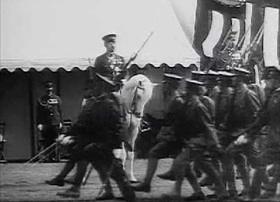
Left: Soldiers parading before Shōwa Emperor Hirohito, a revered symbol of divine status. While perpetuating a cult of religious emperor worship, Hirohito also burnished his image as a warrior in photos and newsreels riding Shirayuki (White Snow), his beautiful white stallion. One news agency reported that Hirohito made 344 appearances on Shirayuki.
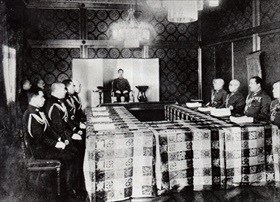
Right: Shōwa Emperor Hirohito, seated in middle, as head of the Imperial General Headquarters in 1943. As part of the Supreme War Council, the Imperial General Headquarters coordinated wartime efforts between the Imperial Japanese Army and the Imperial Japanese Navy. In terms of function, the Imperial General Headquarters was roughly equivalent to the U.S. Joint Chiefs of Staff.
Contemporary Documentary on the Tokyo War Crimes Tribunal, 1946–1948

World War II was the single most devastating and horrific event in the history of the world, causing the death of some 70 million people, reshaping the political map of the twentieth century and ushering in a new era of world history. Every day The Daily Chronicles brings you a new story from the annals of World War II with a vision to preserve the memory of those who suffered in the greatest military conflict the world has ever seen.