

NORMANDY INVASION DRY RUN ENDS TRAGICALLY
Slapton Sands, Devon Coast, Southwest England • April 28, 1944
Shortly after midnight on this date in 1944 German torpedo boats (S‑boats, short for Schnell [Fast] boats) on a routine patrol out of Cherbourg in occupied France suddenly found themselves in the middle of Operation (or Exercise) Tiger, codenamed T‑4. Operation Tiger consisted of a convoy of 8 American LSTs (Landing Ships, Tank) and their British escorts that were engaged in a live-fire dress rehearsal of the D-Day landings on France’s Normandy coast that would take place 6 weeks later. The LSTs were crammed with amphibious vehicles, jeeps, and trucks, along with 30,000 green soldiers from the U.S. 4th (“Ivy,” or I-V) Infantry Division in full battle gear.
The 9 German nighttime interceptors were each over 100 feet/30 meters long, armed with 2 torpedoes and 2 20 mm cannons, and painted black for camouflage. Capable of traveling at 40–50 knots/hour for as many as 700 nautical miles/1,296 kilometers, they were designed to wreak maximum havoc in the English Channel, and on this night in Lyme Bay close to Slapton Sands they did just that. At the time the Germans succeeded in getting close enough to the Tiger convoy to launch their torpedoes, they had no idea what the slow-moving ships and the heavier-than-normal radio traffic meant. In quick succession the Schnellboote slipped through the British destroyer screen, crippled 1 LST, caused another to burst into flames, trapping many of the victims below deck, and sank a third one immediately. One quartermaster service company was virtually wiped out: 201 officers and men out of a total of 251 were killed outright; 300 were wounded in the explosions or succumbed to hypothermia in the cold channel waters. No rescue craft were in the Tiger formation, and the men had not been taught how to use their life preservers. Communication between the Americans and British was impossible because both navies operated on different radio wavelengths. These deficiencies were corrected by D‑Day.
Despite Royal Navy patrols in the English Channel that night, the Schnellboot raiders made a clean escape under a smokescreen without a single casualty. The official death count was 749 American servicemembers; another count puts the dead closer to 1,000—a toll far greater than the 197 casualties the Ivy Division would suffer on D-Day. For days on end bodies of soldiers and sailors washed up on the southwest coast of England. Those floating in the water were scooped up by small landing craft with their ramps lowered. As if that weren’t enough American tragedy, only the week before, on April 22, a scheduling mix-up led to 308 unwitting casualties (dead and dying) on Red Beach (stand-in for Normandy’s Utah Beach), the result of friendly fire from a British heavy cruiser.
Gen. Dwight D. Eisenhower, Supreme Commander of the Allied Expeditionary Force for the Allied gamble that had the potential for deciding the course of the war in Europe, ordered the Slapton Sands dead be buried secretly in military graveyards, refused to decorate soldiers who had acted heroically in rescue operations, and placed the survivors in select camps under quarantine and a news blackout. Servicemen and Army surgeons and nurses were threatened with court-martial if they leaked news of the tragedy. The deadliest American training incident of the war was an ominous precursor to D‑Day, June 6, 1944.
Operation Tiger: Dress Rehearsal for the Allied Invasion of France, April and May 1944
 |
 |
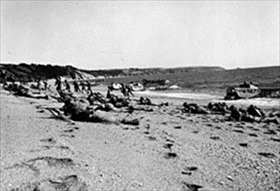
Left: American troops practice beach landings in Southwest England during a dry run for the invasion of Normandy, France. The rehearsal area had been selected owing to its topographical similarity to Normandy. (Selection unfortunately required the forcible evacuation of more than 3,000 English seaside villagers, sworn to secrecy, along with their livestock.) For more than a week soldiers and sailors tested landing and support craft, equipment and vehicles, demolition procedures, and various small unit tactics, among other things, in a live-fire setting. (In an all-too-real scene, a stray dog ran into the lobby of the abandoned Slapton Sands Hotel, triggering a demolition device that destroyed the building—and the dog.) The April 28, 1944, nighttime tragedy off the coast of Devon near Slapton Sands, in which perhaps more than 1,000 servicemen lost their lives, provided valuable military readiness lessons for Operation Overlord 6 weeks away.
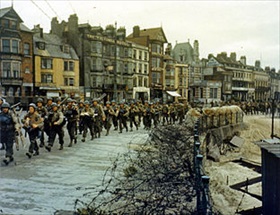
Right: The 2nd Battalion, U.S. Army Rangers march to their landing craft in Weymouth, England, in this photo from June 5, 1944. Along with the 5th Ranger Battalion, the 2nd was tasked with capturing the German heavy coastal defense battery at Pointe du Hoc, a promontory with a 100‑foot/244‑meter cliff, 4 miles/6.4 kilometers to the west of the D‑Day landing zone of Omaha Beach. (On June 6 the Rangers assaulted Pointe du Hoc only to discover the 6 155 mm artillery pieces that directly threatened the Allied amphibious armada and the 2 invasion beaches in the American sector had been removed from the location.) A total of 1.5 million American servicemen and servicewomen and almost a half-million vehicles were squeezed into Southern England in advance of Operation Overlord. During early June, when troops walked or rode to their embarkation ports, civilian traffic came almost to a standstill.
 |
 |
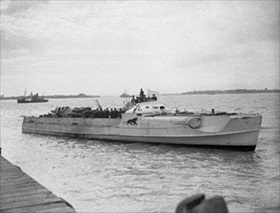
Left: The German S-boot S 204 flies a white flag of surrender at the British coastal forces base at Suffolk on May 13, 1945. During World War II, S‑boats (the equivalent of the U.S. Navy’s PT boats and known by the Allies as “E[for enemy]-boats”) sank 101 merchant ships totaling 214,728 tons, plus numerous ships of the Royal Navy, among them 12 destroyers and 11 minesweepers. Of the 240-odd S‑boats produced during the war, approximately half survived owing in part to their speed, which allowed them to evade enemy pursuers, and in part to their wooden hulls, which allowed them to cross magnetic minefields unscathed. Many of the S‑boats and their larger cousins, T‑boats, were destroyed in Allied bombing attacks on their French home ports.
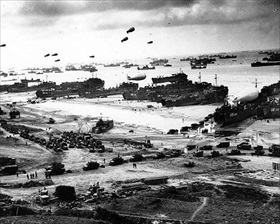
Right: LST (Landing Ship, Tank) was the military designation for naval vessels created during World War II to support amphibious assault operations by carrying significant quantities of vehicles, cargo, and landing troops directly onto an unimproved shore, such as the one shown here on the Normandy coast. The class of LSTs in Operations Tiger and Overlord could carry close to 4,000 tons fully loaded. Of the 1,051 LSTs constructed during the war, only 26 were lost due to enemy action, notwithstanding their derisive nickname, “Large Slow Targets.” Without the LST or something like it, neither the Allied invasion of France nor the Pacific Islands campaign would have been practical.
BBC Production Recounts Operation Tiger Disaster

World War II was the single most devastating and horrific event in the history of the world, causing the death of some 70 million people, reshaping the political map of the twentieth century and ushering in a new era of world history. Every day The Daily Chronicles brings you a new story from the annals of World War II with a vision to preserve the memory of those who suffered in the greatest military conflict the world has ever seen.