

NAZIS WIN BIG AT BALLOT BOX
Berlin, Germany · September 14, 1930
On this date in 1930 German voters went to the polls to elect a new Reichstag, and the results were shocking. The National Socialist German Workers’ Party (Nationalsozialistische Deutsche Arbeiterpartei, or NSDAP) was the ninth and smallest of Germany’s political parties, with but twelve members in the national parliament. In the elections of 1928 the NSDAP had captured a paltry 2.6 percent of the popular vote—810,000 votes out of 31 million cast. But the party’s outspoken, unconventional, dynamic leader, or Fuehrer, Adolf Hitler hoped to quadruple that number by capturing the imagination of a wide cross section of the electorate, not just those who made up his extreme nationalist base. By the end of the day September 14, 1930, the election results exceeded Hitler’s wildest dreams: the Nazis, as party members were known, had won 107 seats in the Reichstag, which vaulted them into the second largest party in Germany.
In the two general elections in 1932, Hitler’s party—helped by the militant tactics of his thuggish brown-shirted supporters, the SA (short for the German Sturmabteilung)—won 37 percent and 34 percent of the vote, which made the Nazi Party the largest party in the Reichstag. Hitler didn’t have a majority of parliamentary seats, but he had enough that politicians and the electorate had to take him seriously. In the tempest of national politics in late January 1933 President Paul von Hindenburg named Hitler Chancellor of Germany and head of yet another coalition government in the Weimar Republic, an entity spawned in the aftermath of the widely despised 1919 Versailles peace settlement. Within months of being named chancellor Hitler headed a totalitarian government.
With the death of 87-year-old President Hindenburg on August 2, 1934, Hitler lickety-split ordered a plebiscite for August 19, seeking approval to combine the offices of president and chancellor. Germany’s voters went to the polls and a whopping 90 percent voted “Ja.” The next day the cabinet decreed the “Law on the Allegiance of Civil Servants and Soldiers of the Armed Forces.” Known as the Hitler Oath, the law required personnel in the armed forces and civil service to swear obedience to the “Bavarian corporal,” as Hindenburg once referred to Hitler, instead of obedience to the German constitution or nation. From that day on Hitler ruled his nation by decree.
Sir Ian Kershaw is my go-to historian for almost all things related to the Third Reich and Adolf Hitler. His 2‑volume biography (subtitled 1889–1936: Hubris and 1936–1945: Nemesis) meticulously detailed the man and the nation he led to perdition. For people who suspect that 1,500 pages require too much armchair time (it did me), I suggest reading Kershaw’s abridged version, Hitler, A Biography, at 1,000 pages or Peter Langerich’s 2019 version, at 965 pages, Hitler, A Biography. The best short biography of Hitler, at 190 pages, is by another British historian, A. N. Wilson. I found his biography Hitler dead on in explaining the essentials of what made Hitler, Hitler. American historian R.H.S. Stolfi’s 2011 biography, Hitler: Beyond Evil and Tyranny, at just over 500 pages, focuses the spotlight more on the dictator’s personality and less on his evil actions. In Volker Ullrich’s two-volume study, Hitler: Ascent, 1889-1939 and Hitler: Downfall 1939-1945, this German historian and journalist likewise focuses on Hitler’s personality traits that made him so attractive to Germans and explains how Hitler used his considerable talent as an organizer, orator, actor, and politician as well as his cold-blooded ruthlessness to claw his way to power and stay there until his suicide in 1945. You may wish to read an older biography of Hitler, titled Hitler, by Joachim Fest, who actually lived through the Nazi years and served in the German Wehrmacht before being captured by the Americans. Fest’s probing study offers the perspective of another German historian on a demagogue who traumatized his country and the rest of Europe using state-sponsored intimidation, war, and genocide.—Norm Haskett
The Rise of der Fuehrer Adolf Hitler, 1930–1934
 |
 |
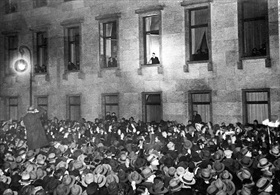
Left: Newly appointed Chancellor Hitler at the window of the Reich Chancellery on Berlin’s Wilhelmstrasse (government district) receiving ovations on the evening of January 30, 1933. President Hindenburg (elected second president of the Weimar Republic in 1925) was no admirer of Hitler and initially refused to name him chancellor. Instead, he appointed fellow army officer Maj. Gen. Kurt von Schleicher to the position. Political intrigue, cabinet crises, and backroom negotiations prompted an exasperated Hindenburg to end government instability by appointing Hitler to head a new cabinet and naming ex-Chancellor Franz von Papen as vice-chancellor, with the understanding that von Papen would act as a “check” on Hitler’s more disturbing tendencies and encourage him to tamp down on the lawlessness and ruthlessness of the SA, his party’s paramilitary hooligans.
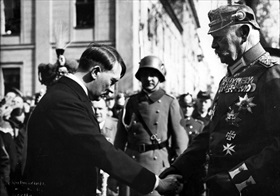
Right: Hindenburg and Hitler on March 21, 1933, known as the “Day of Potsdam.” On that day the newly elected Reichstag was constituted with an opening ceremony in Potsdam’s Baroque Garrison Church. (A new venue was made necessary by the Reichstag fire on February 27, 1933.) The Potsdam gala was a Nazi propaganda pitch to demonstrate unity between the Hitler’s populist movement and the old aristocratic, conservative, and Prussian military elite represented by Hindenburg.
 |
 |
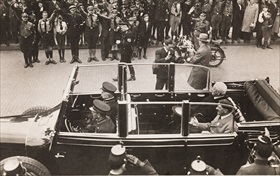
Left: Hindenburg and Hitler ride in an open-top car at the May Day rally, where Hindenburg had delivered a speech in Berlin’s Lustgarten, May 1, 1933. The day had been declared the “Day of National Labor.” Twenty-four hours later Hitler banned and disbanded German trade unions.
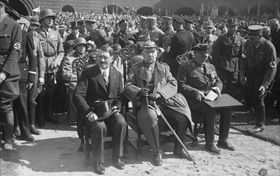
Right: Hitler, Hindenburg, and Hermann Goering at a massive demonstration at the Tannenberg Memorial near Tannenberg, East Prussia (today Olsztyn, Poland) in August 1933. The castle-like memorial of 8 towers, each 20 m high, around a central courtyard commemorated the anniversary of the Second Battle of Tannenberg (August 23–30, 1914), a victory over the Russians that made Field Marshal Hindenburg a national hero. Against his wishes Hindenburg was buried, along with his wife, in the central yard of the Tannenberg Memorial during a large state funeral—this on August 7, 1934, 5 days after his death.
President Hindenburg’s Funeral at Tannenberg Memorial, August 7, 1934, Set to “Ich hatt’ einen Kameraden” (“I had a comrade”), Traditional Lament of German Armed Forces

World War II was the single most devastating and horrific event in the history of the world, causing the death of some 70 million people, reshaping the political map of the twentieth century and ushering in a new era of world history. Every day The Daily Chronicles brings you a new story from the annals of World War II with a vision to preserve the memory of those who suffered in the greatest military conflict the world has ever seen.