

NAZIS DEPLOY MIDGET SUBS IN FRANCE
Off the Normandy Coast, France • May 29, 1944
The German Kriegsmarine (Navy) experimented with a half-dozen stealthy combat vessels that could send torpedoes crashing into Allied ships. Perhaps the most unusual was the Neger (“Negro,” a play on the name of its designer, Richard Mohr, i.e., Moor). Almost 25 ft. long, the battery-powered Neger was shaped like 2 torpedoes, one atop the other, the lower one being the weapon. The upper part contained the pilot’s cramped cockpit, protected by a watertight Plexiglas dome. About 200 were built and saw service in 1944–1945, first at Anzio, Italy, in April 1944 and 3 months later off the Normandy invasion coast of France. Though not designed as a suicide weapon, about 80 percent of the single-man crew were killed when their craft was discovered by aircraft or ships or when the upper section (which did not completely submerge) and lower section failed to separate.
The Kriegsmarine also possessed several notable midget submarines (Kleinst-U-Boote), i.e., undersea vessels of less than 50 tons. One was the 1‑man Biber (English, “beaver”) and the other the 2‑man Seehund (English, “seal”). Neither U‑boat was particularly successful as a weapon against Allied supply and troop ships. The roots of problem may lie in the shoddy or experimental nature of the diving boats and in the diving boats’ crew, many of them Hitler Youth volunteers, draftees, and even military “defaulters” (shirkers) who were supplied with cocaine-spiked chewing gum and strong methamphetamine against the sleepless days and nights per mission.
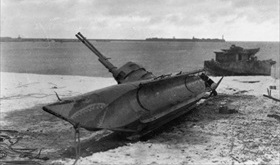
Influenced by a captured 1‑man British submarine, a prototype Biber was in place in March 1944 and successfully tested on this date, May 29, 1944. Hastily developed to help meet the impending Allied invasion of Europe (Operation Overlord), which began in Normandy, France, on June 6, the 1‑man, 6.5‑ton Biber was the smallest submarine, at 29 ft./8.8 meters long, in the Kriegsmarine. The Biber was powered by dual propulsion diesel (surfaced) and electric (submerged) motors. Its top speed submerged was 5.3 knots/6 mph/9.8 km/h, and it had a range of 100 nautical miles/185 km on the surface. A conning tower contained armored glass windows to allow the pilot to see out, plus it had a 5‑ft. periscope. The poor quality of its periscope meant that nighttime operations had to be conducted on the surface. Armed with 2 externally mounted torpedoes, 2 mines, or one of each, over 320 boats were delivered to the German Navy.
The first Biber operation, consisting of 22 boats, was launched from Fécamp harbor in Normandy on August 30, 1944, roughly 100 miles/160 km northeast of the invasion beaches. Only 2 boats reached their operational area. In December 1944 the Bibers were deployed to Rotterdam in the Netherlands to target Allied traffic to Antwerp, the vital Belgian supply port the Allies had recently wrestled from the Wehrmacht (German armed forces). The first Biber attack took place on the night of December 22/23, 1944, in support of the German drive through the Ardennes Forest known as the Battle of the Bulge (December 16, 1944, to January 25, 1945). Of the 18 Bibers involved in the operation, just one returned. The sole Allied casualty was a cargo ship, the Alan A. Dale. All 65 crewmen were rescued.
Operations through December 25 achieved no success and none of the 14 deployed midget submarines survived. Losses at sea at the end of January, combined with Royal Air Force bombing of launch sites, prevented attacks from being mounted in February 1945. The last Biber mission was a mine-laying operation and took place on the night of April 26, 4 days short of Adolf Hitler’s suicide. Of the 4 Bibers that took part in the daredevil operation, one ran aground and 3 were attacked by P‑47 Thunderbolts, which sank 2 of them. With a loss rate of 69 percent, the Biber midget submarine can truly be described as a sailor’s coffin.
Kriegsmarine Midget Submarines
 |
 |
Right: The 1-man, 6.5-ton Biber shown beached in this photo was the smallest of 11 production and prototype submarines in the Kriegsmarine. Plans for a 2-man version of the Biber were scratched. Germany, Japan, and Italy built approximately 2,000 midget submarines. Crewed by 1 to 4 men and armed with either torpedoes and/or mines, these pint-sized submarines performed both special and conventional operations in the Mediterranean, Black Sea, Indian Ocean, North Sea, the English Channel, and Pacific, including at Pearl Harbor
Left: Remains of a Biber midget submarine on its transportation trailer, abandoned and set afire by the roadside by retreating German forces near Arras, a city in the Pas-de-Calais in Northwestern France, 1944. Arras was entered and liberated by British soldiers from the 5th Battalion, Coldstream Guards on September 1, 1944.
 |
 |
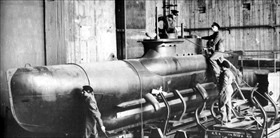
Left: A far more successful undersea weapon than the Biber was the 2‑man Seehund (pl., Seehunde). At 39 ft./nearly 12 meters long, the Seehund had a submerged speed of 7 knots (under 8 mph/13 km/h), had dual propulsion diesel (surfaced) and electric (submerged) motors, and had a range of 270 or so nautical miles/500 km. From January to April 1945, Seehunde performed 142 sorties, during which they sank 8 ships (versus one sinking for the Biber) for a total of 17,301 tons and damaged 3 for a total of 18,384 tons. They lost 35 of their own out of the 138 or so commissioned into the Kriegsmarine.
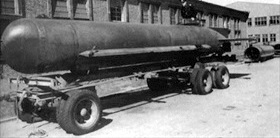
Right: The Molch (Salamander) was an 11-ton, 1-man, all-electric boat designed for coastal operations. Looking like a large torpedo, the Molch had a small range (40 miles/64 km at 5 knots), traveled submerged, and carried 2 underslung torpedoes. A total of 393 such boats were delivered to the Kriegsmarine. Molche (plural form) were used in the Mediterranean against the Allied invasion of the south of France (Operation Dragoon). On the night of September 25/26, 1944, a flotilla of 12 neither sank nor damaged anything for the loss of 10 subs. The last 2 subs were destroyed in Allied warship bombardment of San Remo, Italy, shortly thereafter.
German and Italian Sneak Craft. U.S. Navy Film Includes Descriptions of German Midget Submarines Biber and Seehund As Well As Torpedo Boats

World War II was the single most devastating and horrific event in the history of the world, causing the death of some 70 million people, reshaping the political map of the twentieth century and ushering in a new era of world history. Every day The Daily Chronicles brings you a new story from the annals of World War II with a vision to preserve the memory of those who suffered in the greatest military conflict the world has ever seen.