

NAZI ATROCITY IN RUMBULA FOREST
Riga, Occupied Latvia · November 30, 1941
On November 25 and 29, 1941, Einsatzgruppe 3 (Special Task Group 3), one of many SS (Schutzstaffel) mobile death squads operating behind the front lines, murdered 5,000 “Reich Jews,” that is, German- and Austrian-born Jews. These men, women, and children had arrived in the Baltic ghetto at Kaunas, Lithuania’s second largest city, earlier in the month. On this date in 1941, in the Rumbula Forest 9 miles south of Riga, capital and major city of the Baltic state of Latvia, the first of two sets of even more horrific mass murders began. (The second set occurred on December 8.) Roughly 24,000 of the victims were so-called (by the Nazis) “unproductive” (unwertvoller) Latvian Jews from the overcrowded Riga Ghetto, a 16‑block area known as Maskavas Forštate (Moscow Suburb), where 32,000 lived. Additional victims were approximately 1,000 Reich Jews who had left Berlin two days before on the first of 19 transport trains to Riga. Second only to the Babi Yar massacre in the Soviet Ukraine (September 29–30, 1941, when Germans and local collaborators killed 33,771 Jews in a single operation), the Rumbula massacre was the biggest two-day Holocaust atrocity until Nazi Germany introduced extermination camps in Poland in 1942. The Rumbula massacre was carried out by Einsatzgruppe A, which was assigned to Army Group North commanded by Field Marshal Wilhelm Ritter von Leeb, whose forces had overrun the three tiny Baltic states of Latvia, Lithuania, and Estonia and began an 874‑day siege of the Soviets’ Baltic port and second largest city, Leningrad (part of Operation Barbarossa). Einsatzgruppe A was aided by a unit of Latvians known as the Arajs Commando and to some extent by Latvian auxiliary police. Of the 40,000 Jews living in Riga (about 10 percent of the city’s population) when the Germans invaded the Baltic states in July 1941, only 4,800 were still alive by the end of the year. By late 1943 almost all Latvian Jews (out of approximately 66,000 at the start of the Nazi occupation) had perished in further SS “actions” (the Nazi euphemism for murder; for example, in gas vans), or had been worked to death in Latvia’s infamous Salaspils concentration camp, 11 miles from Riga, or had been transported to other concentration and death camps.
[fblike]
[amazon_carousel widget_type=”ASINList” width=”600″ height=”200″ title=”Recommended Reading” market_place=”US” shuffle_products=”False” show_border=”False” asin=”0275970507,0375708227,0764307541,0230552021,0810117290,0857456016,9881849810,9984905438,9984993183,0465002390″ /]
Holocaust in Riga, Latvia, 1941–1945
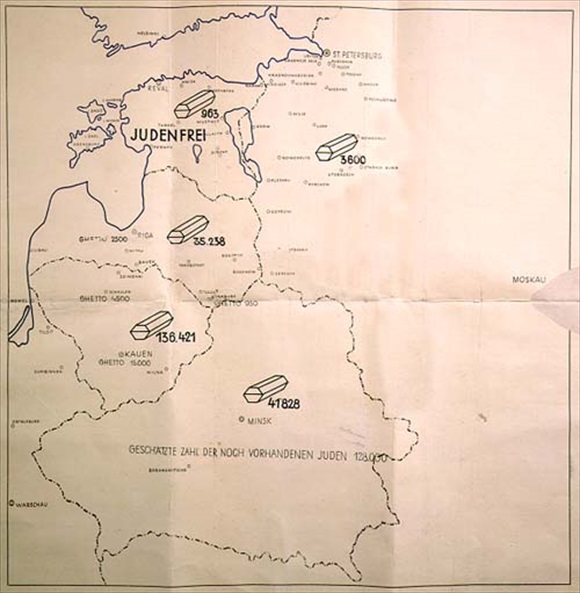 |
Above: Sketch map of Baltic States and Eastern Europe used to illustrate SS-Brigadefuehrer und Generalmajor der Polizei Dr. Franz Walter Stahlecker’s report titled “Jewish Executions Carried Out by Einsatzgruppe A” and stamped “Secret Reich Matter.” The report was sent to Stahlecker’s superior, Reinhard Heydrich, chief of the Reich Main Security Office (which included the Gestapo), on January 31, 1942. The map summarized the number of murders committed by Stahlecker’s SS unit in the Baltic states and the Soviet Union in 1941; namely, 220,250. The legend at the bottom states that “the estimated number of Jews still on hand is 128,000.” Estonia in the north is marked “judenfrei” (free of Jews) (963 killed); Latvia (35,238 killed); Lithuania (138,421 killed); Belarus (41,828 killed); and Russia (3,800 killed).
 |
 |
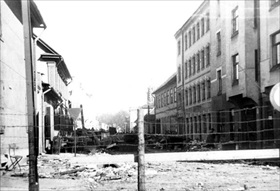
Left: Riga ghetto in 1942. After the mass killings at Rumbula and the liquidation of the so-called “large ghetto,” Latvian survivors moved into a smaller ghetto, which also housed deported Reich Jews from Germany, Austria, and today’s Czech Republic (Bohemia and Moravia). Its barbed-wire perimeter was guarded by Latvians. Within the smaller ghetto, the Germans maintained a special company of guards, consisting of policemen from Danzig, today’s Gdańsk in Poland. Jewish Councils (pl, Judenräte; sing, Judenrat), one for the Latvians and one for the Germans, were set up to work with the German occupation authorities (Gestapo and Wehrmacht). A Jewish Ghetto Police force was also established for each community. The Nazis set up a Labor Authority, which liaised with the Judenräte. Every morning the work crews assembled in the streets according to their work assignments.
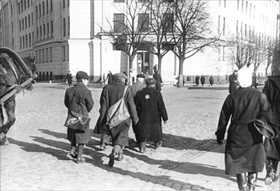
Right: 1942 photo showing Jews in Riga wearing the required yellow six-pointed star, one star visible from the front, the other from the back (man in long dark coat). Jews were forbidden to use the sidewalk and streetcars and were banned from public places, including city facilities, parks, and swimming pools. A Jew was also allotted only one-half the food ration of a non-Jew. Nuremberg-style race laws were introduced governing marriage and employment, and Jews could be randomly assaulted with impunity by any non-Jew. An account from the year 1943 lists 13,200 Jews in the Riga ghetto. By the end of November 1943, all Jews had been removed, either by transport to a concentration or death camp (2,000 to Auschwitz on November 2, 1943) or by murder.
Riga Ghetto—Holocaust Survivor Alex Lebenstein’s Story

World War II was the single most devastating and horrific event in the history of the world, causing the death of some 70 million people, reshaping the political map of the twentieth century and ushering in a new era of world history. Every day The Daily Chronicles brings you a new story from the annals of World War II with a vision to preserve the memory of those who suffered in the greatest military conflict the world has ever seen.