

ME 262, FIRST OPERATIONAL JET FIGHTER, LIFTS OFF
Leipheim Air Base, Bavaria, Germany · July 18, 1942
In mid-April 1941 test flights began of what would become the world’s first operational turbojet fighter, the Messerschmitt 262 Schwalbe, or Swallow. The test was really of the airframe, because the BMW turbojets—primitive and temperamental—were nowhere close to being ready for fitting. On this date in 1942 a true jet version flew—this almost nine months before the first Allied jet, the less capable, less heavily armed and slower British Gloster Meteor, flew on March 5, 1943. (On entering service the Meteor was not permitted to fly over Nazi-occupied Europe.) The Swallow was just beginning to be mass-produced in 1944 when on April 19 an Me 262 squadron was set up in western Bavaria to introduce the jet into service and train a core of pilots to fly it. (Only 800 Me 262s in various configurations were built before the war ended in May 1945.) During March 1945, Me 262 fighter units were able for the first time to mount large-scale attacks on Allied bomber formations in German airspace. On March 18, 1945, 37 Me 262s intercepted a stream of 1,221 bombers and 632 escorting fighters, shooting down eight bombers (the Germans claimed 12) and one fighter for the loss of three Me 262s. (This engagement also marked the first use of Germany’s new wing-mounted, 55mm anti-aircraft R4M rockets, which were fired in four salvos of six rockets outside the range of a bomber’s defensive guns and nearly always guaranteed a kill.) Me 262 fighter squadrons would have needed to sustain a 4:1 kill ratio to make any impact on the war’s outcome, but as it turned out overall Me 262 successes were minor. The Allies countered the potential game-changing Me 262s by attacking them on the ground and during takeoff and landing. Allied air attacks on German fuel supplies during the deteriorating late-war period also reduced the combat effectiveness of the Me 262. All that aside, Allied aircraft production, specifically American, would still have overwhelmed German jet aircraft production: the production playing field simply was no longer level and hadn’t been since 1943. After the war the Me 262’s revolutionary design influenced U.S. jet-powered aircraft such as the North American sweptwing F‑86 Sabre jet fighter and even Boeing’s medium bomber, the B‑47 Stratojet.
[fblike]
[amazon_carousel widget_type=”ASINList” width=”600″ height=”200″ title=”Recommended Reading” market_place=”US” shuffle_products=”False” show_border=”False” asin=”0887403956,1861261624,0887405169,1846032946,0897473329,0859791408,0764340484,1857802306,1849087490,0953346587″ /]
Allied and German Jet-Powered Aircraft
 |
 |
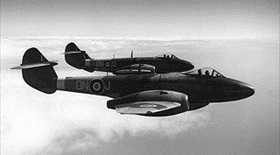
Left: In many ways Hitler’s Wehrmacht caught the U.S. and Britain off-guard, particularly in aviation technology. The unending quest for speed resulted in the need for radical alternatives to piston-engine aircraft, but that quest, like that for rocket-propelled weapons, enjoyed little state support or urgency in the Allied camp. Neither the U.S. nor Britain produced equivalents to the V‑1 and V‑2. And the only Allied combat jet to enter production during the war, the RAF Gloster Meteor, was no game-changer, being relegated to Britain’s home defense.
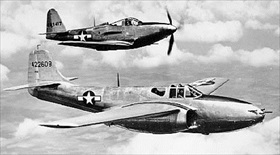
Right: First-production Bell P‑59 Airacomet with a Bell P‑63 Kingcobra in the background. The Airacomet was the first American jet fighter, designed and built by Bell Aircraft during World War II. It first flew on October 1, 1942, but the U.S. Army Air Forces was not impressed by its performance and cancelled the contract when fewer than half the ordered 80 aircraft had been produced. No P‑59 went into combat, though the airplane did pave the way to more advanced designs for postwar U.S. jet-powered aircraft.
 |
 |
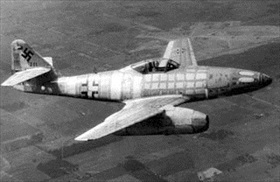
Left: Fighter pilots of the jet-powered Me 262 Swallow (often referred to as the “Stormbird”) faced a numerically superior enemy in an aircraft that was, at this late stage in the air war, technically immature compared to Allied piston-engine fighter and escort aircraft. That said, the Me 262 remained one of the most-feared weapons in the German arsenal, and it was only the overwhelming Allied air superiority and the continuous dwindling of German war resources, including trained pilots, that finally grounded the planes.
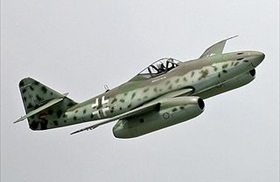
Right: Reproduction of a Messerschmitt Me 262 at the 2006 ILA Berlin Air Show.
1944 German Clips of Messerschmitt Me 262 Schwalbe (Swallow)

World War II was the single most devastating and horrific event in the history of the world, causing the death of some 70 million people, reshaping the political map of the twentieth century and ushering in a new era of world history. Every day The Daily Chronicles brings you a new story from the annals of World War II with a vision to preserve the memory of those who suffered in the greatest military conflict the world has ever seen.