

MATTERHORN WRAPS UP OPERATIONS
58th Bombardment Wing HQ, Kharagpur, India • January 15, 1945
The final strategic bombing raid by American B‑29 Superfortress heavy-bombers based in China occurred on this date in 1945. Targets of Operation Matterhorn, as the bombing of Japanese assets by India- and China-based B‑29s was called, were on the Japanese-occupied island of Formosa (today’s Taiwan).
Behind Operation Matterhorn was President Franklin D. Roosevelt. The president was impatient to resume bombing Japan, last visited by B‑25 medium bombers flown off the rolling carrier deck of the USS Hornet by Lt. Col. James Doolittle and his dare-devil Raiders on April 18, 1942. After the Casablanca Conference of January 1943, attended by Roosevelt, British Prime Minister Winston Churchill, and their Combined Chiefs of Staff, the president dispatched an emissary to Nationalist Chinese leader Chiang Kai-shek to brief the generalissimo on Allied plans and decisions for the next phase of the war against the Axis powers, including the proposal to base long-distance heavy bombers in his country. “Setting Sun,” as the proposed plan was initially known, had metamorphosed by the end of 1943 into a complex of 8 air bases in India and Western China near Chengdu (Chengtu).
By April 1944, 3 months past Roosevelt’s promised start date for the land-based air offensive against Japan, just 4 operational groups of B‑29s from the 58th Bombardment Wing, XXI Bomber Command under 38‑year-old Maj. Gen. Curtis LeMay, were in place, having been slowed by delays in training aircrews and preparing the new, highly complex aircraft for combat readiness.
The first B-29 bombing raid from India took place on June 5, 1944. Ninety-eight B‑29s left bases in Eastern India to attack rail yards in Thailand. Bombardment operations against the Japanese homeland were planned to be carried out from 4 forward deployment bases in China—Kwanghan (Guanghan), Kuinglai (Qionglai), Hsinching (Xinjin), and Pengshan. Working against China-based operations was the need to fly all the supplies of fuel, bombs, and spare parts from India over the Himalaya Mountains (the infamous “Hump”), because Japanese control of the seas off the Chinese coast made seaborne supply of China impossible.
By mid-June 1944 enough supplies were available at Chinese air bases to launch a single attack against a target in Japan. It was a nighttime raid carried out on June 14/15, 1944, against the Imperial Iron and Steel Works at Yawata on Kyūshū, the southernmost Japanese home island. The target had been carefully chosen owing to Yawata’s producing more than 50 percent of Japanese steel. Toward the end of the year, it was obvious that B‑29s flying out of bases in China and India were far too expensive in men and materials and would have to cease. In December 1944 it was decided to phase out Operation Matterhorn. In February 1945 the 58th Bombardment Wing redeployed to new bases in the Central Pacific, thus opening up the last deadly phase of the strategic bombing campaign against Japan.
Operation Matterhorn: Assaulting Japan from Chinese and Indian Airfields, 1944–1945
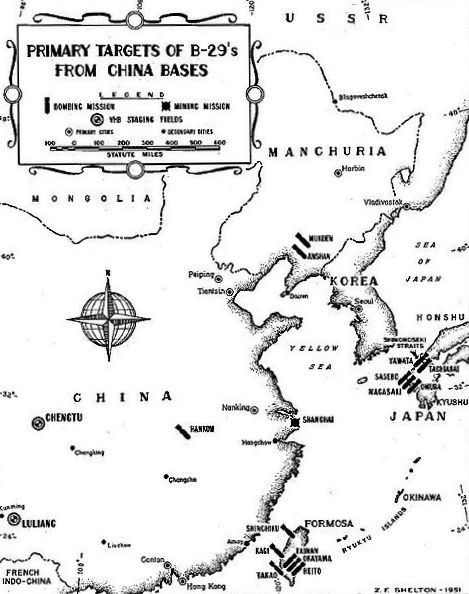 |
Above: Locations of B-29 bomber bases in China and the main targets they attacked in Southeast Asia, including the southernmost Japanese mainland, during Operation Matterhorn, 1944–1945. The name Matterhorn came from the mountain in Switzerland, at the time considered a difficult climb. It was thought that once sufficient numbers of China-based B‑29s were available, Japan could be forced out of the war within 6 months by the destruction of her war industries, making a costly amphibious invasion of the Japanese mainland unnecessary. Operation Matterhorn, it was projected, could defeat Japan by mid‑1945.
 |
 |
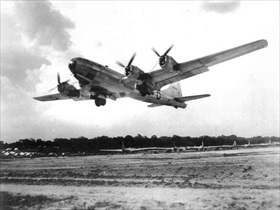
Left: A 40th Bombardment Group B-29 taking off from an unfinished runway in Chakulia, India, June 1944. Two months earlier the U.S. Joint Chiefs of Staff approved Operation Matterhorn. The operational vehicle was the 58th Bombardment Wing (Very Heavy), of which the 40th Bombardment Group was a part.
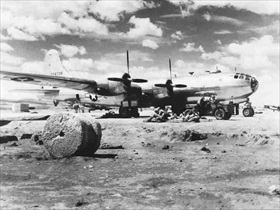
Right: A 40th Bombardment Group B-29 on an unfinished airfield (probably Hsinching Airfield) in China, 1944. Four forward bases in the Chengdu, China, area were assigned to B‑29 operations—Hsinching (Xinjin), Kwanghan (Guanghan), Kuinglai (Qionglai), and Pengshan.
 |
 |
Left: On the night of June 14/15, 1944, 47 B‑29s launched from Chengdu, China, to bomb the Imperial Iron and Steel Works at Yawata, Japan. This was the first attack on the Japanese home islands since the Doolittle Raid in April 1942. The first B‑29 combat losses also occurred during this raid. The city of Yawata was blacked out and haze or smoke or both helped obscure the target. Fifteen aircraft dropped bombs visually while 32 bombed by radar. Only 1 bomb hit anywhere near the intended target, leaving the steel works essentially unscathed. Despite inflicting little damage, the Yawata raid was hailed as a great victory in the American press.
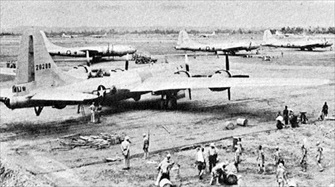
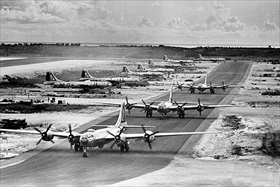
Right: B-29s of the 462nd Bombardment Group, West Field, Tinian, Mariana Islands, 1945. Another wing—the 314th Bombardment Wing also assigned to XXI Bomber Command of the Twentieth Air Force—arrived in the Marianas and settled in at North Field on Guam. Tinian, Guam, and their sister island Saipan were ideal bases from which to launch B‑29 operations against Japan’s major industrial centers and, from March 9, 1945, onwards its major population centers, home to innumerable cottage industries. The 3 islands were about 1,500 miles/2,414 km from Japan’s capital and largest city, Tokyo, a range B‑29s could just about handle. And unlike China, they were on a direct supply line from the United States by ship.
Silent Combat Camera Unit Footage of Operation Matterhorn B‑29s, Aircrew, and Flight Operations

World War II was the single most devastating and horrific event in the history of the world, causing the death of some 70 million people, reshaping the political map of the twentieth century and ushering in a new era of world history. Every day The Daily Chronicles brings you a new story from the annals of World War II with a vision to preserve the memory of those who suffered in the greatest military conflict the world has ever seen.