

MANZANAR CHILDREN’S VILLAGE CLOSES
Manzanar War Relocation Center, Owens Valley, California • September 21, 1945
On June 23, 1942, 62 Japanese American orphaned, abandoned, and unwanted girls and boys arrived at Manzanar’s new Children’s Village. Chaperoned by adult caregivers and 2 soldiers armed with rifles and bayonets, the youngsters departed in several olive-green U.S. Army buses from 2 Los Angeles orphanages, making stops at a few local foster homes along the way. The L.A. orphanages, often referred to as “children’s homes,” were founded to meet a range of institutional care issues in their communities. At Manzanar, after a bus ride of 220 miles/354 kilometers, the weary travelers entered a so-called “relocation center” purpose-built by the U.S. Army to confine over 10,000 Japanese nationals and American-born Japanese behind barbed wire in the remote, desolate Owens Valley of Eastern California for an indeterminate period. Swept up in an Army roundup, eviction, and incarceration of people of Japanese ethnicity that kicked off on March 24, 1942, these parentless children—some of whom were no more than one‑eighth Japanese—were considered by many Americans to be a potential threat to the nation’s wartime security after Japan’s December 7, 1941, crippling strike on U.S. military assets at Pearl Harbor, Hawaii.
A little more than 3½ months after Pearl Harbor, on March 25, 1942, the Manzanar War Relocation Center became the first of 10 War Relocation Authority (WRA) camps to receive a portion of the 125,000‑plus displaced persons of Japanese ancestry forcibly evicted from the Pacific west coast and part of Arizona. The Children’s Village, a special section of the Manzanar camp, was the only orphanage in the WRA system. A month later, on April 28, 1942, representatives from one of the Los Angeles orphanages (the Shonien), anticipating the inevitable closure of all Japanese orphanages on the West Coast, visited Manzanar to assist state, federal, and military authorities in selecting a location for the Children’s Village (see Manzanar site map). By the end of June 1942, the Village was 40 short of the 101 inhabitants who would spend part of their life at the children’s home. Roughly 50 percent of the admitted were under 7 years of age and 29 percent were under four. Eleven children were 3 months old when admitted. The oldest Villagers were a set of 19‑year-olds. Records indicate that 54 of the children were male and 47 were female. Also, 63 percent were second-generation Japanese American (Nisei) and 37 percent third generation (Sansei).
Racially, an estimated 19 percent of Villagers were born to parents who acted contrary to the Japanese taboo and stigma of conceiving children outside the racial-ethnic community. Fourteen percent were born out of wedlock. Most mixed-race children (hapa or hafu, meaning “half”) were Sansei babies and toddlers. Eight were over 3 years old. Hapa kids (14 percent) had 2 counts against them, as it were: they were orphans or foster kids and furthermore they did not look “pure” Japanese (jun nihonjin). One tall, blond, fair-skinned foster child was 7½ years old when he learned he was hapa.
Village children attended school and church services and related functions with the larger inmate community. K‑12 school instruction was provided by mostly white teachers hired directly by the WRA. There were classes for advanced learners and for those with special needs. At first the classrooms were scattered around the camp; in 1944 they coalesced in Block 16 for attendees of elementary school and in Block 7 for secondary school students. Similarly, Buddhist, Protestant (aka Christian), and Catholic parishioners attended religious services and activities in recreation (multipurpose) barracks in Blocks 13 (primary site), 27, and 34 (Buddhist); Blocks 15 (primary site), 5, and 32 (Protestant); and Block 25 (Catholic). Buddhist congregants outnumbered Protestants and Catholics. Children’s Villagers had the option of attending informal Christian services on their own campus or at houses of worship off campus.
On this date, September 21, 1945, Manzanar’s child-care program shut down. Thirty-two children left the Village in August and September. Roughly 50 percent of the 101 children who were confined in the Village were reunited with one or both parents or other relatives and guardians. Six were discharged to foster parents, 5 to “work and wage homes,” 10 to boarding houses, and 20 to temporary-care institutions. Just a fraction of Village children were adopted; adoptees were primarily mixed-race Sansei.
Manzanar Children’s Village: Orphans Behind Barbed Wire
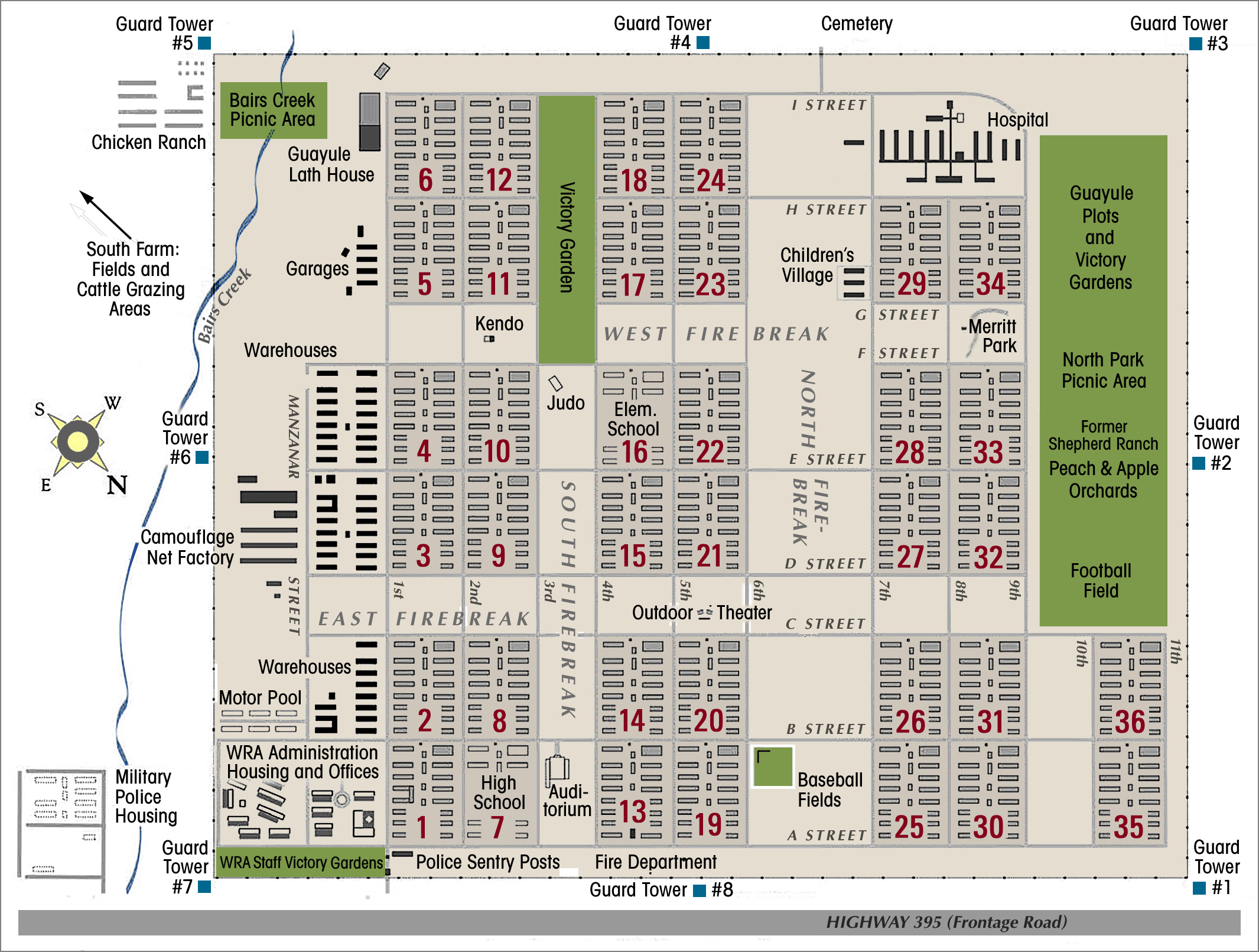
Above: Seen in the upper right corner, Children’s Village was a grouping of 3 enlarged barracks within which were boys’ and girls’ dormitories, a nursery, a small children’s dormitory (one for each gender), gender-specific shower and toilet facilities, a small recreation room, staff housing, a mess hall, and kitchen and storeroom facilities. The children had their own basketball and volleyball courts, softball field and team, and a large grassy area for playing football. Close-knit bonds among the Villagers were the result of their communal living arrangements, their loving and nurturing environment, and the social rejection and isolation of the children by a large part of the Manzanar community, especially by Japanese-born Issei. Site map of Manzanar residential barracks, street grid, and public facilities from a 1944 blueprint adapted by Mark S. Haskett.
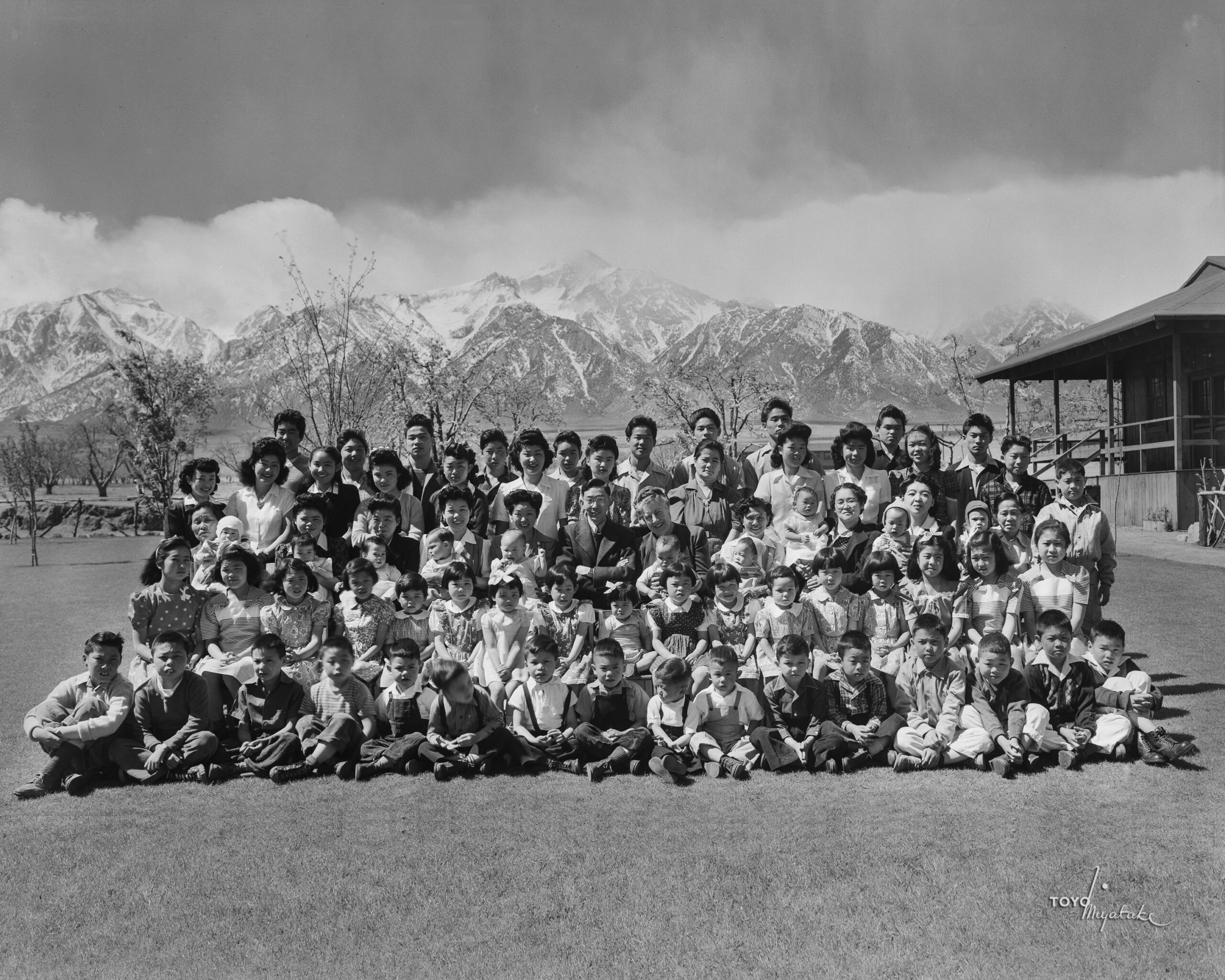
Above: Toyo Miyatake’s photograph of Manzanar’s Village children and staff taken on Easter Sunday, April 9, 1944. In the center of the photograph are Harry H. Matsumoto (suit) and wife Lillian I. Matsumoto (holding months-old Karyl on lap); the couple were the superintendents of Manzanar’s Children’s Village. Manzanar resident Toyo Miyatake, with permission of camp director Ralph Merritt, became the official camp photographer and was allowed to take photographs at will, in the process becoming a community archivist with camera. As a member of the internee-run Manzanar Cooperative Enterprises, Miyatake initially set up his busy studio in one of the communal ironing or laundry rooms within Manzanar’s Block 30 (see site map). Needing more space for equipment and his growing clientele, Miyatake moved the studio into one of the camp’s mess halls. Village orphans and foster children were principally drawn from the Shonien and the Maryknoll Catholic Home, the 2 Los Angeles children’s homes, and San Francisco’s Salvation Army Home. A small number of children placed in the Village were newborn babies delivered by schoolgirl mothers incarcerated in other WRA facilities in California, Oregon, Washington, Arizona, and Alaska. Photo courtesy of Alan Miyatake of Toyo Miyatake Studio, San Gabriel, California.
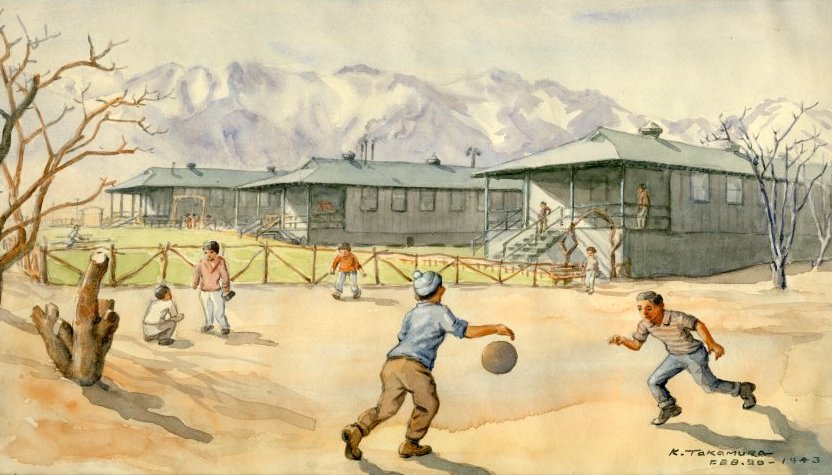
Above: A group of Japanese American orphans and foster children play at Manzanar’s Children’s Village in 1943. Painted by Japanese-born Kango Takamura (1895–1990), the former Hollywood studio photo retoucher arrived at Manzanar on June 16, 1942. During his imprisonment he worked as a curator for the camp’s iconic Visual Education Museum. Like Miyatake, Takamura was a community archivist; however, instead of using black & white film, he documented inmate life in scores of watercolors and drawings that today hang in museums and appear in numerous coffee-table-size books. Prior to leaving Manzanar in 1945, Takamura presented this watercolor to the superintendents of the Manzanar orphanage, Harry and Lillian Matsumoto. The watercolor is one of the few images of how Children’s Village appeared. The original watercolor is on permanent loan to the Eastern California Museum in Independence, California. Permission to use this image was granted by Karyl M. Matsumoto.
Injustice Camouflaged as Military Necessity: Japanese American Incarceration During World War II

World War II was the single most devastating and horrific event in the history of the world, causing the death of some 70 million people, reshaping the political map of the twentieth century and ushering in a new era of world history. Every day The Daily Chronicles brings you a new story from the annals of World War II with a vision to preserve the memory of those who suffered in the greatest military conflict the world has ever seen.