

MAN TO DESIGN GENERAL PURPOSE CAR FOR ARMY
Detroit, Michigan · July 17, 1940
As war clouds gathered over Europe in the late 1930s, the U.S. Army asked American automobile manufacturers to tender suggestions to replace its aging light-motor vehicles, mostly motorcycles and sidecars but also (incredible as it seems) some Ford Model Ts. As early as 1937–1938, several prototypes were presented to Army officials. However, Army requirements were not formalized until July 11, 1940, when 135 U.S. automotive companies were approached to quickly submit a design conforming to the Army’s specifications for an inexpensive, robust, four-wheel-drive reconnaissance or command vehicle.
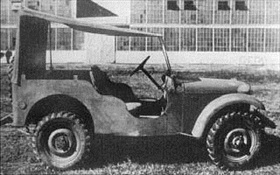
On this date in 1940 Karl Probst, a talented freelance designer from Detroit, Michigan, accepted the challenge. Five days later he submitted a bid, complete with blueprints. A prototype, dubbed the “Blitz Buggy,” was hand-built in 49 days by the American Bantam Car Company of Butler, Pennsylvania, mostly using existing off-the-shelf automotive parts. Tested in September at the Army’s motor research and development facility outside Baltimore, Maryland, the vehicle failed only to meet engine torque criteria.
The blueprints, which the government claimed it owned under terms of the award, were turned over to Willys-Overland and Ford Motor Company. Both companies made design modifications, though the resulting prototypes looked similar to Probst’s “Blitz Buggy.” The War Department, requiring a large number of vehicles to be manufactured in a relatively short time, granted Willys-Overland the production contract to build the vehicle for $648.74 apiece. Ford was licensed to manufacture the vehicles using Willys’ specifications. Between them, Willys-Overland and Ford produced about 640,000 of the legendary Jeeps, as the general purpose vehicles were called, a number representing about 18 percent of all wheeled military vehicles built in the U.S. during World War II. “The world’s greatest fighting machine” saw service as scout vehicles, communications vehicles, staff cars, and battlefield ambulances, among other utility chores.
[fblike]
[amazon_carousel widget_type=”ASINList” width=”600″ height=”200″ title=”Recommended Reading” market_place=”US” shuffle_products=”False” show_border=”False” asin=”0764344609,0897475852,0953447014,184176888X,1906133379,1870979761,3936519285,1855202182,0764330985,1561382353″ /]
U.S. and German Military General Purpose Vehicles
 |
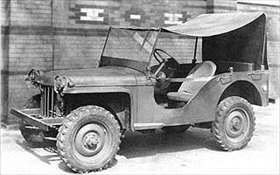 |
Left: The Bantam No.1 “Blitz Buggy,” the test vehicle delivered to Camp Holabird, Maryland, on September 23, 1940. “Old Number One” was the first vehicle of a 70‑vehicle contract between the U.S. Army and the American Bantam Car Company.
Right: The BRC40 4×4 Light Reconnaissance Vehicle, the final evolution of the Bantam design. Bantam built 2,765 of these nimble BRCs (Bantam Reconnaissance Cars), of which more than half went to the British Army, while some were sent to the Soviet Union. The term “Jeep” made its first appearance in print in late February 1941, after Willys-Overland staged a press event of its Jeep ascending the steps of the Capitol building in Washington, D.C.
 |
 |
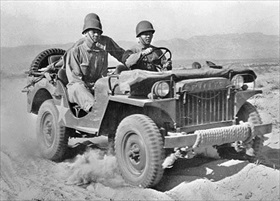
Left: Willys MA Jeep at the Desert Training Center, Indio, California, June 1942. Most MA Jeeps were sent to the Soviet Union under the Lend-Lease program. Willys made its first 25,000 1/4‑ton, 60‑hp MB Jeeps (formally, Truck, 1/4 ton, 4×4) with a welded flat iron “slat” radiator grille. It was Ford that first designed and implemented the now familiar and distinctive stamped, slotted steel grille into its Jeeps. MB Jeeps were given other modifications, among them longer wheelbases, 6×6 drive trains, skis, armor plating, railway wheels, and weapons mounts of various types.
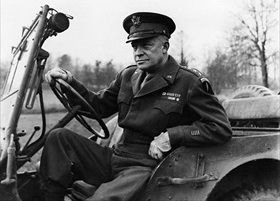
Right: Allied Supreme Commander Gen. Dwight D. Eisenhower behind the wheel of a Jeep, December 1944. Often referred to as “the wartime limousine,” the Jeep transported everyone from royalty to presidents and prime ministers, to generals and privates. Eisenhower remarked, “The Jeep, the Dakota [Douglas C‑47 Skytrain] airplane, and the landing craft were the three tools that won the war.”
 |
 |
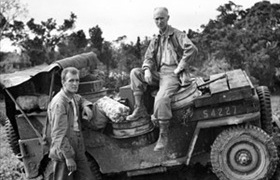
Left: War correspondent Ernie Pyle (seated) and jeep driver, Okinawa, April 10, 1945, ten days before Pyle’s death on the island. “Good Lord,” Pyle said, “I don’t think we could continue the war without the jeep. It does everything. It goes everywhere. It’s as faithful as a dog, strong as a mule, and as agile as a goat. It constantly carries twice what it was designed for, and keeps on going. It doesn’t even ride so badly after you get used to it.”
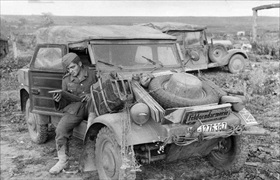
Right: A Volkswagen Type 82 Kuebelwagen (literally, tub or bucket car) on the Eastern Front during Germany’s Operation Citadel, June 21, 1943. In January 1938 the Wehrmacht (German armed forces) approached renowned designer Ferdinand Porsche of Volkswagen Type 1 fame about designing an inexpensive, light-weight, on- and off-road military transport vehicle, suggesting that his Volkswagen Kaefer (we know it today as the Beetle) could provide the basis for such a vehicle. Full-scale production of the Kuebelwagen started in February 1940. Between 1940 and 1945, 50,435 of these reliable and durable vehicles with their air-cooled engines were produced, including a Schwimmwagen version.
“Autobiography of a Jeep,” a 1943 Film Narrated by a Talking Jeep

World War II was the single most devastating and horrific event in the history of the world, causing the death of some 70 million people, reshaping the political map of the twentieth century and ushering in a new era of world history. Every day The Daily Chronicles brings you a new story from the annals of World War II with a vision to preserve the memory of those who suffered in the greatest military conflict the world has ever seen.