

M1 FLAMETHROWERS SEE FIRST COMBAT SUCCESS
Guadalcanal, Solomon Islands • January 15, 1943
On this date in 1943 M1 portable flamethrowers were used successfully in combat for the first time relatively late in the 6‑month Battle of Guadalcanal (August 7, 1942, to February 9, 1943). In one attack by U.S. Marines several 2‑man flamethrowing teams crawled close enough to 3 Japanese bunkers to burn out or suffocate the occupants.
Consisting initially of a single upright 5‑gallon/19‑liter fuel tank with 2 compartments (one for pressurized nitrogen, the propellant, the other for fuel oil) and a hose with a pistol grip and nozzle at the end, all of which was mounted on an infantryman’s back, a fully loaded M1 flamethrower could shoot a stream of burning liquid between 65 ft/19.8 m (effective range) and 141 ft/43 m (maximum range) for about 10 seconds of burn time. The 72 lb/32.6 kg device was normally used to clear out enemy trenches, pillboxes, and other hardened enclosures whose walls were impervious to artillery bombardment. An improved version that consisted of 3 upright bottles, the M1A1, weighed 7 lb/3.2 kg less, had 3 times the range (150 ft/43 m) with the same fuel tank capacity, and fired a narrow stream of thickened fuel known as napalm that could reach 4 times farther into the target structure than the M1. (Napalm is an incendiary mixture of a gelling agent and a volatile petrochemical, usually gasoline or diesel fuel.) The first M1A1 infantry flamethrowers reached the South Pacific in August 1943.
Man-portable flamethrowers posed multiple risks to operators. For one thing, riding on the back of an infantryman, the weapon was top-heavy, cumbersome, and its weight impaired his mobility. Secondly, the bulky backpack weapon was plainly visible on the battlefield, turning “flametankers” into magnets for enemy fire, especially for sniper bullets. Lastly, the flamethrower’s effective range was short in comparison to that of other battlefield weapons of similar size and weight, meaning that to be effective flamethrower carriers had to approach their targets up close. The U.S. Army and Marine Corps sought to reduce casualties among their flamethrower teams and increase the kill-ratio by testing the weapons mounted on tanks.
The first combat use of American flamethrower tanks occurred on the neighboring Pacific island of Bougainville in late January 1944 as soldiers and Marines were expanding their beachhead. The tank was the M3A1 Stuart light tank with a modified M1A1 flame gun mounted below its Browning M1919 .30‑caliber/7.62 mm bow machine gun. A stronghold of Japanese bunkers dubbed the “Hornet’s Nest” was the objective of these armed men and fire-belching tanks. During the fight the Stuarts used both their 37 mm/1.4 in. guns and M1A1 flamethrowers to eliminate Japanese defenders. A total of 28 large bunkers were destroyed, of which half were credited to flamethrower tanks. In all, roughly 80 Japanese troops were killed outside their bunkers, while an estimated 120 to 180 Japanese were shot, suffocated, or incinerated inside their bunkers.
After capturing the “Hornet’s Nest,” senior Army and Marine officers acknowledged the urgent need for flamethrower tanks to dispose of the threat posed by heavily protected enemy defensive works. In early 1944 new custom-designed E4‑5 “auxiliary” and “primary” flamethrowers entered production and began to arrive that summer. The Army began adapting the Canadian-built Ronson Flamethrower to the turrets of their M3A1 Stuarts. Nicknamed Satans or Zippos, these flamethrower tanks with their huge 170‑gallon fuel tank for maximum burn time saw their combat debut on Saipan, Tinian, and Guam in mid-1944, about the time Marines began favoring better-armored M4A2 Sherman medium flamethrower tanks. Flamethrower tanks played increasingly important roles in the battles on Iwo Jima and Okinawa as well as modest roles in the European Theater in 1944–1945.
World War II Man-Portable and Tank-Mounted Flamethrowers
 |
 |
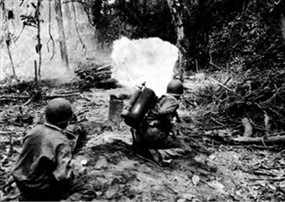
Left: A flamethrower team comprised an operator and an assistant, who turned on the tanks from the rear just before use and, if the device experienced an electrical spark ignition problem, used a thermite grenade to ensure that the target emplacement “cooked off.” By 1944 the assistant also carried a jerrycan of additional fuel. The 5‑gallon fuel tank allowed only 8–10 seconds of fire.
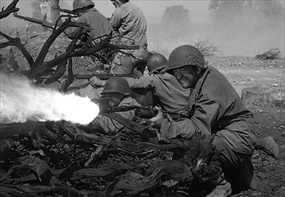
Right: By 1944 many but not all Army and Marine divisions in the Pacific were organizing specially equipped bunker-busting teams of 15–25 men who used “blowtorch and corkscrew” tactics. These teams were formed around 2 flamethrowers (the blowtorch) who would burn off jungle cover to expose enemy-occupied caves, pillboxes, and log bunkers. Team members equipped with rifles, Browning machine guns (BARs), and bazookas (the corkscrew) proceeded to lay down suppressive fire while the flamethrowers moved forward, directing their narrow streams of liquid fire across and through the enemy’s gun slits, thus forcing the defenders back as demolition men closed in for the kill. Combinations of thrown demolition charges, bazooka fire, and close-range flame and rifle fire finished the job. (Note: Image is a still from Hell Is for Heroes, a 1962 film.)
 |
 |
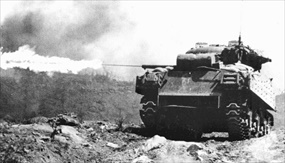
Left: Flamethrower tanks carried much more fuel than backpack-wearing infantry and fired longer-ranged flame bursts. They were invaluable for rooting out heavy fortifications. As no U.S. tank cannon could penetrate the thick bunkers and cave warrens created by Japanese defenders on islands such as Tarawa or Iwo Jima (shown here), flame-tanks were used instead. Army and Marine infantry provided the necessary security during the tankers deployment.
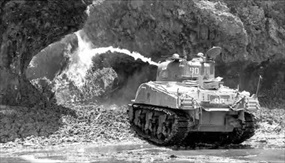
Right: An M4A1 Sherman flamethrower tank of the U.S. Army’s 713th Tank Battalion hoses down a cave entrance in support of the 7th Division’s advance on southern Okinawa, June 25, 1945. Although flame-tanks in the Pacific Theater were widely dispersed in small numbers, the 713th was the only complete flame-tank battalion and worked closely with the infantry and regular tank units. In combat, flamethrowing tanks were often closest to enemy positions because of the limited range of their firing. Of all the weapons directed at them, Japanese soldiers were most fearful of the fire-belching tanks. Refusing to surrender and attempting to evade or flee the flames, enemy soldiers were peppered individually or mowed down in mass by U.S. riflemen.
World War II Hand-Held and Tank-Mounted Flamethrowers

World War II was the single most devastating and horrific event in the history of the world, causing the death of some 70 million people, reshaping the political map of the twentieth century and ushering in a new era of world history. Every day The Daily Chronicles brings you a new story from the annals of World War II with a vision to preserve the memory of those who suffered in the greatest military conflict the world has ever seen.