

LUFTWAFFE WANTS GIANT TRANSPORTER
Berlin, Germany · October 18, 1940
On this date in 1940 German aircraft maker Messerschmitt was given just 14 days to submit a proposal for a large-capacity troop- and cargo-carrying glider. A prototype heavy-lift glider flew February 25, 1941, pulled by several 4-engine Junkers Ju 90s. The prototype glider’s maiden flight encouraged Messerschmitt to enlarge the cockpit to accommodate a co-pilot and a radio operator and add electric servo motors to assist the pilots in moving the huge trailing edge flaps.
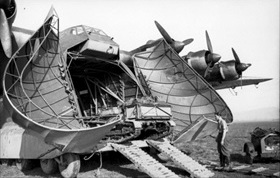
Out of this the Messerschmitt Me 321 Gigant (“Giant”) emerged, not for use in Operation Sea Lion, the planned invasion of England as originally envisioned, but for use in Operation Barbarossa, the Russian campaign, which kicked off on June 22, 1941. Standing over 33 ft./10 m tall, made of steel tubing, wooden spars, and covered in doped fabric, with clamshell doors in the nose and massive high-mounted wings that stretched 181 ft./55 m in length, the aircraft could carry inside its boxcar-sized belly a combination of 120–130 fully equipped troops, or 60 stretcher cases with medical attendants, or an 88 mm gun and tractor, a medium tank, or 2 4‑ton trucks along with barrels of oil and gasoline. The biggest land-based cargo aircraft of World War II, some 200 were built between June 1941 and April 1942, seeing considerable service on the Eastern Front.
Another 200 or so six-engine variants of the Me 321, with a strengthened wing and designated the Me 323, were built between 1942 and 1944. Four liquid-fuel rockets assisted take-off. The Me 323 “D” series had a crew of five (2 pilots, 2 flight engineers, and a radio operator) and was armed with five 13mm machine guns. Maximum payload was around 10–12 tons (130 troops) with a range of 500 miles/805 km (loaded) flying at 136 mph/219 km/h, making it lumbering and vulnerable to enemy fighter planes. Losses quickly mounted. As the Allies closed in on Axis forces in their shrinking Tunisian redoubt, having closed the sea route between North Africa and Sicily, 27 heavily loaded Me 323s escorted by Messerschmitt Bf 109s flew into seven Malta-based squadrons of British Spitfires and Curtiss P‑40 Warhawks. The Luftwaffe escorts downed three Allied planes but 21 of 27 Me 323s met a watery grave. The monster transports, still considered by the Germans to be an invaluable asset, stayed in service, but they were increasingly regarded by Allied pilots as sitting ducks.
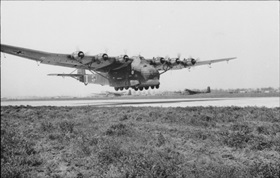
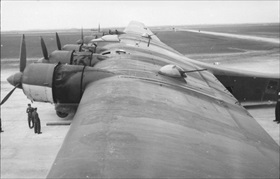
Messerschmitt Me 323 Gigant (“Giant”), Powered Variant of the Me 321 Military Glider
 |
 |
Left: A motorized variant of the Messerschmitt Me 321 heavy-lift glider, the Me 323 was largest land-based transport aircraft of World War II. Around 200 of these 6-engine behemoths were built before production ceased in April 1944. It is believed that no Me 323s survived in service beyond the summer of 1944. A ruined but complete wreck was found in 2012 off the coast of Sardinia, Italy.
Right: This photograph from March 1944 shows an Me 323 with multiple machine-gun turrets. Among the mounted guns were the 7.92 mm drum magazine MG 15 and the belt-fed MG 81 or the belt-fed 13 mm MG 131. The MG 81 could fire between 1,400 and 1,600 rounds per minute.
 |
 |
Left: An Me 323 unloading a Renault UE Chenillette, a light tracked armored carrier, Tunisia, January 1943.
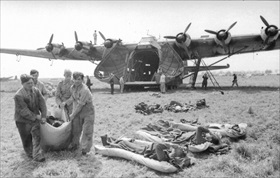
Right: The monster airplane ferried troops, equipment, and fuel (up to 52 drums), and evacuated the wounded as shown in this photograph taken in Italy in March 1943. Me 323s saw service in Tunisia, Italy, and on the Eastern Front.
History of the Messerschmitt Me 323 Gigant (“Giant”), 1942–1944, the Powered Variant of the Me 321 Military Glider

World War II was the single most devastating and horrific event in the history of the world, causing the death of some 70 million people, reshaping the political map of the twentieth century and ushering in a new era of world history. Every day The Daily Chronicles brings you a new story from the annals of World War II with a vision to preserve the memory of those who suffered in the greatest military conflict the world has ever seen.