

LAST U.S. HOLDOUTS SURRENDER TO JAPANESE
Manila, Occupied Philippines • May 6, 1942
On Monday, December 8, 1941, Japanese forces attacked the Philippines, a largely self-governing U.S. possession, formally known as the Commonwealth of the Philippines. (December 8, Manila and Japanese time, was Sunday, December 7, east of the International Date Line, the day Japanese carrier-based planes attacked Pearl Harbor, Hawaii, in a set of interlocked assaults on U.S., British, and Dutch military assets in Southeast Asia.) Led by 61‑year-old Gen. Douglas MacArthur, the combined U.S.-Filipino ground force, 130,000 strong and the largest part of the U.S. Armed Forces in the Far East (USAFFE), could not check the Japanese naval and air onslaught (close to 70 percent of MacArthur’s army consisted of raw Filipino recruits), so MacArthur’s troops, armed with mostly rifles, machine guns, and hand grenades, withdrew onto the Bataan Peninsula, a 530-square-mile/1,373-square-kilometer finger of land across the bay from the Philippine capital Manila. There they held out until April 1942. Their fighting retreat, without naval and air support, was the longest and most gallant in U.S. military history. Nearly 80,000 U.S. and Filipino men and women went into Japanese captivity, many of them murdered or dying from exhaustion, dehydration, exposure, and the brutal treatment by their captors on the subsequent 5 to 10‑day, 80‑plus-mile/129‑plus-kilometer “death march” out of Bataan to inland prison camps in Central Luzon. Those who survived the march were doomed to live in deplorable conditions, some as slave laborers in Japan beginning as early as July 1942.
After a 4-month ordeal, the last-ditch U.S. stronghold, the tadpole-shaped “rock” of Corregidor in Manila Bay, surrendered its booty of 14,000 Americans and Filipinos, among them 19 generals, on this date, May 6, 1942. The bitter, drawn-out fight in the Philippines, so infuriating to the invaders, inflicted heavy losses on both sides and forced Japan to send troop reinforcements, more equipment (artillery and mortars), and bombers than originally planned to capture an objective far less important to their ambitions of securing the great mineral resources of British Malaya, overwhelmed in mid-January 1942, and the Dutch East Indies (today’s Indonesia), which surrendered on March 9, 1942. Between December 8, 1941, and May 8, 1942, the date the Philippines campaign officially ended, the U.S. lost an estimated 30,000 troops, the Filipinos about 80,000, and the Japanese an estimated 12,000.
In the months preceding the outbreak of hostilities, Japanese expansionists and policymakers had counted on the anticipated successes of their early military operations in Southeast Asia to nudge the Western colonial powers to sue for peace after hostilities had broken out. When that didn’t happen, the sanguine appraisal of how Japan was going to win the Pacific War it had started morphed into anxiety and later despair. Fully 80 percent of Japanese troops remained tied down in a ground war in China that Japan had started in 1937 (Second Sino-Japanese War), though many historians currently date the start of the ground war on the Chinese mainland to 1931 (Japanese conquest of Manchuria). The rest of the army and the Imperial Japanese Navy now had to contend with a massive buildup of a revived U.S. Pacific Fleet, as well as converging attacks by U.S. and British Commonwealth forces from one retaken Pacific island after another. In the end, the bushidō spirit (“warrior spirit”) that the Japanese fell back on as their fortunes turned bleaker by the month could not trump the Allies’ superior strength in financial and natural resources, armaments, and fighting men, a combination that secured the Allies victory over Japan in September 1945.
Some of the most vicious fighting anywhere in World War War War II was waged across the Philippines, an archipelago of 7,100 islands. Nearly 80,000 Americans and Filipinos, half-starved, battle-weary, and wracked with disease, were taken prisoner on the Bataan Peninsula, the name of which is forever linked with the notorious “death march.” During the 3 years that Japan occupied the archipelago, 130,000 American and Filipinos died. POWs in Japanese prison camps were 10 times more likely to die in captivity as those in German camps. When U.S. troops returned to retake the Philippines beginning in October 1944, they preferred not to take any enemy prisoners at all. Drawing heavily on firsthand accounts, Gerald Astor gives voice to the Marines, soldiers, sailors, and airmen who participated in this gruesome period of military history in Crisis in the Pacific: The Battles for the Philippine Islands by the Men Who Fought Them. Astor’s dramatic narrative brought home to me that the physical and emotional costs of defeating the Japanese in the Pacific were as high, and probably higher, as those incurred in defeating Nazism in Europe.—Norm Haskett
The 80-Mile Bataan Death March Began on April 9, 1942
 |
 |
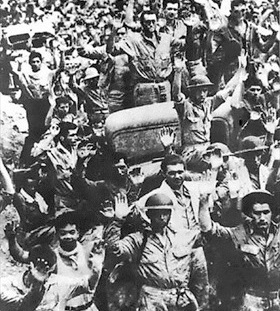
Left: In a staged photograph by a Japanese cameraman, American and Filipino troops are shown surrendering to Japanese invaders on Bataan Peninsula. The three-month Battle of Bataan (January 7 to April 9, 1942) resulted in the largest surrender in American and Filipino military history, and was the largest U.S. surrender since the American Civil War. After a 77‑day residence on the fortress island of Corregidor (formally named Fort Mills) 2 miles/3.2 kilometers south of Bataan, Gen. MacArthur, his family, and a small group of staff officers escaped Japanese capture, evacuated on March 11, 1942, aboard a fast torpedo boat. Six harrowing days later the very symbol of U.S. resistance to Japanese aggression landed safely on Australian soil. Shortly after arriving MacArthur gave a speech in which he famously vowed “I shall return” to the Philippines. On April 1, 1942, President Franklin D. Roosevelt awarded MacArthur the Medal of Honor, the nation’s highest military decoration, for his actions in the Philippines and3‑1/2 months later, on June 18, appointed him Supreme Allied Commander, South West Pacific Area (SWPA) with a single Australian and 2 U.S. divisions under his command. Twenty-eight months later, on October 20, 1944, at Palo, Leyte, the 4‑star general made good on his promise to return.
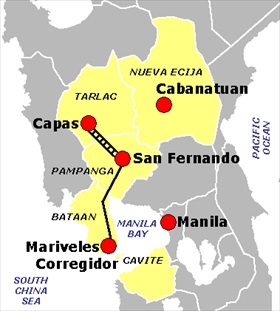
Right: Route taken during the aptly named Bataan Death March, April 9–15, 1942. (The march dragged on for several more days because of the thousands of prisoners involved.) From Mariveles on the tip of the Bataan Peninsula, it was at least 31 miles/50 kilometers by foot to the nearest railway depot in San Fernando. From San Fernando to Capas was 3 hours by rail cramped inside sunbaked boxcars without ventilation, and from there to Camp O’Donnell 9 miles/14‑1/2 kilometers further by foot or truck. A secondary POW camp was located near Cabanatuan City, where as many as 8,000 American and other Allied POWs and civilians were imprisoned. April 9 is a special holiday in the Philippines—“Araw ng Kagitingan,” or Day of Valor—which commemorates the fall of Bataan and Corregidor to Japanese troops.
 |
 |
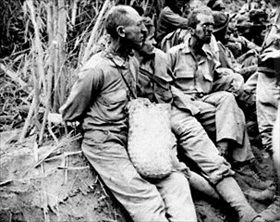
Left: U.S. soldiers, their hands tied behind their backs, rest on the Bataan Death March to their prison camp at Cabanatuan. Approximately 2,500–10,000 Filipino and between 100 to as high as 5,000 American POWs died from thirst, wounds, disease (chiefly dysentery due to open latrines everywhere and the millions of flies around them), as well as their captors’ savage mistreatment, including executing stragglers, before they reached Camp O’Donnell.
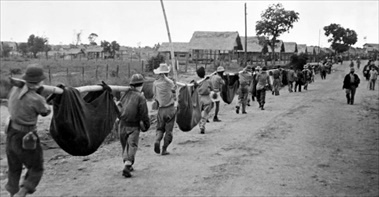
Right: American and Filipino POWs, using improvised litters, carry the bodies of their comrades who died shortly after their arrival at Camp O’Donnell. Survivors of the march continued to die at a rate of 30–50 per day, a total of 16,000 captives, including 1,600 Americans, over a 2‑month period. Rosedith Van Hoorebeck Hawkins, a U.S. Army nurse with the Thirty-Fifth General Hospital, described the survivors of the camp’s liberation in 1945 this way: “The boys who’d been in the Bataan Death March came to us, and I’m telling you they were a mess. . . . They couldn’t eat so we just gave them liquids and soft foods. . . . Almost all of them had lost a foot or arm or leg. They’d had no medical treatment and had healed very badly.” (Quoted in Diane Burke Fessler, No Time for Fear: Voices of American Military Nurses in World War II, p. 55.)
Forgotten History: Horrors of the Bataan Death March (Turn on CC, Closed Captions)

World War II was the single most devastating and horrific event in the history of the world, causing the death of some 70 million people, reshaping the political map of the twentieth century and ushering in a new era of world history. Every day The Daily Chronicles brings you a new story from the annals of World War II with a vision to preserve the memory of those who suffered in the greatest military conflict the world has ever seen.