

JAPANESE AMERICAN VIOLATED MILITARY ORDER
San Leandro, California · May 30, 1942
On this date in California in 1942, California-born Japanese American Fred Korematsu was arrested for refusing to comply with President Franklin D. Roosevelt’s Executive Order 9066, which authorized the Secretary of War and his military commanders to require all people of Japanese heritage be removed from designated “military areas” and placed in incarceration camps in the U.S. interior. When orders were issued on May 3, 1942, for Japanese Americans and Japanese nationals to report on May 9 to assembly centers as a prelude to their being sent to incarceration camps, Korematsu, a trained shipyard welder, became a fugitive. He underwent plastic surgery on his eyelids in the hope of passing as a Caucasian, changed his name to Clyde Sarah, and claimed to be of Hawaiian-Spanish heritage. He was arrested in San Leandro near Oakland, California, after being recognized as a “Jap.”
Korematsu’s conviction for disobeying a military order issued under the authority of Executive Order 9066 led to a test of the order’s legality before the U.S. Supreme Court in Korematsu v. United States. On December 18, 1944, in a 6-3 decision, the High Court ruled that “compulsory exclusion,” i.e., removal of people of Japanese heritage from the Pacific west coast and part of Arizona, though constitutionally suspect, was justified during circumstances of “emergency and peril.” Yet even after Japan’s surrender the exclusion order remained on the books.
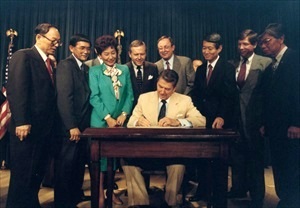
Decades later Korematsu’s conviction was overturned after new evidence revealed that challenged the need for the internment. On February 19, 1976, President Gerald Ford rescinded Executive Order 9066. “We now know what we should have known then,” he said, “that evacuation [was] wrong.” His successor Jimmy Carter signed legislation in 1980 to create a Congressional commission to conduct an in-depth study of Executive Order 9066, related wartime orders, and their impact on Japanese Americans, Japanese nationals, and native Alaskans. In December 1982 the commission issued its findings in Personal Justice Denied, concluding that the incarceration of West Coast Japanese Americans and their Japanese parents had not been justified by military necessity and recommended an official government apology and redress payments of $20,000 to each of the survivors. Congress passed and President Ronald Reagan signed the Civil Liberties Act of 1988 to ensure that the injustice inflicted on Japanese Americans and Japanese nationals during World War II would never happen to any group again.
Japanese and Japanese American Relocation and Incarceration
 |
 |
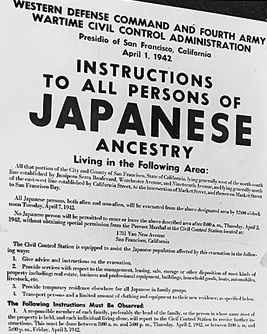
Left: Sign posted in San Francisco notifying people of Japanese ancestry to report for relocation. Approximately 125,000 Japanese and Japanese Americans (62 percent of whom were U.S. citizens) from the U.S. west coast were affected by Executive Order 9066. While roughly 10,000 were able to relocate to other parts of the country of their own choosing, the remainder—some 115,000 men, women, and children—were crammed into hastily constructed camps called “War Relocation Centers” in remote parts of the nation’s interior. About 6,000 babies were born in the internment camps.
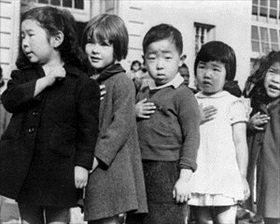
Right: San Francisco, California, first-graders, some of Japanese ancestry, pledge allegiance to the U.S. flag, April 1942. The evacuees of Japanese ancestry would soon be housed in War Relocation Authority (WRA) centers for the duration of the war.
 |
 |
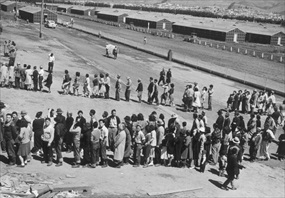
Left: This assembly center in San Bruno, California, just south of San Francisco, had only been open for two days when Dorothea Lang, on assignment with the WRA, snapped this photograph on April 29, 1942. Busload after busload of evacuated persons of Japanese ancestry were arriving that day, going through the necessary procedures for registration. Afterwards the families were guided to the newly built barracks in the background, to be bussed later to permanent relocation centers like Manzanar.
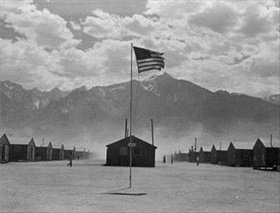
Right: Manzanar, located at the foot of the Sierra Nevada in California’s Owens Valley, was the first of ten permanent internment camps where over 125,000 Japanese Americans and Japanese nationals were incarcerated. Lange visited Manzanar in July 1942 and recorded the internees’ plight and deprivation in a remarkable collection of photographs. This one is of either a laundry or sanitary barracks sandwiched between horizontal rows of residential barracks looking west to the Sierras. On this day, July 3, a hot windstorm blanketed the camp with dust from the surrounding desert. At its peak Manzanar held 10,046 internees. In all, 11,070 people were “relocated” to Manzanar, 90 percent drawn from the Los Angeles area.
 |
 |
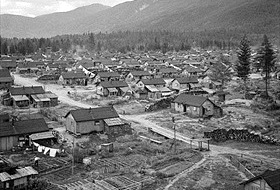
Left: Unnamed incarceration camp for Japanese Canadians in British Columbia, June 1945. Over 75 percent of those interned in Canada were Canadian citizens. The camps were euphemistically called “Self-Supporting Centers.” Some incarceration camps in British Columbia were in a mountainous area so physically isolated that fences and guards were not required because the only way in or out was by rail or water.
Right: In 1988 President Ronald Reagan signed legislation that apologized on behalf of the U.S. government for wartime Japanese American internment. The legislation stated that government actions at the time were based, not on “military necessity,” but on “race prejudice, war hysteria, and a failure of political leadership.” Starting in 1990 the U.S. government paid reparations to surviving internees.
Wartime American Propaganda Film Justifying the Incarceration of Japanese Americans and Japanese Nationals

World War II was the single most devastating and horrific event in the history of the world, causing the death of some 70 million people, reshaping the political map of the twentieth century and ushering in a new era of world history. Every day The Daily Chronicles brings you a new story from the annals of World War II with a vision to preserve the memory of those who suffered in the greatest military conflict the world has ever seen.