

JAPAN SHELVES WAR PLANS AGAINST SOVIETS
Tokyo, Japan • June 30, 1941
On September 19, 1931, soldiers of the Kwantung Army (eventually the largest, most prestigious branch of the Imperial Japanese Army) invaded Manchuria in Northeast China from their Chinese base at Port Arthur (known as Ryojun in Japanese; present-day Dalian or Lüshun Port) and established a puppet state they called Manchukuo. This event was a massive act of insubordination against the express orders of Japanese political and military leaders in Tokyo. Suddenly thrown into disarray, the same leaders were powerless to stop the eruption of locally based Japanese aggression in Northeastern China. Nonetheless, Tokyo dispatched reinforcements to Manchukuo from Japan and Japanese-held Korea and initiated large-scale “anti-bandit operations” to quell a growing resistance movement in the empire’s newest possession.
For the rest of the 1930s Japanese military and civilian officials were of two minds: expand their imperial holdings west and north from their Manchukuo base by attacking Inner Mongolia (1933–1936 skirmishes), the Soviet Union (Siberia), or the Soviets’ proxy state, Outer Mongolia (present-day Mongolia) (1938–1939, decisive Soviet victories). Either that or expand south by attacking equally tempting Western colonial holdings in British Malaya and Singapore, the Dutch East Indies (present-day Indonesia), and the American Philippines (see map below).
In July 1940 the Japanese government formally decided on a twin policy at least to the south of Manchukuo: first, win the existing war (since 1937) on China’s mainland by interdicting the lifelines that brought Western arms, munitions, and related materiel to their Chinese enemy; and, secondly, gain access to the desired raw materials from Malaya and the East Indies, if necessary by starting a new war in Southeast Asia. Toward the end of September 1940, Japan took the first step in implementing this plan and moved troops into the northern part of French Indochina (present-day Vietnam) by agreement with the German vassal state of Vichy France.
On this date, June 30, 1941, Japanese officials shelved any plans for expansion northward or westward from their Manchukuo base. Two days later, July 2, 1941, a Liaison Conference (Renraku Kaigi), consisting of Emperor Hirohito (presiding), the Japanese prime minister and senior cabinet officials, ministers of the Army and Navy, and Army and Navy chiefs of staff, formally confirmed the decision to expand southward. The decision of the Liaison Conference was formally disclosed and approved at the July 2, 1941, Imperial Conference (Gozen Kaigi) over which (again) the Emperor presided. This was the moment when war between Japan and the Western powers became inevitable.
That controversy still surrounds the prewar and wartime role of Japanese Emperor Hirohito should surprise no one. Hirohito took the auspicious reign-title “Showa” (“illustrious peace”) in 1926. One popular narrative portrays Hirohito as “reigning without ruling,” a sacred but ceremonial head of state under the Japanese 1889 constitution who was trapped in a precarious and ambiguous position and who was maneuvered (often against his personal sentiments and inclinations) by an elite set of Japanese militarists and ultranationalists to sanction decisions they’d already made. The most recent proponent of this narrative is Noriko Kawamura, whose revisionist history titled Emperor Hirohito and the Pacific War draws on a huge number of primary and secondary Japanese-language sources—many of them only recently available to scholars; her book is very persuasive indeed. An opposing narrative asserts that Hirohito was a true war leader—he was after all the Generalissimo (commander in chief) of the Imperial Japanese Armed Forces—and therefore should have been charged with war crimes in a postwar military tribunal just as were Japanese Prime Minister/War Minister Gen. Hideki Tōjō and other senior officials who served the emperor. Herbert P. Bix, in his Pulitzer Prize-winning book Hirohito and the Making of Modern Japan, consigns the first interpretation to the scrapheap. Bix asserts that Hirohito must bear the strongest share of political, legal, and moral responsibility for the criminal conduct of Japanese armed forces in the Asia Pacific Theater in the 1930s and ’40s, and he certainly bears direct responsibility for sanctioning the bombing of Chinese cities and Japan’s use of poison gas on Chinese soldiers and civilians. For many readers, Bix convincingly demonstrates that Hirohito was a repeat violator of international peace, starting in 1931 with Japan’s illegal seizure of Manchuria in Northeastern China, continuing for more than a dozen years for millions of victims swept up in an awful China-Southeast Asia tsunami, and ending only in August 1945 when Hirohito & Co. could find no way out of the catastrophe they had created. As seen by many in Bix’s camp, Hirohito was the missing defendant in the Tokyo Trials of 1946–1948.—Norm Haskett
Japanese and Western Holdings in the Asia Pacific Region, September 1939
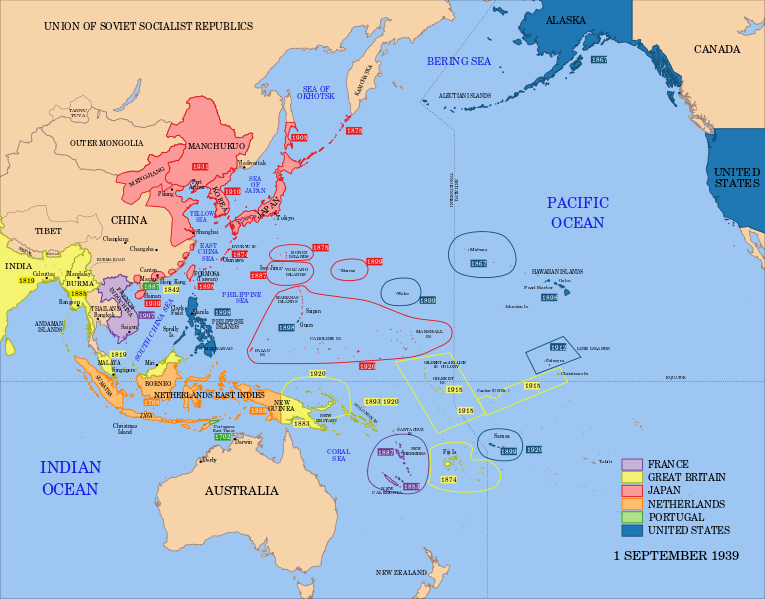
Above: A map of imperial possessions in the Asia Pacific region as of September 1939. The start of the Second Sino-Japanese War (1937–1945) was the inaugural event in World War II and arguably the deadliest, costliest global conflict ever. The total number of Chinese military and nonmilitary dead was upwards of 20 million, with maybe 15 million wounded. Additionally, Japanese “kill all, loot all, burn all” operations created 95 million Chinese refugees. Chinese forces claim to have killed at most 1.77 million Japanese soldiers during the 8‑year war. The Pacific islands encircled in red lines (the Northern Marianas, Carolines, Marshall Islands, and Palau groups) are former German possessions under Japanese administration following World War I. They would play a major role in facilitating Japanese victories over the Allies in the early years of the Pacific War.
“Manchukuo: The Newborn Empire,” Japanese Propaganda Film, Circa 1937

World War II was the single most devastating and horrific event in the history of the world, causing the death of some 70 million people, reshaping the political map of the twentieth century and ushering in a new era of world history. Every day The Daily Chronicles brings you a new story from the annals of World War II with a vision to preserve the memory of those who suffered in the greatest military conflict the world has ever seen.