

HUSH-HUSH FACE-TO-FACE FOR FDR, CHURCHILL
Quebec, Canada · August 18, 1943
On this date in 1943 in Quebec, Canada, President Franklin D. Roosevelt, British Prime Minister Winston Churchill, and Canadian Prime Minister Mackenzie King, along with their Combined Chiefs of Staff, set to work planning Operation Overlord, the 1944 invasion of German-occupied France. At this first of two Quebec conferences, codenamed “Quadrant” (August 17–24, 1943), the leaders discussed the continued buildup of U.S. forces in Britain prior to kicking off Operation Overlord, as well as steps to be taken in the bombing offensive against Germany that would hasten the collapse of the enemy’s economy, its armed forces, and civilian morale. In view of the Allied invasion of Sicily (Operation Husky, begun July 10, 1943) and the current invasion of mainland Italy (August 11–17), the leaders resolved to focus even more resources on extracting Italy from the Axis alliance. (An Italian armistice was soon signed on September 3.) A representative from China also attended the talks.
One measure the conferees settled on was to escalate Allied military operations in the Far East, which appeared to have been short-changed. This resulted in the reorganization of the Allied South-East Asia Command. SEAC’s new directive was to intensify operations against Japan in an effort to exhaust enemy resources by cutting communications lines between Japan and its overseas conquests, as well as to secure forward bases in China and the Pacific from which the Home Islands could be attacked by long-range heavy bombers.
Another measure agreed on by Roosevelt and Churchill resulted in the secret Quebec Agreement, signed on August 19, 1943. The agreement mandated joint cooperation in developing the atomic bomb and mutual consent before either party used nuclear weapons. Almost two years later at the victors’ Potsdam Conference (July 17 to August 2, 1945), held on the outskirts of Adolf Hitler’s former Reich capital, Roosevelt and Churchill agreed to use the atomic bomb, successfully tested on July 16, 1945, in the New Mexico desert, on the last Axis hold-out, Japan. Two atomic bombs obliterated Japanese cities, Hiroshima on August 6 and Nagasaki on August 9. Between the two cities, 180,000 people died in an instant. On August 14, 1945, Japanese Emperor Hirohito (posthumously referred to as Emperor Shōwa) surrendered his country (the surrender was made public the next day in a nationwide broadcast), though it was not until September that Japanese forces in Southeast Asia finally conceded defeat.
[fblike]
[amazon_carousel widget_type=”ASINList” width=”600″ height=”200″ title=”Recommended Reading” market_place=”US” shuffle_products=”False” show_border=”False” asin=”0743259920,0307388719,0807855073,1137270314,0812974972,1566634849,052173536X,1591144558,0812972821,0061228583″ /]
Quadrant Conference, Quebec, August 1943: Important Implications for Europe and Japan
 |
 |
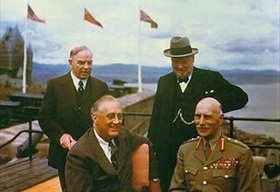
Left: On the terrace of the Citadel in Quebec, Canada, during the Quadrant Conference (or First Quebec Conference, August 17–24, 1943) are Prime Minister of Canada Mackenzie King, British Prime Minister Winston Churchill (standing), President Franklin D. Roosevelt, and the Earl of Athlone, Alexander Cambridge, Governor General of Canada. The Citadel is the official residence of the Governor General of Canada.
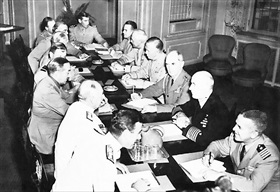
Right: In a decision taken at the Quadrant Conference, the Allies created the combined South-East Asia Command (SEAC), which assumed overall strategic command of all air, sea, and land operations of all Allied forces in the Asia Pacific region. With the agreement of the Combined Chiefs of Staff for the Western Allies (formed in February 1942), shown seated around the table in this photo taken on August 23, 1943, Vice Admiral Lord Louis Mountbatten (foreground, leaning forward) was appointed Supreme Allied Commander South East Asia, a post he held until 1946. U.S. Gen. Joseph Stilwell was First Deputy Supreme Allied Commander and headed the U.S. China Burma India Theater (CBI) command. Command arrangements in SEAC were always complicated (Stilwell was recalled in October 1944), and Mountbatten had nothing like Gen. Dwight D. Eisenhower had in the form of SHAEF (Supreme Headquarters Allied Expeditionary Force) in Europe.
August 1943 Quadrant Conference: Allied Leaders Discuss Military and Diplomatic Moves Against Axis Powers

World War II was the single most devastating and horrific event in the history of the world, causing the death of some 70 million people, reshaping the political map of the twentieth century and ushering in a new era of world history. Every day The Daily Chronicles brings you a new story from the annals of World War II with a vision to preserve the memory of those who suffered in the greatest military conflict the world has ever seen.