

HUGE B-29 RAID DESTROYS JAPANESE CAPITAL
Tokyo, Japan · March 9, 1945
Apart from Lt. Col. Jimmy Doolittle’s April 1942 raid on the Japanese capital, Tokyo, early air raids on Japan focused on military and industrial targets with disappointing results. So U.S. Army Air Forces Maj. Gen. Curtis LeMay, a veteran of the horrific air campaign over Nazi Germany, filled each of his new four-engine Boeing B‑29 Superfortresses with ten times the payload carried by Doolittle’s twin-engine B‑25 Mitchells. With highly effective incendiary bombs in their bomb bays, 297 B‑29s of the Twentieth Air Force, flying at the relatively low altitude of 7,000 ft, firebombed Tokyo late on this date and into the early morning hours of 1945 in an operation called “Meetinghouse,” which was a code term for the urban area of the Japanese capital. The Dante-esque raids on a densely populated area of 16 sq. miles proved the single-most destructive bombing raid in history: 267,000 buildings and homes (many built of wood and paper) were destroyed and an estimated 100,000 Tokyo residents were killed—the highest loss of life of any aerial bombardment of the war, including victims of Hamburg (42,600), Berlin (20,000–50,000), Dresden (25,000), Hiroshima (70,000–80,000), and Nagasaki (40,000–75,000). Nagoya, Japan’s aircraft manufacturing center, suffered the night after the Tokyo raid and again a week later. In between it was Osaka’s and Kobe’s turn. After “Blitz Week” (a total of 1,434 sorties on the main Japanese island of Honshū), Tokyo was again razed on May 23 and 25, leaving three million urbanites now homeless, followed on May 29 by Yokohama’s business district and waterfront (one-third of the city). In May alone one-seventh of Japan’s built-up urban area—a staggering 94 sq. miles—had been devastated, raising total urban destruction to over one-third. LeMay described his policy as “Bomb and burn ’em until they quit.” Along with ineffective Japanese intercept aircraft, LeMay’s B‑29 campaign dramatically limited Japan’s options to avoid certain annihilation. Because of the terrifying attacks on Tokyo (over 50 percent of the city’s urban area had been reduced to ashes), the Japanese capital was spared further fire raids because it was no longer a viable target. One B‑29 flier quipped, “Tokyo just isn’t what it used to be.”
[fblike]
[amazon_carousel widget_type=”ASINList” width=”600″ height=”200″ title=”Recommended Reading” market_place=”US” shuffle_products=”False” show_border=”False” asin=”0141001461,0802715656,0760341222,1594160392,1475997132,1416584412,0975951505,0230613969,0811733335,0312010729″ /]
Bombing of Tokyo, 1944–1945
 |
 |
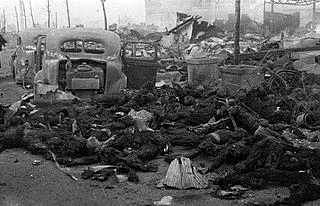
Left: The charred remains of civilians after the carnage and destruction wrought by 1,665 tons of bombs falling on Tokyo the night of March 9–10, 1945. The majority of the bombs were 500‑pound cluster bombs packed with napalm-carrying incendiary bomblets. Emperor Hirohito’s tour of the destroyed areas of his capital that March is said to have been the beginning of his personal involvement in the peace-making process.
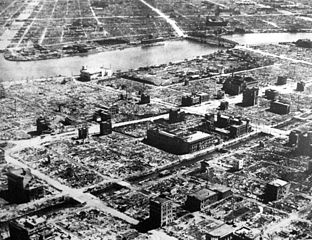
Right: A virtually destroyed Tokyo residential section. An estimated 1.5 million people lived in the city wards devastated by Operation Meetinghouse. By the end of World War II over 50 percent of Tokyo had been reduced to ashes. In fact, an estimated 40 percent of Japan’s built-up cities were destroyed in U.S. air attacks in 1944–1945.
 |
 |
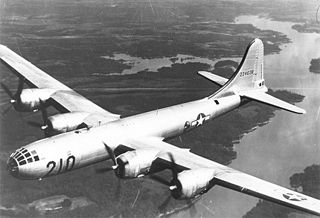
Left: Boeing built 3,970 of these four-engine, propeller-driven bombers between 1943 and 1946. Though designed as a high-altitude daytime bomber, in practice B‑29s actually flew more low-altitude nighttime incendiary bombing missions. B‑29s carried out the atomic bombings that destroyed Hiroshima and Nagasaki on August 6 and 9, 1945, respectively. On August 14, 1945, the last day of combat in World War II, B‑29s targeted the Japanese naval arsenal at Hikari on the southern tip of Japan’s main island, Honshū.
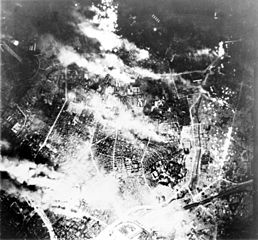
Right: Tokyo burns under a B‑29 firebomb assault, May 26, 1945. B‑29 raids on Tokyo began on November 17, 1944, and lasted until August 15, 1945, the day Japan capitulated. Twin-engine bombers and fighter-bombers carried out additional attacks on Tokyo.
March 1945 “Blitz Week” Targets: Tokyo, Nagoya, Osaka, and Kobe (Four Consecutive Videos)

World War II was the single most devastating and horrific event in the history of the world, causing the death of some 70 million people, reshaping the political map of the twentieth century and ushering in a new era of world history. Every day The Daily Chronicles brings you a new story from the annals of World War II with a vision to preserve the memory of those who suffered in the greatest military conflict the world has ever seen.