

HITLER, WIFE CREMATED AFTER SUICIDES
Berlin, Germany · April 30, 1945
On this date in 1945 Adolf Hitler, to all the world the face of unspeakable evil, shot himself in the right temple after he and Eva Braun had poisoned themselves by ingesting cyanide. The Fuehrer’s psychotic desire for an apocalyptic end for Germany—a Wagnerian Götterdämmerung—was nearly completed by his death, leaving Berlin’s formal surrender in the hands of its garrison commander, Gen. Helmuth Weidling, two days later. From the recessed Fuehrerbunker, Hitler’s pall bearers carried the bodies of their troglodyte leader and his wife of 40 hours (and near-secret mistress for 14 years) into the once-beautiful, now desolated gardens of the ruined Old Reich Chancellery. The pall bearers (and former wedding attendants) were Erich Kempka, Hitler’s chauffeur since 1932; Heinz Linge, Hitler’s valet; Martin Bormann, ruthless head of the Reich Chancellery; Joseph Goebbels, fanatic apostle, Hitler diarist, and bombastic Minister of Propaganda; and Dr. Ludwig Stumpfegger, Heinrich Himmler’s former personal physician and the provider of the poison capsules. The two corpses were laid next to each other in the sand on level ground. Shortly before 3:00 p.m., five barrels of gasoline were poured over their remains and set on fire. In Hitler’s last will and testament, he wrote that he and his wife chose death rather than witness the overthrow and capitulation of his nation. Less than a mile from the funeral pyre, Private Mikhail Minin risked bullets and bombs to plant the Soviet flag atop the shambles of the Reichstag, a symbolic present to Joseph Stalin in time for Moscow’s May Day parade. Soldiers had sewn the banner together out of tablecloths the night before. The emblematic moment was re-enacted two days later for the camera. As news of Hitler’s death spread throughout the capital (in part facilitated by loudspeaker trucks and airdropped leaflets), most citizens rejoiced, but it was by no means a universal feeling. In neutral Portugal, the government ordered two days of mourning. In Dublin, Ireland’s capital, the Irish prime minister called at the German legation to express his condolences. And in Tokyo, capital of Germany’s still undefeated ally Japan, the German embassy held a memorial service for the fallen Fuehrer. It is believed to be the only memorial service anywhere held for Hitler.
[fblike]
[amazon_carousel widget_type=”ASINList” width=”600″ height=”200″ title=”Recommended Reading” market_place=”US” shuffle_products=”False” show_border=”False” asin=”0312423926,1848326300,0312378653,1602399727,0393322521,1605980080,1602398046,1611453232,1844153614,1904449131″ /]
The Fuehrerbunker and Hitler’s and Braun’s Initial Gravesite
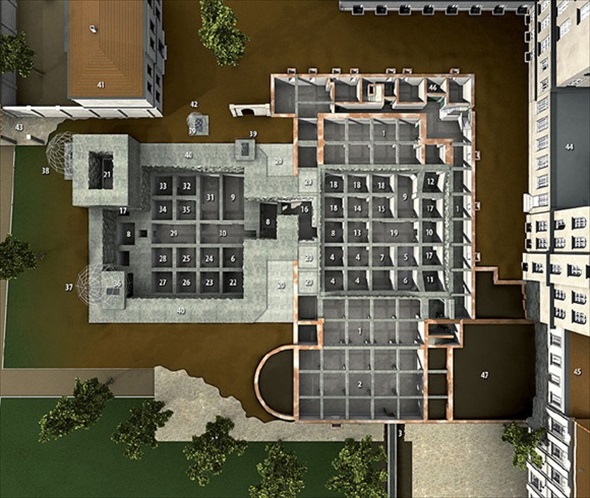 |
Above: 3-D representation of the Vorbunker and the Fuehrerbunker. The Vorbunker (“forward bunker”) was located behind the large reception hall, or marble gallery, that was added onto the Old Reich Chancellery in 1939. It was meant to be a temporary air raid shelter for Hitler, his guards, and servants. The bunker was officially called the “Reich Chancellery Air Raid Shelter” until 1943, when construction began that expanded the complex with the addition of the Fuehrerbunker located one level below.
 |
 |
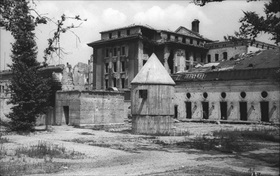
Left: Taken in July 1947, this photo shows the massive first emergency exit of the main bunker (erster Notausgang des Hauptbunkers), or the rear entrance to the Fuehrerbunker (number 21 in 3‑D representation, above). Hitler and Eva Braun were cremated in a shell hole in front of the emergency exit. The cone-shaped structure in the center of the photo served as the exhaust tower and bomb shelter for the guards. An unfinished tower (number 38 in 3‑D representation), a ventilation tower, is partially hidden behind the tree.
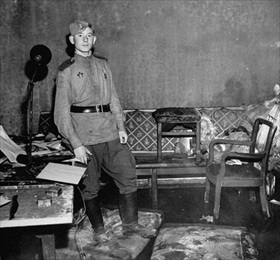
Right: A young Soviet soldier stands amid the scattered remains of Hitler’s sitting room (number 26 in 3‑D representation, above), the place of his and his wife’s suicides. On December 5, 1947, Soviet engineers blew up the Fuehrerbunker. Both ventilation towers and the entrance structure seen in the picture on the left were destroyed in the blast.
Death in the Bunker: The Last Days of Adolf Hitler

World War II was the single most devastating and horrific event in the history of the world, causing the death of some 70 million people, reshaping the political map of the twentieth century and ushering in a new era of world history. Every day The Daily Chronicles brings you a new story from the annals of World War II with a vision to preserve the memory of those who suffered in the greatest military conflict the world has ever seen.