

HITLER TO GENERALS: “DEVIL’S WORK” AHEAD
Obersalzberg, Bavaria, Germany · August 22, 1939
Adolf Hitler’s foreign minister Joachim von Ribbentrop was just about to affix his signature to the German-Soviet non-aggression pact (the Molotov-Ribbentrop Pact), when, on this date in 1939, the Fuehrer summoned the commanders of his various armed forces and other officers to the Berghof, his Bavarian retreat on the Obersalzberg. There he told his audience that in the coming war—less than 10 days away—they would see things not to their liking. The war would be “hard and ruthless,” he prophesized. “I have sent to the East . . . my ‘Death’s Head Units’ [SS-Totenkopfverbände, special SS Einsatzgruppen death squads] with the order to kill without pity or mercy all men, women, and children of the Polish race and language.” Two battalions of Death’s Head Units were clandestinely in place in the semi-autonomous city-state of Danzig (today Gdańsk) before September 1. Hitler wasn’t worried about world reaction: “Who still talks nowadays of the extermination of the Armenians?” Previously he’d stated that “Salvation Army methods” didn’t win wars, and on other occasions he spoke about the brutality that lay ahead of Germany as necessary “devil’s work.” Hitler had planned for devil’s work all along. But the German “house-cleaning” of Polish Jews, intelligentsia, businessmen, clergy, and the nobility by SS Einsatzgruppen, chiefly using machine guns, sickened many German generals as well as others in the Wehrmacht. As house-cleaning was extended eastwards to the Soviet Union in June 1941, when Hitler violated the German-Soviet non-aggression pact by launching Operation Barbarossa, Reichsfuehrer-SS Heinrich Himmler put into place a plan designed to buffer the killers from their victims. These were the infamous death camps that would eventually number over forty. Eight camps were reserved for mass murder and six were built in occupied Poland, “hidden” from the German populace (see map). During the reign of Nazi terror in Europe, six million Jews died—about forty percent of the world’s Jewish population—and probably five million more people deemed “undesirable” by the Nazis: “incorrigible law offenders,” political and ideological enemies, the physically and mentally disabled, homosexuals, Jehovah’s Witnesses, and Roma (Gypsies), among others in a long list.
[fblike]
[amazon_carousel widget_type=”ASINList” width=”600″ height=”200″ title=”Recommended Reading” market_place=”US” shuffle_products=”False” show_border=”False” asin=”078583012X,0375708227,0374529922,0415426510,1602391785,0674061578,0691006857,0141390123,1568521332,3833476109″ /]
“Death’s Head Units” and the Death Factories They Staffed: Focus on Mauthausen, Austria
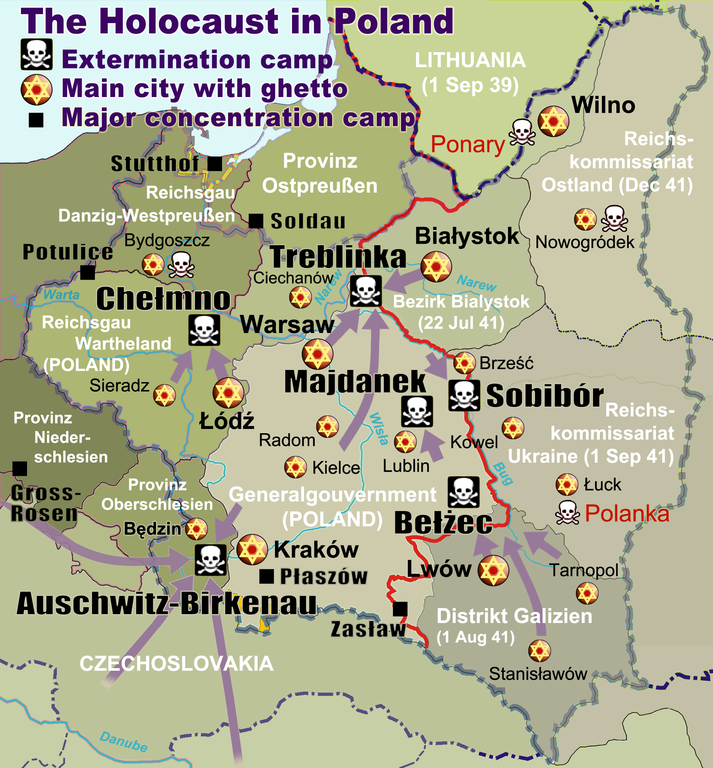 |
Above: This map shows all extermination camps (Vernichtungslager), most major concentration camps, labor camps, prison camps, ghettos, and major deportation routes in Nazi-occupied Eastern Europe. The SS-Totenkopfverbände, rendered in English as “Death’s Head Units,” staffed the camps. They helped facilitate the Final Solution, or Holocaust, in collaboration with the Reich Main Security Office (RSHA), an office within the Ministry of the Interior under Reichsfuehrer-SS Heinrich Himmler.
 |
 |
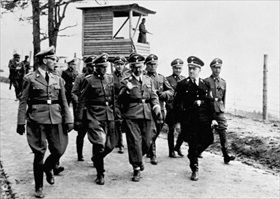
Left: Heinrich Himmler visiting Mauthausen concentration camp, April 1941. The site for the camp was near the Austrian city of Linz, where Hitler had spent most of his youth, and was personally chosen by Himmler. Mauthausen was opened on August 8, 1938, a few months after the Anschluss (union) of Austria and Germany on March 12, 1938. Eventually Mauthausen and the nearby Gusen camp together operated more than 101 camps, including 49 major subcamps (Außenlager), in Austria and southern Germany.
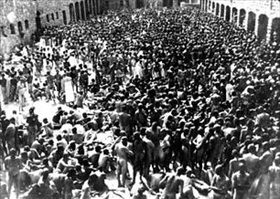
Right: New prisoners await disinfection in Mauthausen’s garage yard, undated photo. Mauthausen-Gusen rented inmates out to various local businesses as slave laborers, particularly as more and more Austrians were drafted into the Wehrmacht. Altogether, 45 German and Austrian companies of varying sizes took part in making Mauthausen-Gusen one of the most profitable concentration camp complexes in the Third Reich. Roughly 85,000 inmates were rented out to granite quarries, munitions factories, mines, arms and vehicle factories, and an underground Messerschmitt Me 262 fighter plane assembly plant, among others.
 |
 |
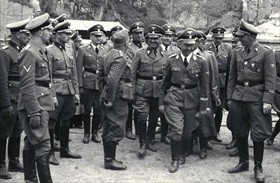
Left: Himmler (right of center) visited Mauthausen-Gusen in 1942 and is shown in this photo visiting the granite quarry. The granite mined in the quarry had previously been used to pave the streets of Vienna, but the Nazi authorities envisioned a complete reconstruction of major German towns in accordance with plans of Albert Speer and other architects of Nazi architecture, for which large quantities of granite were needed.
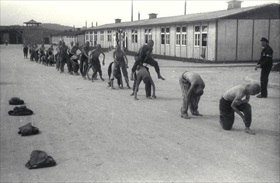
Right: Arbitrary terror, routine violence, and grueling physical exercise were some of the methods of wearing down camp inmates. Here a group of young prisoners is forced to play leapfrog in Mauthausen’s roll-call yard.
 |
 |
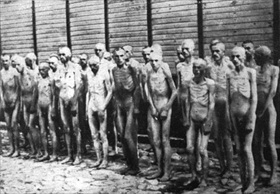
Left: “Death’s Head Units” provided guards for concentration and death camps. They were known for their brutal and inhumane tactics, a result of their doctrine of “no pity.” Even when camps were not dedicated death camps, they took a heavy toll on inmate lives (extermination through labor). The Nazi camp system expanded greatly after the invasion of the Soviet Union in 1941, when large numbers of Soviet soldiers were captured. This undated photo shows skeletonized Soviet POWs (most probably Soviet officers) standing before a barracks in Mauthausen. Most Soviet POWs were kept in huts separated from the rest of the camp and were a major part of the first groups to be exterminated in the newly built Mauthausen gas chamber in early 1942.
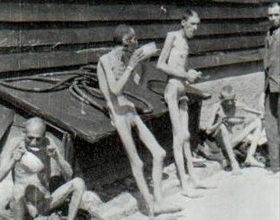
Right: Emaciated survivors of the Mauthausen-Gusen concentration camp shortly after their liberation, June 1945. The estimated total death toll in the four main camps of Mauthausen-Gusen ranges from 55,000 to 60,000. Inmate deaths in the subcamps may have reached 240,000.
Contemporary Scenes of Mauthausen Concentration Camp Shortly After Liberation. WARNING: Graphic content. Viewer discretion advised

World War II was the single most devastating and horrific event in the history of the world, causing the death of some 70 million people, reshaping the political map of the twentieth century and ushering in a new era of world history. Every day The Daily Chronicles brings you a new story from the annals of World War II with a vision to preserve the memory of those who suffered in the greatest military conflict the world has ever seen.