

HITLER ORDERS CONQUEST OF NEUTRAL DENMARK, NORWAY
Berlin, Germany • April 9, 1940
On this date in 1940 German land, sea, air, and specialized forces advanced overland into Denmark and attacked various points along Norway’s coast from the air and sea. Earlier in the year, on January 27, the German High Command (Oberkommando der Wehrmacht, OKW) had established a task force to orchestrate the invasion of neutral Denmark and Norway after Adolf Hitler’s decision to push Germany’s offensive against France and the Benelux countries into late spring. Shortly after the OKW got down to business, 2 British Army divisions began formulating their own plans for operations in Norway.
Both Scandinavian countries had deficiencies in men, organization, training, and modern equipment that prevented a credible defense of their homelands. Tiny Denmark, a country of 3.8 million people and no natural barriers to stymie German invaders, fell within hours. The very real threat of the Luftwaffe mercilessly bombing the Danish capital, Copenhagen, as German aircraft had bombed Warsaw, Poland, the previous September caused government leaders to capitulate. A circular in Copenhagen that day announced that Denmark was now under German “protection” against “British attack.” The German ambassador to Copenhagen swore a solemn oath that Germany did not wish to interfere in Denmark’s internal affairs and would respect her integrity and independence after the war. The Danish government would continue in office and King Christian X would remain on his throne. The German military commander would take no part in the administration of the country and the German garrison of around 200 men would be deliberately kept low-key. Luckily for the Danish Navy, two-thirds of its naval force (240 ships and 6,500 men) were outside territorial waters on the day of the invasion, allowing the majority of Danish ships to escape to Allied harbors and begin sailing under Allied flags.
As for Norway, with a population of 3 million, that country took no precautions to meet a potential German threat, being fixated instead on a series of British violations of its territorial waters in March and early April. The Western Allies (British, French, Polish, and Norwegian), despite plenty of warnings of troop buildup and embarkations along Germany’s North Sea and Baltic coasts, followed by sightings of sizable German naval units steaming north at high speed, could conceivably have prevented the loss of Norway to the Nazi blitzkrieg had they fully or partially mobilized between April 5 and 9, mined harbors, fully manned coastal defenses, provided adequate infantry protection for Norwegian airfields, and abandoned the notion that the Kriegsmarine was cowed by the Royal Navy. Instead, the Norwegian government appeared paralyzed, its 13,000‑strong army and 5,200 naval personnel unable to mount a truly effective defense against less than 20,000 of the enemy.
The Germans would have preferred a solution like that of Denmark applied to Norway were it not for the conduct of Norwegian traitor Vidkun Quisling. As King Haakon VII and his government abandoned the capital, Oslo, for points north, Quisling, head of the Nasjonal Samling political party took to the airways. Quisling claimed that the king’s government had lost the right to rule and that he and his party were filling the void, briefly as it happened, with the blessings of the invaders. Haakon refused to negotiate with the Germans so long as they insisted the treacherous Quisling be named prime minister.
In mid-April a poorly led, reactive Anglo-French-Polish expeditionary force landed in Norway to stiffen Norwegian defenses and evict the Germans. The fight went badly and the force began to withdraw at month’s end. The king, his family, and ministers went into exile late on June 7, 3 days before Norway capitulated. Brave Norwegians had resisted Nazi aggression for 2 months but the outcome was never in serious doubt. The nation’s 126 years of continuous peace was replaced by 5 years of enemy occupation assisted by 40,000 Norwegian collaborators, or “Quislings.”
Operation Weseruebung, Germany’s Conquest of Denmark and Norway, April 1940
 |
 |
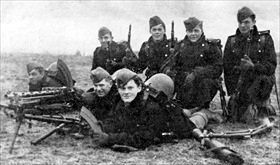
Left: Danish troops on the morning of the German invasion, codenamed Operation Weseruebung, April 9, 1940. Hours later 2 of the squad’s 7 men had fallen to German bullets. They were 2 out of between 16 and 100 Danish soldiers who died in the invasion (the figures are hotly contested). German troop losses were minimal in Denmark (203 killed or wounded) and Norway (5,296 killed or wounded). Not so for the Kriegsmarine. The Royal Navy succeeded in crippling the German Navy as a fighting force, sinking 13 destroyers. (Nearly half of German losses in Norway were at sea.) From May 1940 onward, the Kriegsmarine was reduced to a fleet of submarines, which enjoyed mounting successes up to mid‑1943, plus a handful of heavy warships that were used as commerce raiders.
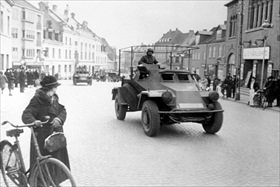
Right: Three-man, 4-wheel-drive German armored radio car, with its overhead circular system of aerials, moving north through Viborg, Central Jutland (Denmark), April 12, 1940. The radio car was part of a motorized reconnaissance battalion under the orders of a division commander. The reconnaissance battalion generally consisted of 2 armored car companies, each with 6 heavy armored cars and 18 light armored cars. Rounding out the battalion was a motorcycle rifle company, a antitank platoon, and an engineering (“pioneer”) platoon, all 3 of them sharing machine guns, light mortars, and 2 75 mm howitzers.
 |
 |
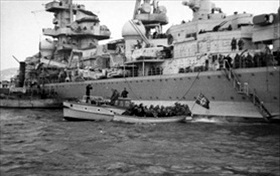
Left: Hitler resolved to invade Norway after the British Navy violated Norwegian neutrality in mid‑February 1940 to rescue captive British sailors on the German prison ship Altmark, a 12,000-ton tanker. This touched off a diplomatic crisis between Britain and Norway. (For fear of provoking Germany, Norwegian authorities had turned a blind eye to the Altmark’s having violated Norwegian neutrality in the first place.) The British rescue operation resulted in 7 German sailors killed and 11 wounded. This photo shows German heavy cruiser Admiral Hipper landing troops at Trondheim in Central Norway in April 1940. The assault on Denmark and Norway represented the first joint land-air-and-sea campaign in the history of warfare. For its part, the Luftwaffe used 500 transport Junkers Ju‑52 aircraft to insert paratroopers and airborne troops at crucial ports and airports as well as supply isolated forces at Trondheim and Narvik in Northern Norway. Operation Weseruebung turned out to be the Wehrmacht’s only campaign that was planned, launched, and completed by the 3 services.
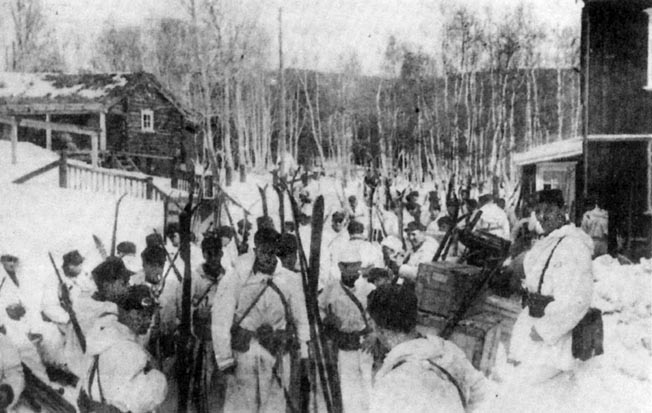
Right: Company 6, 11th Norwegian Infantry Regiment shoulders its skis and prepares to advance toward invading German airborne troops near Dombås, a village in Central Norway at the intersection of roads, rail, and river.
 |
 |
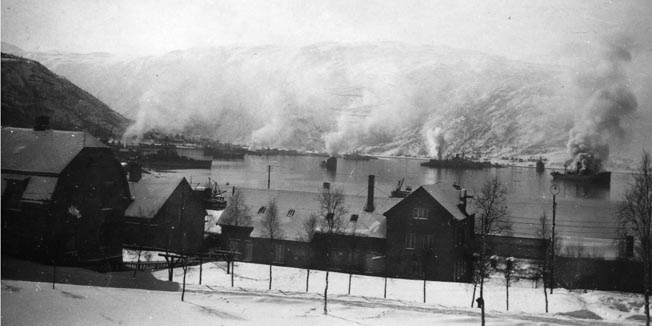
Left: German merchant ships, filled with supplies for their invading forces, burn in Ofotfjord near Narvik, Northern Norway, after the effort by the British Royal Navy and warplanes to clear the fjord of German vessels, April 1940.
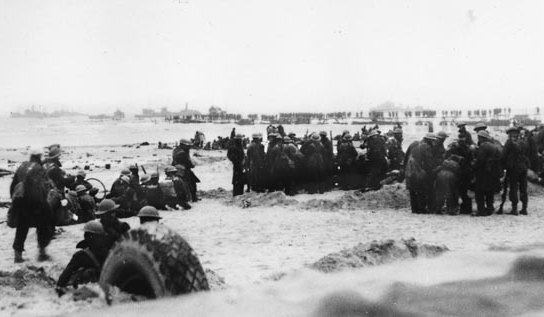
Right: Reminiscent of a scene from the Dunkirk evacuation on the English Channel coast in Northwestern France (May 26 to June 4, 1940), British troops take up defensive positions on a Norwegian beach most likely during Operation Alphabet (June 4–8, 1940). Previously, on May 25, Allied commanders received the order to evacuate their men from Norway. The French and British contingents of the Allied expeditionary force were sorely needed on the European continent after Hitler had declared war on France and the Benelux countries on May 10, 1940.
Newsreel of the German Occupation of Denmark (English subtitles)

World War II was the single most devastating and horrific event in the history of the world, causing the death of some 70 million people, reshaping the political map of the twentieth century and ushering in a new era of world history. Every day The Daily Chronicles brings you a new story from the annals of World War II with a vision to preserve the memory of those who suffered in the greatest military conflict the world has ever seen.