

HITLER, MUSSOLINI DISCUSS AUSTRIA’S FUTURE
Munich, Germany · September 25, 1937
On this date in 1937 Italian strongman Benito Mussolini paid his first visit to Germany, meeting Adolf Hitler in the Fuehrer’s private residence in Munich. During the visit Mussolini made Hitler an honorary corporal of the Italian Fascist militia, while Hitler conferred the Iron Cross of Greater Germany on Mussolini. The meeting of the two former World War I corporals included a secret understanding regarding Austria, the tiny country that lay between them. Hitler made his guest aware that Italy’s acceptance of his scheme to gobble up Austria (the so-called Anschluss, or union) was a precondition of their two nations’ friendship. For his part, the Duce was ready to accept Anschluss as long as Hitler informed him in advance. (Hitler kept his word, informing Mussolini of Germany’s upcoming annexation of Austria in a letter dated March 10, 1938, just two days before Nazi troops surged over the border.) Mussolini had recently grown tired of being Europe’s guardian of Austrian independence. Four years earlier Mussolini had taken the murder of his friend and Austrian chancellor Engelbert Dollfuss by Austrian Nazis as a personal affront. He told the Austrian vice-chancellor, who had come to arrange a meeting between the Duce and Dollfuss’s successor, Kurt Schuschnigg, that he knew “the Reich chancellor [Hitler] had ordered the murder of Dollfuss.” He despised Hitler: “A dangerous madman, a revolting individual, a sexual degenerate.” Mussolini predicted that Hitler “will create an army, will rearm the German people, and go to war, perhaps in two to three years. I can’t hold him off by myself.” Mussolini floated the idea of a multinational treaty that would guarantee Austrian independence, but it was rejected by Schuschnigg when the two men met in August 1934. One alternative—Italian troops on Austrian soil—made Schuschnigg nervous: “Politically unacceptable,” he told an irked Mussolini. Schuschnigg failed to foresee the steps Hitler would take to bring Austria into the Nazi firmament, including arresting and interning him in Sachsenhausen, then Dachau concentration camps after Mussolini abandoned Austria to the Nazi predator. When columns of goose-stepping jackboots, cannon, and armored vehicles entered Austria’s capital, Vienna, in March 1938, an aggressive pan-Germany was born.
[fblike]
[amazon_carousel widget_type=”ASINList” width=”600″ height=”200″ title=”Recommended Reading” market_place=”US” shuffle_products=”False” show_border=”False” asin=”0333748158,0195146794,0340981733,1929631421,1586177095,0807853631,0205846785,0393337618,1469192438,0195125371″ /]
Austria, March 1938: The Return of Provincial Son Adolf Hitler
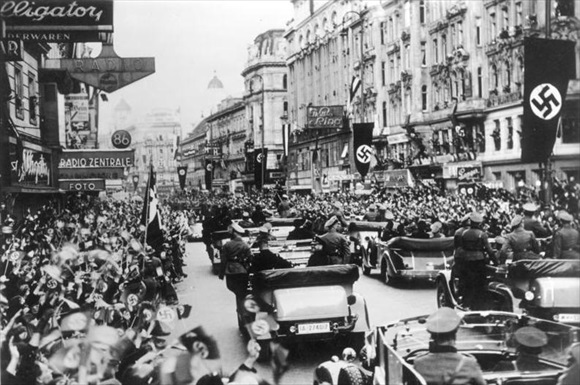 |
Above: Tens of thousands of Austrians lined Vienna’s streets hours before Hitler’s motorcade entered the capital on Monday, March 14, 1938. Hitler had followed his army’s entrance from Bavaria into Austria on Saturday, March 12, visiting his birthplace, Braunau, before arriving that evening in Linz, the country’s third-largest city, to an enthusiastic welcome. Hitler’s travels eastward were turned into a triumphal tour that climaxed with his speech in Austria’s capital on Tuesday, March 15, 1938. “Not as tyrants have we come, but as liberators,” he told his audience.
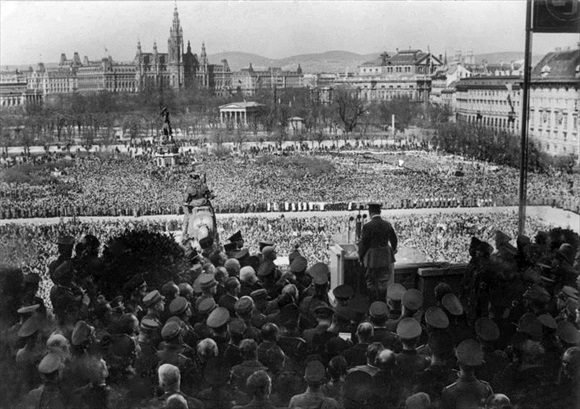 |
Above: A crowd estimated at 200,000 gathered in Vienna’s Heldenplatz (Heroes Square) to hear Hitler say: “The oldest eastern province of the German people shall be, from this point on, the newest bastion of the German Reich.” The Anschluss was given immediate effect by a legislative act, subject to voters’ ratification. A plebiscite was held on April 10 and approved by 99.7 percent of the voters, but not before 70,000 people had been arrested, and not before a huge propaganda campaign had had its effect, and not before some 400,000 people (nearly 10 percent of the eligible voting population) had been disenfranchised. Those unable to vote were chiefly former members of left-wing parties and Jews (200,000 in Vienna alone). Austria became the German province of Ostmark, its capital eventually turned into a drab provincial town.
Big Fish Swallows Little Fish: Austria Becomes Part of German Reich

World War II was the single most devastating and horrific event in the history of the world, causing the death of some 70 million people, reshaping the political map of the twentieth century and ushering in a new era of world history. Every day The Daily Chronicles brings you a new story from the annals of World War II with a vision to preserve the memory of those who suffered in the greatest military conflict the world has ever seen.