

HITLER, MUSSOLINI CONFER AFTER STALINGRAD
Salzburg, Austria · April 8, 1943
On this date in 1943 in Salzburg, Austria, Adolf Hitler and Benito Mussolini met for the first time since the collapse of the Axis defense of Stalingrad at the end of January. Ignoring Mussolini’s trial balloon about negotiating a ceasefire with the Soviet leader, Joseph Stalin, Hitler remained convinced that the European war would be won or lost in Russia. For his part, Mussolini had already accepted the inevitable loss of his Libyan colony to the Allies, although Hitler put a brave face on events in North Africa since the start of the Anglo-American offensive in November 1942 (Operation Torch): “Duce, I can assure you that Africa will be defended. The situation there is serious but not desperate.” Mussolini could not but cringe in anxious anticipation of Allied landings in Sicily from their new North African springboard, an event which his entourage in Salzburg believed would be soon. Mussolini requested Hitler’s help in creating a new southern army with modern equipment and a shield to sufficiently protect it against air attacks that would ensure the failure of any Allied landings in Italy. Hitler, however, had much to gain by keeping the Allies bogged down on the Italian front and offered Italy only moral support. After his two-hour meeting with Hitler, Mussolini met with the Reichsfuehrer of the SS, Heinrich Himmler. He wanted the advice of the much-feared head of German police forces on how to suppress likely internal unrest due to the lengthening nature of the war. (Italy had already been plagued with worker strikes in the country’s north.) Himmler tore a prescription out of his own black book in Germany—throw the troublemakers into concentration camps. Himmler had a low opinion of the Duce, believing that Germany could not count on Mussolini or his regime anymore. In fact, he predicted that within a few months at most Italy would drop out of the war. Himmler confided to a colleague that, if the condition of the Duce today (Mussolini took sick the next day) was a reflection of the condition of the Italian people and his Fascist regime, then the end was near. It was an eerie prophecy, for on July 25, 1943, the Grand Council of Fascism in Rome deposed the Duce from his leadership position, and Italian king Victor Emmanuel III placed him under arrest.
[fblike]
[amazon_carousel widget_type=”ASINList” width=”600″ height=”200″ title=”Recommended Reading” market_place=”US” shuffle_products=”False” show_border=”False” asin=”1929631421,1589790952,1906033560,0340981733,0230606059,0060576502,1936274299,1844157598,1105074013,0199219346″ /]
The Men in Mussolini’s Life
 |
 |
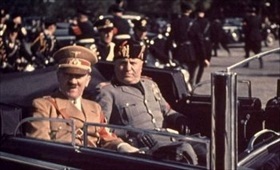
Left: His face expressionless, Mussolini rides in an open-air car with Hitler in Florence, Italy, May 1938. Hitler beamed and strutted like a peacock across his host’s stage, having pulled off his bloodless land grab of Austria (Anschluss) earlier in March after Mussolini had abandoned his northern neighbor to the Nazi predator.
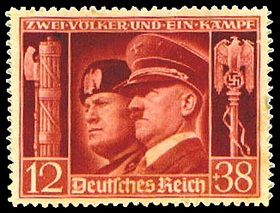
Right: 1941 German stamp of Hitler and Mussolini. Translation of text at the top: “Two Peoples and One Struggle.”
 |
 |
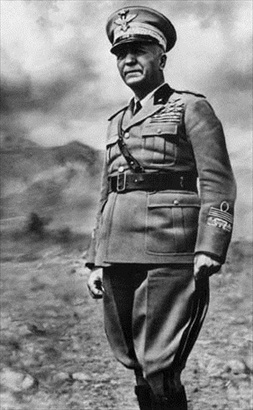
Left: Marshal of Italy Pietro Badoglio. On the night of July 24–25, 1943, two and a half weeks after Allied landings in Sicily (Operation Husky) and a week after Allied aircraft had unloaded their bombs on Rome, the Grand Council of Fascism voted 19-to-7 to remove 60-year-old Mussolini from power. Italy’s king ordered the Duce’s arrest the next day, July 26, and appointed 72-year-old Badoglio to be Italy’s new prime minister.
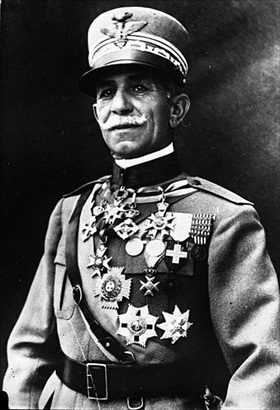
Right: King Victor Emmanuel III of Italy. Publicly, the king and Prime Minister Badoglio claimed that their country would continue the war as a member of the Axis. Privately, they both began negotiating with the western Allies for an armistice, which was signed on September 3, 1943, but made public on the 8th. Bodoglio’s government declared war on Germany on October 13, 1943.
Mussolini: Italy’s Nightmare, 1940–1943

World War II was the single most devastating and horrific event in the history of the world, causing the death of some 70 million people, reshaping the political map of the twentieth century and ushering in a new era of world history. Every day The Daily Chronicles brings you a new story from the annals of World War II with a vision to preserve the memory of those who suffered in the greatest military conflict the world has ever seen.