

HITLER DIRECTS WAR FROM UNDERGROUND
Berlin, Germany · January 16, 1945
On this date in 1945 Adolf Hitler moved his entourage into the Fuehrerbunker under the Old Reich Chancellery in Berlin, where he lived and directed the last months of the war in Europe. The “Leader’s bunker”—a maze of living quarters, conference rooms, offices, and utilities spreading 2 stories deep some 25 feet/7.6 meters beneath the chancellery gardens—had been specially built the previous fall prior to Hitler vacating for good his massive Wolf’s Lair headquarters complex in Rastenburg, East Prussia, now in Poland. An aide recalled hearing Hitler say in mid-November 1944 that the war was lost, but Hitler soldiered on anyway, moving his forward headquarters to the “Eagle’s Eyrie” (Alderhorst) near Bad Nauheim in the German state of Hessen, from where he directed the Ardennes Offensive (Battle of the Bulge). Ardennes was intended to turn the tide of war by splitting the Allied armies (chiefly U.S., British, and Canadian armies) in the west when the German Wehrmacht (armed forces) retook the strategically vital Belgian port of Antwerp. After it became clear that his high-stakes Ardennes gamble had failed, the Fuehrerbunker in Berlin beckoned.
Eva Braun, his long-standing girlfriend, joined him there “in this critical hour,” as Minister of Propaganda Joseph Goebbels confided to his diary. The Fuehrerbunker survived a 900‑bomber raid on Berlin on February 3 that destroyed the government district and partly reduced the Old Reich Chancellery to rubble. Several days later Goebbels found passage into the underground bunker “totally blocked with mountains of rubble.”
On March 19 Hitler issued his so-called Nero Order, his “scorched earth” directive to destroy German infrastructure lest it fall into enemy hands. (Both the Germans and the Soviets had used “scorched earth” in their see-saw battle for control of the Eastern Front.) By this date in the war, however, little of material value remained in Germany after that country had been pummeled from all directions by land-based artillery and incessant aerial bombardments.
Now Hitler’s closest lieutenants were drawing away. Reichsfuehrer‑SS Heinrich Himmler and Foreign Minister Joachim von Ribbentrop were in secret contact with Western powers via Sweden, shaking Hitler to the core when he discovered their perfidy. When Eva Braun bit into the cyanide capsule and Hitler blew his brains out on April 30, 1945, even Hermann Goering, Hitler’s designated successor since June 1941, stood accused of treason and, on Hitler’s order, was under house arrest in the Reichsmarschall’s own castle near Salzburg, Austria.
The Fuehrerbunker: Hitler’s and Braun’s Initial Gravesite
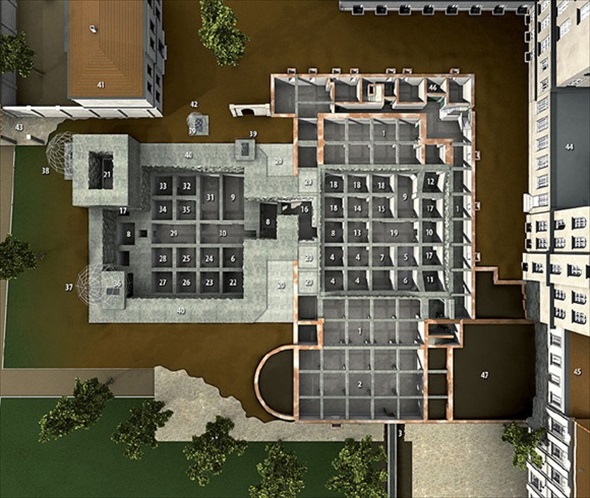 |
Above: Schematic diagram of the Fuehrerbunker (left in image) and the Vorbunker. The 16‑room Vorbunker (“forward bunker,” or antebunker) was located beneath the large hall that was added to the rear of the Old Reich Chancellery in 1939. (The hall connected the Old Reich Chancellery on Wilhelmstrasse with the New Reich Chancellery on Vossstrasse.) The Vorbunker was meant to be a temporary air raid shelter for Hitler, his guards, and servants. It was officially called the “Reich Chancellery Air Raid Shelter” until 1943, when construction began that expanded the bunker complex with the addition of the 20‑room Fuehrerbunker over 30 ft/9.1 m beneath the garden of the Old Reich Chancellery and to the Vorbunker’s southwest. The two bunkers were connected by a set of stairs.
 |
 |
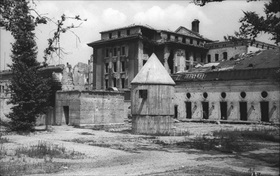
Left: Taken in July 1947, this photo shows the massive first emergency exit of the main bunker (erster Notausgang des Hauptbunkers), or the rear entrance to the Fuehrerbunker (no. 21 in the schematic diagram above). Hitler and Braun were cremated in a shell hole in front of the emergency exit. The cone-shaped structure in the center of the photo (no. 37) served as an observation tower and bomb shelter for the guards. An unfinished tower (no. 38), a ventilation tower, is partially hidden behind the tree.
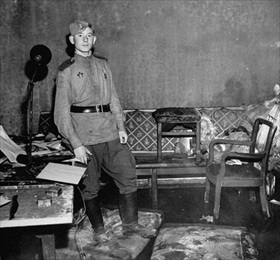
Right: A young Soviet soldier stands reputedly amid the scattered remains of Hitler’s personal study (no. 26), the place of his and his wife’s suicides on April 30, 1945. A Dutch still life that once hung over the sofa is missing. On December 5, 1947, Soviet engineers tried dynamiting Hitler’s bunker complex but had limited success. Both ventilation towers and the entrance structure seen in the picture on the left were destroyed in the blasts. Twelve years later the East German government applied more dynamite to the bunker ruins, then covered everything over with earth. In the second half of the 1980s East German work crews finished demolishing the site and built residential housing and other buildings in the space where the 2 Reich chancelleries, garden, and bunker complex had been. A children’s playground occupies the spot where Hitler’s and Braun’s bodies were burnt.
The Last Days of Adolf Hitler. Video Consists of Contemporary Soviet Footage of the Battle of Berlin

World War II was the single most devastating and horrific event in the history of the world, causing the death of some 70 million people, reshaping the political map of the twentieth century and ushering in a new era of world history. Every day The Daily Chronicles brings you a new story from the annals of World War II with a vision to preserve the memory of those who suffered in the greatest military conflict the world has ever seen.