

HITLER CELEBRATES MUSSOLINI’S RESCUE
Fuehrer HQ, Rastenburg, Germany • September 12, 1943
On September 11, 1943, imprisoned in the Hotel Campo Imperatore high in the Apennine Mountains of Central Italy, deposed Italian dictator Benito Mussolini learned of the terms of the Long Armistice the Allies had presented to Marshal Pietro Badoglio’s new Italian government. (A Short Armistice had been signed in Sicily on September 3 between Italy and the Allies, who believed an armistice was needed to facilitate Operation Avalanche, their landings on the Italian mainland on September 8 and 9.) The Long Armistice had been pushed by Britain to humiliate Italy for having declared war on the British Empire. It required the Italians to turn over Mussolini and other high-ranking Fascists suspected of having committed war crimes against the forces of the “United Nations.”
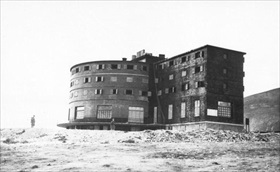
Il Duce (Italian, “the leader”) considered suicide while his friend and Axis partner Adolf Hitler pressed his special rescue operations team ever more urgently to discover where Badoglio’s government had hidden Mussolini and snatch him to safety. It was a cat-and-mouse game as the Badoglio government moved Mussolini from police barracks in the capital Rome, to an island in the Tyrrhenian Sea, to the island of La Maddalena near Sardinia, to finally the mainland in the area of the Gran Sasso d’Italia (“Great Rock of Italy”) mountain, a popular skiing center with a 70‑room hotel, the Campo Imperatore, that could only be reached by cable car—clearly a place hard to get to and easy to defend.
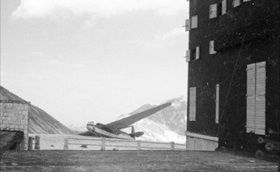
But Mussolini’s German rescuers were clever, resourceful, and capable of following Mussolini’s movements within hours or days in a country where few secrets were kept. On this date, September 12, 1943, a few planes, 10 towed DSF 230 transport/assault gliders, and 73 crack Luftwaffe airborne troops (Fallshirmjaeger) landed without resistance in a deadly bolder-strew field on the back slope of the hotel yards/meters away. Accompanying the airborne troops was a burly, scar-faced, 35‑year-old Waffen‑SS captain by the name of Otto Skorzeny and 16 of his SS commandos. Neither Mussolini’s abductors nor his surprised captors (200 well-equipped military police) exchanged a shot. After a few snapshots of Skorzeny and Mussolini before the hotel, Skorzeny squeezed himself and the liberated dictator into a single-engine, 3‑seater plane and made off with his prize. Operation Eiche (Oak), or the Gran Sasso Raid, was a propaganda coup for the Nazis, who flew Mussolini to Hitler’s East Prussian headquarters, then back to Northern Italy. There Il Duce was installed as puppet ruler of a second (and last) incarnation of a Fascist Italian State, the Repubblica Sociale Italiana, informally known as the Salò Republic.
Operation Oak: High-Stakes Rescue of Imprisoned Italian Dictator Benito Mussolini, September 12, 1943
 |
 |
Left: The isolated alpine ski resort Campo Imperatore Hotel in 1943, where deposed dictator Benito Mussolini was eventually incarcerated. Mussolini’s Axis partner, Adolf Hitler, claimed that he would not let “Italy’s greatest son” down in his hour of need. His “old ally and dear friend” had to be rescued. The risky rescue was the last of Hitler’s spectacular gambles to bear fruit.
Right: Seventy-three paratroopers under the command of Luftwaffe Major Harald-Otto Mors along with 17 select commandos led by Waffen-SS captain Otto Skorzeny crash-landed gliders onto the hotel’s boulder-filled slopes, then overwhelmed Mussolini’s stunned jailers without firing a single shot. (Il Duce’s jailers may have been rendered directionless by the surrender of Italian armed forces in Rome 2 days before.) Skorzeny rushed past the paratroopers to greet Mussolini, boasting, “Duce, the Fuehrer has sent me to set you free!” To which Mussolini replied, “I knew that my friend would not leave me in the lurch!” The hotel rescue had taken all of 12 minutes.
 |
 |
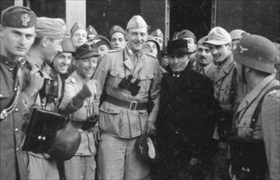
Left: Otto Skorzeny (center, dangling binoculars) with the liberated Mussolini and to Skorzeny’s right the slightly built Harald-Otto Mors, planner and leader of the glider rescue operation, Hotel Campo Imperatore, September 12, 1943. Photograph by Toni Schneiders, who was attached to Mors’ paratroop battalion. Same for Skorzeny’s commandos, whose role was to act as Mussolini’s bodyguard detail and guard any Italians taken prisoner. The high-risk adventure in the Apennine Mountains saved the deposed Italian strongman from being turned over to the Allies under the terms of the Long Armistice and catapulted the self-promoting SS commando leader to worldwide fame. Skorzeny connived with SS-Reichsfuehrer Heinrich Himmler and propaganda minister Joseph Goebbels to take credit for the whole Operation Oak raid, from planning to execution (this is still the dominant narrative today). Skorzeny received a promotion to SS Sturmbannfuehrer, a Nazi Party paramilitary rank equivalent to major, and was awarded the Knight’s Cross of the Iron Cross.
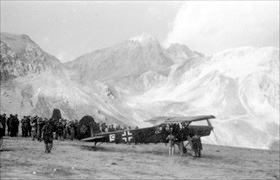
Right: From his work on the intelligence side of the Gran Sasso Raid, Skorzeny knew that only a light plane with short landing and takeoff capabilities stood a chance of getting Mussolini off the mountain. It was therefore decided to land a 3‑passenger, highly maneuverable Fi 156 Fieseler Storch (“Stork”) spotter plane on the small, uneven plateau. It was a hair-raising takeoff on a short, improvised runway as the pilot, Skorzeny (who had forced his way into the aircraft), and Mussolini (Skorzeny’s future meal ticket) in the now overloaded Storch toppled over the edge of the 6,990‑foot/2,131‑meter mountaintop into the abyss below. A hundred feet/30 meters from their doom on the valley floor, the men were saved when the pilot, Capt. Heinrich Gerlach, was able to correct the aircraft in the thin mountain air. Mussolini transferred to a Heinkel 111 twin-engine bomber and was eventually flown to Hitler’s Rastenburg headquarters in East Prussia via Vienna and Munich.
 |
 |
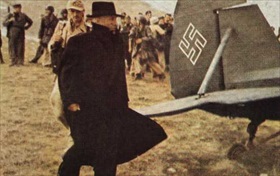
Left: Mussolini departed the Campo Imperatore Hotel for the Storch wearing a heavy coat and heavy ski boots. His rescue was one of the most famous commando operations of war, and it shocked the Allies. Eleven days after his rescue, Mussolini returned to German-occupied Northern Italy, where he was installed as the titular head of the puppet Salò Republic.
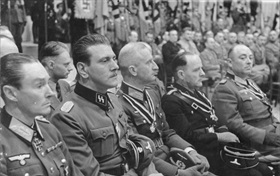
Right: The successful exploit by Luftwaffe paratroopers and Waffen-SS commandos produced a rare late-war public relations blip to sagging Axis fortunes thanks to German propaganda organs, for it kept at least the appearance that Fascist Italy was still in the war on the Axis side. On October 3, 1943, Nazi Germany’s Thanksgiving Day, Berliners gathered in the Sport Palace to cheer Skorzeny (second from left in photo) and some of the brave glider-borne raiders who had extracted the deposed dictator from the hands of his enemies.
Operation Oak: The Raid to Free Imprisoned Benito Mussolini, September 12, 1943

World War II was the single most devastating and horrific event in the history of the world, causing the death of some 70 million people, reshaping the political map of the twentieth century and ushering in a new era of world history. Every day The Daily Chronicles brings you a new story from the annals of World War II with a vision to preserve the memory of those who suffered in the greatest military conflict the world has ever seen.