

HITLER, AUSTRIAN HEAD TO CONFER
Salzburg, Austria • February 11, 1938
On this date in 1938 Austrian Chancellor Kurt Schuschnigg arrived in Salzburg for a quick trip over the German border to confer with Adolf Hitler at his Bavarian Alps residence above Berchtesgaden, the Berghof. An Austrian native who had served as a lance corporal in the Bavarian Army in World War I, Hitler had been granted German citizenship in February 1932. The following January the Nazi Party leader was appointed Chancellor of Germany. In 1934 Schuschnigg succeeded to the top post in Austria after Chancellor Engelbert Dollfuss had been murdered in a failed coup d’état by members of the Austrian Nazi Party, a party that was secretly funded by the German Foreign Office in Berlin.
Chancellor Schuschnigg’s clandestine meeting with his German counterpart on February 12 was anything but pleasant, Hitler insulting the Austrian leader and raving at one point: “I have only to give an order and your ridiculous defenses will be blown to bits!” Hitler gave the Austrian chancellor a deadline of February 15 to resign in favor of Austrian Nazi Party leader Arthur Seyss-Inquart, whose party Dollfuss had banned, jailing many of its members. The next morning Hitler instructed his newly appointed chief of the Wehrmacht High Command (Oberkommando der Wehrmacht), Wilhelm Keitel, who had attended the previous day’s meeting, to make arrangements for intimidating military maneuvers on the Austrian border.
Once safely back in Austria, Schuschnigg reorganized his cabinet, brought in representatives of former political parties (some banned), and worked against German machinations. He called for a March 13 nationwide plebiscite to demonstrate Austrian resolve against German coercion, political or otherwise, believing that Hitler would not risk an international incident. To ensure the vote went his way, the wily politician disenfranchised Austrian voters younger than 25, because a predominant number of them were Nazi enthusiasts. Hitler called foul. The day before the scheduled plebiscite German troops marched into Austria. Schuschnigg was arrested (he and his wife were eventually sent to Sachsenhausen, then Dachau concentration camps in Germany), and Austrian Nazi Party leader Seyss-Inquart named himself both chancellor and president of Austria, despite the refusal of the sitting president, Wilhelm Miklas, to resign his office. Hitler crossed the border shortly afterwards, welcomed by thunderous crowds, some celebratory scenes genuine, some staged.
April 10 sham plebiscites in both countries showed 99 percent of the votes counted supported the Anschluss, or union with Germany. (British intelligence, on the other hand, estimated that not more than 35 percent of Austrian voters had cast their ballots in favor of Anschluss, an opinion shared in reports on Viennese voters by the Nazis’ own Sicherheitsdienst, Security Service.) After the elections Austria became known as Ostmark, “the Eastern Region,” and was fully incorporated into Greater Germany (Grossdeutschland), a dream Hitler had laid out in his muddled, frightening blueprint, Mein Kampf (My Struggle), in 1925.
German-Austrian Anschluss, 1938
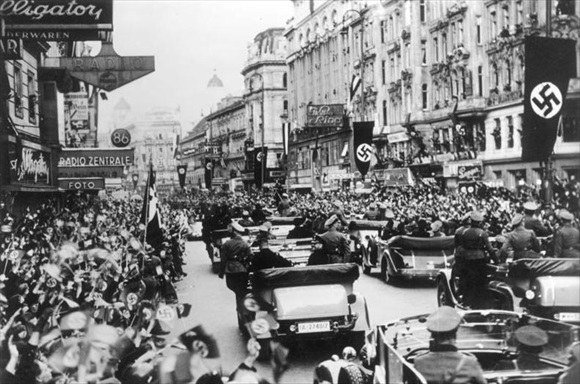 |
Above: Hundreds of thousands of Austrians lined the streets as Hitler and his entourage made a triumphal entry into Austria’s capital, Vienna, on March 14, 1938.
 |
 |
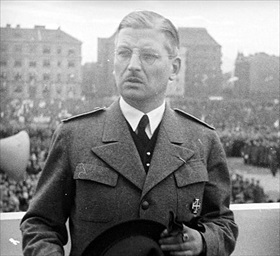
Left: Austrian chancellor (1934–1938) and Fatherland Front leader Kurt Schuschnigg at a party rally in 1936. Schuschnigg rejected Hitler’s Pan-German politics; instead, he focused on protecting Austria’s independence during a decade of political unrest in Central Europe. After the war and his release from German captivity, Schuschnigg emigrated to the United States, where he taught political science at Saint Louis University in Missouri from 1948 to 1967. Schuschnigg returned to Austria where he died in 1977.
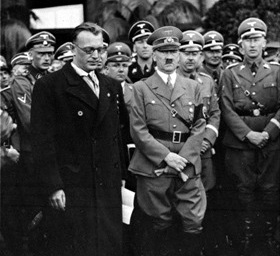
Right: Nazi Reich Governor Arthur Seyss-Inquart with Hitler in Vienna, 1938. During their February 1938 meeting at the Berghof, Hitler bullied Schuschnigg into appointing Austrian Nazi Party leader Seyss-Inquart to head Austria’s Ministry of Public Security, a post that gave Austrian Nazis full and unlimited control of their country’s police forces. With the assistance of Seyss-Inquart’s post-Anschluss puppet government and the support of Reichsfuehrer-SS Heinrich Himmler, Chief of German Police, and his deputy, Gestapo (Secret State Police) chief SS-Gruppenfuehrer Reinhard Heydrich (left and to the rear of Hitler in the photograph), the Nazis quickly embarked on a campaign of repression and terror. Tens of thousands of Austrians, among them Catholics, Social Democrats, Socialists, Communists, and Jews, were arrested and sent to concentration camps or, in the case of Jews in the immediate aftermath of Anschluss, forced to leave the country, their property confiscated.
British Newsreel of Wehrmacht’s and Hitler’s Entry into Austria, March 1938

World War II was the single most devastating and horrific event in the history of the world, causing the death of some 70 million people, reshaping the political map of the twentieth century and ushering in a new era of world history. Every day The Daily Chronicles brings you a new story from the annals of World War II with a vision to preserve the memory of those who suffered in the greatest military conflict the world has ever seen.