

HARD-CHARGING ELITE FORCE RENAMED 10TH MOUNTAIN DIVISION
Camp Swift, Texas • November 6, 1944
Days after a receipt of a construction permit on April 7, 1942, a massive warfare training facility began to take shape for the U.S. Army’s Mountain Training Center and the 87th Mountain Infantry Battalion, the Army’s new mountain ski unit activated 5 months earlier. Camp Hale, as the army later named it, became the nation’s first military cantonment constructed for basic and specialized training for ski and mountain troops. Camp Hale recruits trained for year-round mountain warfare, eventually forming the elite mountain unit, the 10th Light Division (Alpine) (July 15, 1943) that was re-designated the 10th Mountain Division on this date, November 6, 1944.
By way of background 2 events in Europe in the late 1930s/early 1940s—the Russo-Finnish War and the Greco-Italian War—prompted U.S. Army Chief of Staff Gen. George C. Marshall to authorize the formation of mountain warfare troops for a new mountain battalion, forerunner to the first and only mountain infantry division in U.S. military history. The same day the U.S. declared war on Japan, December 8, 1941, the army activated the 87th Mountain Infantry Battalion. The battalion (later expanded to a regiment) initially trained in Washington state, then moved south to Camp Hale. At an elevation of 9,200 feet/2,800 meters above sea level, the remote, rugged, and mountainous central Colorado site was ideally suited for training specialized winter and mountain warfare troops.
Training the men, most of whom were experienced skiers or rock climbers, initially took place in the higher elevations above Camp Hale. Equipment, alpine climbing gear, provisions, clothing, and transportation suitable for mountain troops were studied and tested in the snow and sub-zero temperatures at which the men might be operating. To increase the strength of the new division by 50 percent to the 16,000 planned, the military transferred troops from other infantry divisions and accepted volunteers from various national guard units.
The 10th Mountain Division was made up of 3 mountain infantry regiments—85th, 86th, and 87th—each made up of 3 battalions. Three light field artillery battalions on mules, an anti-tank infantry battalion, and an anti-tank battery supported the regiments. The combat troops were also supported by a medical battalion, a veterinary company, and a mountain engineer battalion.
After nearly 2 years of training, deployment to Italy began on December 11, 1944, when the 86th Mountain Infantry Regiment embarked for Naples, arriving there 11 days later. The 85th and 87th infantry regiments and the 3 field artillery battalions arrived in Italy in January. In Italy the 10th was strengthened by additional battalions and a British artillery regiment. Combat, support, and medical units took military trains and trucks to their staging areas near Pisa as part of the U.S. Fifth Army.
Prior to the start of Operation Encore (February 18–March 5, 1945), 10th Mountain patrols had secretly scouted 5 routes up the steep, icy slopes and vertical cliffs of Riva Ridge (Monti della Riva), an observation post on the formidable Gothic Line (aka Green Line II, 200 miles/320 kilometers long and 10 miles/16 kilometers deep) that German defenders believed was unassailable. On the dark, ever more foggy night of February 18/19, 1945, 700 men from the 86th Infantry Regiment scaled between 1,700 and 2,200 feet/518 and 670 meters up the vertical cliff to the top of Riva Ridge and completely surprised the entrenched 40–50‑man German encampment. For over 36 hours the 86th held off enemy counterattacks. The night after the daring Riva Ridge assault, 6 battalions of the 85th and 87th Infantry Regiments, some 13,000 men, began the 3,000 foot/914 meter ascent up neighboring Mount Belvedere. For 4 days the warriors fought their way up the mountain in the face of withering machine-gun and mortar fire. On February 23 10th Mountain took full control of the Mount Belvedere ridgeline.
Enemy defenses in Italy began collapsing in the waning days of April 1945. On April 30 the mountain men secured the western shore of Lake Gardia, effectively ending organized German resistance in Italy. During the Italian Campaign (July 9, 1943, to May 2, 1945), 10th Mountain—19,789 men strong—suffered between 4,154 and 5,146 casualties (sources vary), of which just under 1,000 were combat deaths. These were the highest casualty numbers sustained by an American division in Italy in relation to the time spent there.
Camp Hale and the U.S. 10th Mountain Division, 1942–1945
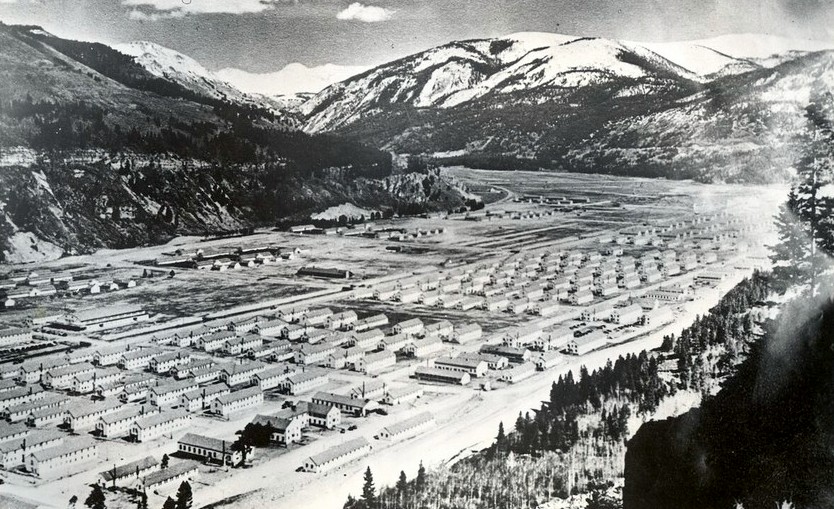
Above: At its height Camp (not Fort) Hale (elevation 9,250 feet/2,819 meters) sprawled across nearly 1,500 acres/607 hectares and contained 1,000 white buildings, including 33 administration buildings, 226 barracks that could house more than 15,000 men and 240 WACs (Women’s Army Corps), 5 churches and chapels, and an 18,000‑sq.-foot/1,672‑sq.-meter gymnasium used for indoor games, concerts, and dances, etc. Built by 10,000 workers at a then cost of $30 million in an incredible 7 months, the camp also included parade grounds, 100 mess halls, a 676‑bed hospital, weapons, gunnery, and artillery ranges, 2 ski areas, horse and transport mule barns, a school and post office, stockade, motor pool, rail yards, and more—essentially a small city built high in the breathtaking Rocky Mountains. Today the demolished campsite is part of the 53,804‑acre/21,774‑hectare Camp Hale-Continental Divide National Monument. During its brief 114 days of combat in Northern Italy, the 10th Mountain Division suffered a staggering 4,846 casualties—a full quarter of its strength. This average of 1,216 casualties per month was the highest in the Italian Campaign.
 |
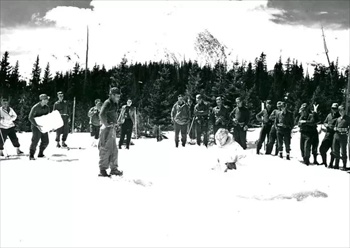 |
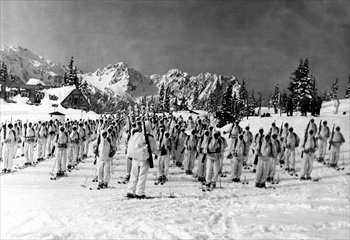
Above: Rigorous and demanding winter training at Camp Hale: learning ski warfare techniques and tactics, rock climbing, weapons and ordinance use, and cold weather survival skills. Over 32,000 men served with the 10th Mountain Division between 1942 and 1945. Of these, 4,000 men of the 87th Mountain Infantry Regiment deployed to Alaska’s Aleutian Islands in mid-August 1943 but saw no combat, and 20,000 men in all 3 mountain infantry regiments (85th, 86th, and 87th) engaged the Axis enemy in combat operations in Northern Italy in 1945 without once using their skis.
 |
 |
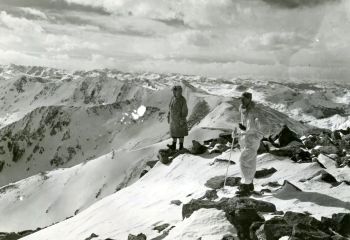
Left: Members of a mountain troop witness springtime in the Colorado Rockies at 13,000 feet/3,962 meters near the timberline at Camp Hale, May 8, 1943. The flat, open Pando Valley and the rugged, high-altitude peaks cloaked in perpetual snows that surrounded the camp (annual snowfall 250 inches/635 centimeters) forged the elite alpine warriors of the 10th Mountain Division. When the mountaineers went into combat in Northern Italy in early 1945, they cemented the mountaineering spirit that inspired their motto “Climb to Glory.”
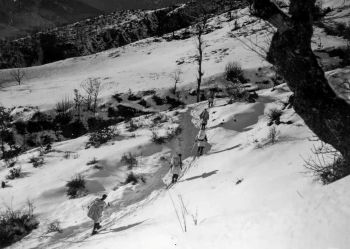
Right: Difficult as these men are to see in their camouflage ski parkas and wool trousers, this 5‑man ski patrol of the I&R (Intelligence and Reconnaissance) platoon, 86th Mountain Infantry Regiment begin to ascend the slope of a snow- and ice-clad mountain as they move deep into enemy territory on a 3‑day patrol, January 21, 1945. The ski patrol was the longest ever made in this part of Northern Italy up to that time. All 5 men were champion skiers and held records at one time or another in their respective states.
 |
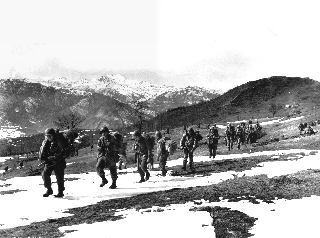 |
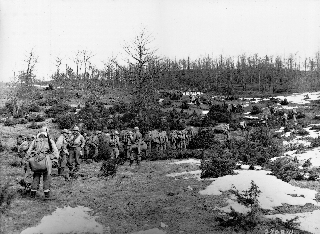
Above: In these photos likely taken on February 23, 1943, mountaineers of the 85th or 87th Infantry Regiment, 10th Mountain Division walk the ridgeline after ousting the enemy from the summit of Mount Belvedere, also referred to as Monte Castello. At 3,740 feet/1,140 meters high, the mountaintop had a commanding view over 10 miles/16 kilometers of critical highway through Italy’s Northern Apennine mountains. Led by Lt. Gen. Mark Clark, U.S. 5th Army, the goal of Operation Encore was to capture vital high ground, break German defenses on the Gothic Line that ran across the top of Italy’s boot, and open the highway to the Po Valley, where a third of all Italians lived.
Snow, Blood, and Victory: The 10th Mountain Division in World War II in Italy

World War II was the single most devastating and horrific event in the history of the world, causing the death of some 70 million people, reshaping the political map of the twentieth century and ushering in a new era of world history. Every day The Daily Chronicles brings you a new story from the annals of World War II with a vision to preserve the memory of those who suffered in the greatest military conflict the world has ever seen.