

GOERING TO HEAD GERMAN AIR FORCE
Berlin, Germany · March 1, 1935
On this date in 1935 Adolf Hitler appointed World War I air ace (last commander of the famous “Red Baron” Richthofen Fighter Squadron) Hermann Goering to the position of Luftwaffe Commander-in-Chief. Goering held the post until the final days of the Third Reich. A faithful Nazi from the earliest days of the National Socialist party, Goering was wounded in the upper right thigh by a high-velocity 7.9mm slug during Hitler’s botched attempt to seize political power in Bavaria (the Beer Hall Putsch) in November 1923. Treated with morphine to relieve the terrible pain caused by the wound, Goering developed a lifelong addiction to the drug, not to mention permanent changes to his metabolism: he quickly doubled his weight, ballooning to more than 320 pounds. Nevertheless, he performed yeoman duties for the party, becoming President of the Reichstag (German Parliament) in August 1932. After the Nazis came to power in national elections at the end of January 1933, Goering assumed the post of Prussian Minister President. While in office he founded and briefly ran the Gestapo, the national Secret State Police, which was modeled on the long-standing Prussian Secret Police. In 1934 Goering handed the reins of the Gestapo to another top Nazi, Heinrich Himmler, a singularly evil character who directed the killing of six million Jews and countless more victims in death camps he built and oversaw. Meanwhile, Luftwaffe chief Goering, officially designated Hitler’s successor on September 1, 1939, the day World War II broke out in Europe, directed the buildup of the air force and later the air campaigns against Poland and France. On June 19, 1940, he was promoted to Reich Marshal, a military position second to none. Goering was cunning, brutal, corrupt, and ambitious, and for much of the war he remained genuinely popular with the German people, who regarded him as manly, honest, and more accessible than the Fuehrer. Despite his popularity, servile dependence on Hitler, and political power (in marked decline beginning in September 1940 due to his military errors in the air war against England), Goering was not among the inner circle of Hitler intimates. In April 1945 Hitler dismissed him ignominiously from all his posts and ordered his arrest. On May 9, 1945, he became a prisoner of the U.S. Seventh Army.
[fblike]
[amazon_carousel widget_type=”ASINList” width=”600″ height=”200″ title=”Recommended Reading” market_place=”US” shuffle_products=”False” show_border=”False” asin=”1906502668,1616081090,030680915X,1500421286,1848859325,161039156X,1602391785,0307742601,0750937815,0557142415″ /]
Luftwaffe Chief and Reichsmarschall Hermann Goering, 1893–1946
 |
 |
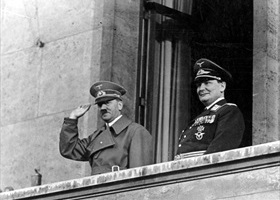
Left: With Anschluss (union between Germany and Austria) awaiting only a sham plebiscite in both countries, Hitler and Goering greet admirers from the balcony of the Reich Chancellery in Berlin following their triumphal return from Vienna, March 16, 1938.
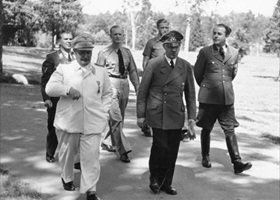
Right: Goering, Hitler, and Minister of Armaments and War Production Albert Speer meet for discussions at Fuehrer headquarters, August 10, 1943.
 |
 |
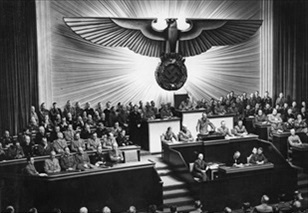
Left: Goering, in his capacity as Reichstag President, sits in the high-back chair directly behind Hitler, who stands at the podium delivering his declaration of war against the United States, December 11, 1941. Sitting next to the empty chair (left center) is Foreign Minister Joachim von Ribbentrop.
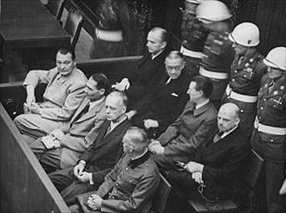
Right: Defendants in the dock at the Nuremberg Trials, 1945–1946. Front row (l–r): Hermann Goering, former Deputy Fuehrer Rudolf Hess, Joachim von Ribbentrop, and Field Marshal Wilhelm Keitel, one of two men (the other was Col. Gen. Alfred Jodl) who surrendered Nazi Germany to the Allies on May 7 and 8, 1945. Goering and Hess committed suicide years apart (1946 and 1987, respectively), and Ribbentrop, Keitel, and Jodl were hanged on October 16, 1946, as war criminals.
History Channel Biography of Hermann Goering: Ambition Without Conscience

World War II was the single most devastating and horrific event in the history of the world, causing the death of some 70 million people, reshaping the political map of the twentieth century and ushering in a new era of world history. Every day The Daily Chronicles brings you a new story from the annals of World War II with a vision to preserve the memory of those who suffered in the greatest military conflict the world has ever seen.