

GERMANY ASSAULTS SOVIET UNION
Berlin, Germany · June 22, 1941
The largest military force ever assembled—three million soldiers, 4,300 tanks, nearly 4,400 aircraft, and some 46,000 artillery pieces—assaulted the Soviet Union on this date in 1941. Since the 1920s Adolf Hitler had championed a crusade against “Jewish Bolshevism,” with its political, ideological, and economic center in Moscow. Hitler believed that only when the Soviet Union was beaten down in a quick campaign would the British—whose island nation was currently being blitzed by Hermann Goering’s Luftwaffe—give up their solitary struggle against the Nazi juggernaut.
The blitzkrieg in the East, Hitler estimated, would take about three months to advance to the Ural Mountains-River Volga line, some 1,300 miles from the Third Reich’s eastern border. Once there, the Wehrmacht (German armed forces) could throw up a defensive line against Soviet Siberia and Central Asia and occupy European Russia. Beyond those three months the Wehrmacht had no battle plans, no supplies, no reinforcements—no Plan B in other words.
Operation Barbarossa, as the first strike against the Soviet Union was called, proved to be the start of Nazi Germany’s Untergang (downfall). Tactically, the Wehrmacht won resounding victories and seized some of the most important economic assets of the Soviet Union, among them the heavily populated and rich agricultural heartland of the Ukraine. But the Eastern Front sucked Germany and its Axis allies in and refused to spit them out until they’d been mauled by Mother Nature or in battle. The Wehrmacht in 1941 was not equipped for winter warfare. Frostbite and disease caused more casualties than combat. There was no shelter from subzero temperatures (-40°F and lower). Equipment froze and air operations were suspended. In one three-week period, German dead and wounded totaled 155,000. Some divisions were a fraction of their original strength.
In the Soviet capital Moscow, newly built-up, well-equipped units, some fresh from Siberia, approached over half a million men. On December 5 they launched a massive counterattack that shifted the front line westward, over 200 miles in places. Operation Barbarossa, cut short by the onset of an arctic winter the German High Command had neither plans nor provisions for, cost the German Army over 210,000 killed and missing and 620,000 wounded in 1941, to say nothing about casualties incurred by other Axis armies. A calamitous, drawn-out death struggle in the East was now inevitable.
[fblike]
[amazon_carousel widget_type=”ASINList” width=”600″ height=”200″ title=”Recommended Reading” market_place=”US” shuffle_products=”False” show_border=”False” asin=”184415923X,1612001203,0742544826,052117015X,0742521923,0752460706,1782004084,1107035120,1781590702,0764343769″ /]
Operation Barbarossa: Germany’s Invasion of the Soviet Union, 1941
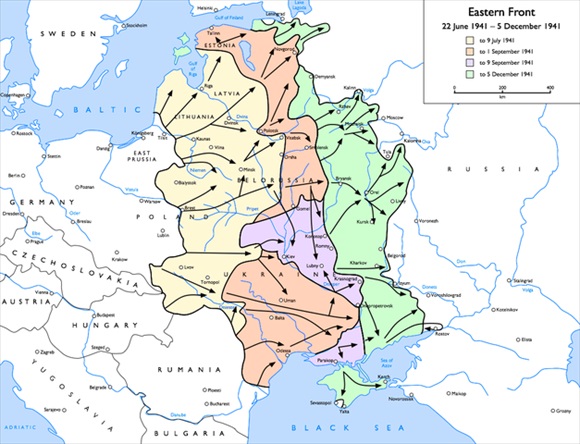 |
Above: Map of German operations against the Soviet Union, June 22 to December 5, 1941. Operation Barbarossa was the largest military operation in history in both manpower and casualties. It eventually cost the German Army (Heer) over 210,000 killed and missing and 620,000 wounded in 1941, a third of whom became casualties after October 1. Unknown is the number of Axis casualties among Romanian, Hungarian, and Waffen-SS units, as well as co-belligerent Finns.
 |
 |
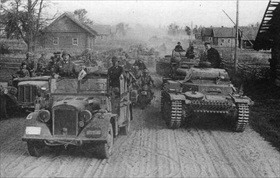
Left: Panzer units from Army Group Center speed into Western Belarus on an unpaved road, June 1941. By the end of the first week of Operation Barbarossa, all three German Army Groups—North, Center, and South—had achieved major campaign objectives. Chief of the Army Franz Halder trumpeted in his diary: “It is thus probably no overstatement to say that the Russian Campaign has been won in the space of two weeks.”
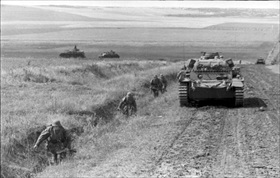
Right: A German tank and crouching infantry make good time crossing the steppes in July 1941. But four months into the campaign, temperatures fell and there was continual rain, which by mid-October would have turned this unpaved road into a muddy bog. The changed road conditions slowed the German advance on Moscow to as little as 2 miles a day.
 |
 |
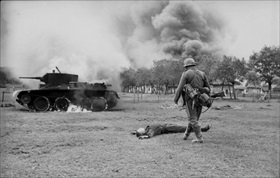
Left: An Army Group South infantryman encounters an enemy KIA (killed in action) and a burning BT‑7 light tank in the Ukraine during the early days of Operation Barbarossa, June 1941. In the course of the five-month campaign, Soviet losses were over 465,000 killed, over 235,000 noncombat deaths, over 101,000 deaths from wounds after the victims had been moved to evacuation zones, and 2.3 million MIAs (missing in action).
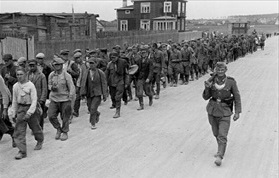
Right: A group of Soviet POWs in Bailystok, Northeastern Poland, July 1941, being marched to a prison camp. The Nazis’ contempt for the “subhuman” (Untermensch) Slav set the stage for atrocities rarely equaled before in Europe. In just eight months in 1941–1942, some 2.8 million captured Soviet combatants were executed in the field or died under inhuman conditions (for example, starvation, lack of medical care, and exposure) in German POW camps (Russenlager). In line with their deliberately genocidal policies toward the 5.7 million captured Soviets during the war, the Nazis are credited with causing the deaths of 3.3–3.5 million Soviet prisoners. By contrast, between 374,000 and one million German POWs (out of an estimated 2.4 to 3.3 million) died in Soviet captivity.
 |
 |
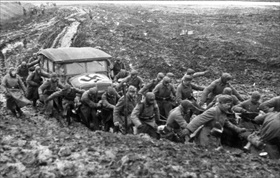
Left: German soldiers pull a staff car through heavy mud on a Russian road, November 1941. Hitler, arrogant and ruinously overconfident owing to his blitz of successes in Western Europe, expected a victory in the East within a few months, and therefore he did not prepare his Wehrmacht for a campaign that might last into a wet late fall, much less a bitterly cold winter. The assumption that the Soviet Union would quickly capitulate proved to be his, and Nazi Germany’s, tragic undoing.
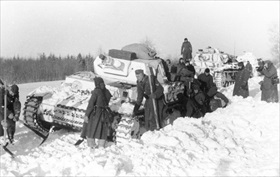
Right: On December 2, 1941, the first blizzards of the Russian winter began just as one unit of the Wehrmacht caught a glimpse of the spires of Moscow’s Kremlin 15 miles away. Sometime later a reconnaissance battalion crept to within 5 miles of Moscow, but that was as close to the military prize as any Wehrmacht unit managed. In this photo a Panzer IV tank in white camouflage is stranded in deep Russian snow as its crew attempts to free it. At the right edge of the photo is a war correspondent who filmed the scene for audiences back in Germany.
Operation Barbarossa: Hitler’s Invasion of the Soviet Union

World War II was the single most devastating and horrific event in the history of the world, causing the death of some 70 million people, reshaping the political map of the twentieth century and ushering in a new era of world history. Every day The Daily Chronicles brings you a new story from the annals of World War II with a vision to preserve the memory of those who suffered in the greatest military conflict the world has ever seen.