

GERMANS MUST CHOOSE VICTORY OR DEATH
Berlin, Germany · April 2, 1945
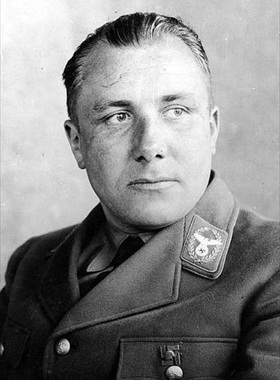
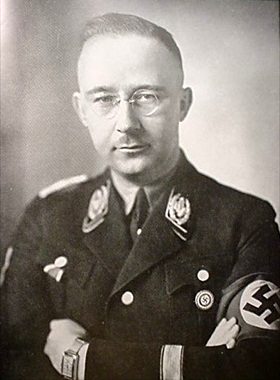
In the spring of 1945 senior leaders of the Third Reich were growing panicky. In the west, American troops had succeeded in crossing the Rhine River at Remagen 35 miles south of Cologne on March 7 and were advancing into the German heartland. In the east, the tracks of Soviet mechanized armor and the boots of their infantry could be heard approaching the outskirts of the epicenter of Nazism, Berlin. On this date in 1945 the Nazi leadership made desperate calls on the shrinking population under its control. Martin Bormann, head of Adolf Hitler’s Reich Chancellery and, as Hitler’s “shadow” the Fuehrer’s primary connection with the outside world, now called on his countrymen to make a last-ditch stand against the Allied invaders. The hour admitted of only one slogan: “Victory or death.” Already engaged in sending out peace feelers to the Allies behind his Fuehrer’s back, duplicitous Reichsfuehrer-SS Heinrich Himmler, chief of the secret police and lead engineer of the “final solution,” decreed that severe measures would be taken against those hanging white sheets off their balconies or out their windows. All male inhabitants of a house displaying a white sheet would be shot. Anyone refusing to serve in the Volkssturm (a home guard of mostly child soldiers and World War I veterans who were under the direct control of the Nazi Party), or caught removing tank barriers in the streets, or otherwise believed imperiling the Fatherland would be severely dealt with. On the same date, round-the-clock work on a vast new Fuehrerbunker southeast of Weimar near the Ohrdruf slave labor camp in eastern Germany ended when 9,000 inmates were forced-marched to the parent Buchenwald death camp 32 miles away. It was from this still unfinished headquarters in the hills around Ohrdruf that Hitler and other Nazi stalwarts hoped to strike a deal with the Western Allies to join the remnants of the Wehrmacht in fighting the “Jewish-Bolshevik” Soviet Union. When covert initiatives such as Himmler’s peace feeler surfaced in Western capitals (Reuters and the BBC leaked Himmler’s test balloon in news reports), they were rejected out of hand. For the Western Allies, coming to terms with Nazi Germany demanded unconditional military surrender, not a negotiated armistice in the style of World War I or updating the Nazi-era anti-Cominterm (anti-Soviet) Pact.
[fblike]
[amazon_carousel widget_type=”ASINList” width=”600″ height=”200″ title=”Recommended Reading” market_place=”US” shuffle_products=”False” show_border=”False” asin=”0306809583,0142002801,0393337618,0821406159,1848842899,0786717084,0143122134,0199592322,0099551896,0684829495″ /]
The Two Most Powerful Men in Nazi Germany After Adolf Hitler
 |
 |
Left: Martin Bormann (1900–1945?), Chief of the Party Chancellery (Parteikanzlei, May 12, 1941 to May 2, 1945) and private secretary to Adolf Hitler. By using his position to control the flow of information and access to Hitler, Bormann earned many enemies, including Heinrich Himmler. After Hitler’s suicide, Bormann left the Fuehrerbunker on May 1, 1945. In attempting to avoid falling into Soviet hands, Bormann may have been killed at the site of today’s Berlin Hauptbahnhof. A fellow bunker escapee claimed to have clearly seen Bormann’s body in the moonlight. The body was never recovered by the Soviets, though not for want of trying.
Right: Heinrich Himmler (1900–1945), Reichsfuehrer of the Schutzstaffel (SS). From 1943 onward Himmler was both Chief of German Police and Minister of the Interior, overseeing all internal and external police and security forces, including the Gestapo (Secret State Police). Adm. Karl Doenitz, Hitler’s successor, stripped Himmler of all authority in his new government. The fugitive was captured by the British and during his examination by a doctor bit into a hidden cyanide capsule and died within minutes on May 23, 1945.
Martin Bormann, Head of the Nazi Party Chancellery and Private Secretary to Adolf Hitler

World War II was the single most devastating and horrific event in the history of the world, causing the death of some 70 million people, reshaping the political map of the twentieth century and ushering in a new era of world history. Every day The Daily Chronicles brings you a new story from the annals of World War II with a vision to preserve the memory of those who suffered in the greatest military conflict the world has ever seen.