

GERMANS KILL 3,000 SERBIAN CIVILIANS IN REPRISAL
Kragujevac, Serbia, Yugoslavia · October 21, 1941
From Europe, to Africa, and to the Far East, regular Axis troops and specialized killing squads (Einsatzgruppen) murdered millions of unarmed civilians. These mass murders often targeted ethnic or political groups. Sometimes they were committed in retaliation for acts of resistance, whether or not the victims were actually involved. Sometimes they simply defied explanation and beggared the imagination, as in the case of Japanese atrocities (looting, torture, rape, and murder) against 300,000 civilians in Nanking (Nanjing), China, in 1937.
On this date, October 21, 1941, in Kragujevac, Yugoslavia (today Central Serbia), Germans murdered about 3,000 Serbian men and teenage boys in reprisal for partisan attacks on German troops. In Italy 2½ years later German soldiers of the SS (Schutzstaffel), assisted by Fascist collaborationist soldiers, took 335 Italian civilians—10 for each German policeman whom Italian partisans had recently killed with a bomb—to the Ardeatine Caves outside Rome and shot them, then sealed the cave with explosives to hide the evidence. On June 9, 1944, in the French industrial town of Tulle in Central France a German Waffen‑SS company (“Das Reich”) and members of the Sicherheitsdienst (the intelligence agency of the SS) first tortured, then murdered 99 randomly selected men aged between 17 and 42, hanging the victims’ bodies from trees, balconies, and lamp posts all over town. The reprisal massacre followed the killing and maiming of some 40 German soldiers in Tulle the day before by members of the French Maquis resistance movement. Fifteen miles north of Tulle, in the village of Oradour-sur-Glane, the same Waffen‑SS unit massacred 642 inhabitants, including women and children, the next day, June 10.
The year before in the Moscow Declaration of October 30, 1943, President Franklin D. Roosevelt, British Prime Minister Winston Churchill, and Soviet dictator Joseph Stalin put the Axis powers on notice that the people responsible for such atrocities would eventually stand in courts of law in the very countries they were oppressing and answer for their crimes. As for those people whose criminal offenses had no particular geographical localization, they would be punished by joint decisions of the Allied governments, thus presaging 2 postwar international tribunals, one in Nuremberg, Germany, the other in Tokyo, Japan.
Nazi Reprisals Cost Millions of Innocents’ Lives: Three Examples
 |
 |
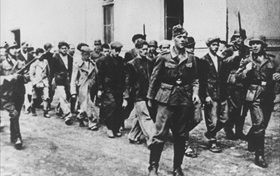
Left: Germans and their Serbian allies escort men and boys from Kragujevac and its surroundings to their execution place. Around 10,000 male civilians, aged 16 to 60, were arrested by German troops and collaborationist militia members, and the nearly 3,000 victims, including a high school full of students, were selected from among them. The massacre on October 20–21, 1941, was in direct reprisal for German losses in battling Communist partisans and Serbian nationalists (Chetniks) in the area.
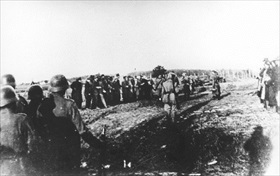
Right: Serbian civilians on the point of execution. People were shot in groups of 400. A German report stated: “The executions in Kragujevac occurred although there had been no attacks on members of the Wehrmacht [German armed forces] in this city, for the reason that not enough hostages could be found elsewhere.”
 |
 |
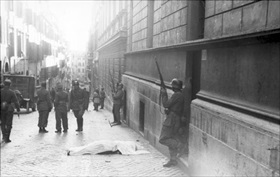
Left: Twenty-eight members of an SS police regiment of ethnic Germans from Northern Italy, which had been organized by the Germans to intimidate and suppress Italian partisans, were killed in a bomb attack on March 23, 1944, while marching and singing in Rome’s narrow Via Rasella. More policemen died over the next few days. The 16 partisans who had ambushed the regiment escaped. A body lies in the street during the roundup of civilians by Italian collaborationist soldiers and German troops after the bombing.
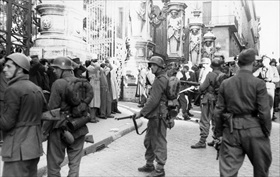
Right: The Germans needed reprisal victims and set about rounding up innocent civilians in front of the Palazzo Barberini, Rome, as shown here in this photograph, to add to the number of prisoners and Jews already in custody. Adolf Hitler authorized the reprisal, stipulating that it be carried out within 24 hours. Led by SS officers, 335 victims (5 more than necessary) were transported on March 24, 1944, to the Ardeatine Caves (Fosse Ardeatine) south of Rome in truckloads and then, in groups of 5, put to death by pistol inside. German military engineers set explosives to seal the caves and hide the atrocity. The scale and even the occurrence of this retaliation were unprecedented on Italian soil.
 |
 |
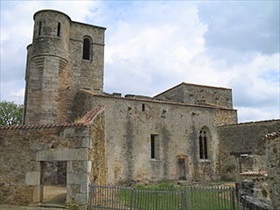
Left: The church in Oradour-sur-Glane in which 245 women villagers or visitors and 205 children were burnt to death or shot as they attempted to escape on June 10, 1944. Their husbands, sons, and brothers were marched to nearby barns, lined up, and shot. One woman and 6 men survived the massacre. After the war a new village was built on a nearby site. On the orders of French president Charles de Gaulle the original village has been maintained as a museum and permanent memorial to the cruelty of the Nazi occupation. Photo taken June 11, 2004.
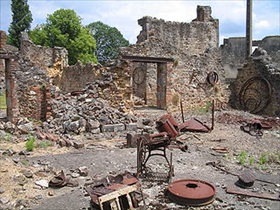
Right: Wrecked hardware (bicycles, sewing machine, etc.) 6 decades later, left as a reminder of the barbarity of the German reprisal in Oradour-sur-Glane. In January 1953 a military tribunal in Bordeaux, France, heard the case against the surviving 65 of the approximately 200 German soldiers who had been involved in the reprisal. Only 21 defendants were in court. On February 11, 1953, with a single exception, all were convicted of war crimes.
1941 Kragujevac Massacre: Testimony and Reconstruction (Serbian with English subtitles)

World War II was the single most devastating and horrific event in the history of the world, causing the death of some 70 million people, reshaping the political map of the twentieth century and ushering in a new era of world history. Every day The Daily Chronicles brings you a new story from the annals of World War II with a vision to preserve the memory of those who suffered in the greatest military conflict the world has ever seen.