

GERMANS BOMB U.S. AIR BASE IN UKRAINE
Poltava, Ukraine SSR, Soviet Union • June 22, 1944
Since mid-1942 U.S. Army Air Forces brass had proposed to the Soviets an expansion of shuttle bombing missions that would strike hard-to-reach targets in Central and Eastern Europe. The concept of shuttle bombing was straight-forward: Allied bombers and fighter escorts would launch themselves from 1 airfield, unload their bombs over Axis railroads, bridges, highways, aircraft and armament plants, etc., and land at a second airfield, or terminal, on the other side of otherwise unreachable targets. At the second airfield the warbirds would refuel, rearm, and bomb their way back to the originating airfield or to a third airfield. The early strategic and tactical shuttle bombing missions had been successfully demonstrated using airfields in England and Italy. But to make shuttle bombing more effective would require the mission scope be stretched eastward to encompass targets in Hungary, Romania, Bulgaria, Czechoslovakia, and Poland. The rub of course was coaxing the Soviets into placing some of their air bases in the West’s shuttle hopper. Predictably, the habitually suspicious Soviet dictator Joseph Stalin said “Nyet” to that. In February 1944 he changed his mind.
By mutual agreement new shuttle termini would be opened in areas of the Ukraine recently liberated by the Soviet Army. In March 1944 Operation Frantic was born and Poltava, Mirgorod, and Pyriatyn airstrips, each about 50 miles/80 kilometers apart, became the new eastern termini. Poltava doubled as the U.S.-Soviet headquarters for the 3 termini under the on-site supervision of the freshly created U.S. Eastern Command. On June 2 Poltava welcomed scores of 4‑engine Boeing B‑17 Flying Fortresses and long-range P‑51 Mustang fighter escorts flying in from U.S. Fifteenth Air Force bases around Foggia, Southeastern Italy. Hours earlier American flyboys had bombed the Hungarian rail hub of Debrecen before setting course for the Ukrainian airstrips. The heavy bombers landed at Poltava and Mirgorod airfields, the fighter escorts at Pyriatyn. On June 6 U.S. aircraft left their Ukrainian bases to attack a Romanian airfield, only to return to base. On June 11 the Fifteenth Air Force bade farewell to their Ukrainian hosts and concluded the first Frantic mission.
Frantic II was assigned to the U.S. Eighth Air Force residing in England. Squadrons of bombers and fighters touched down at Ukrainian termini on June 21, 1944, after assaulting a synthetic oil plant and 2 rail yards in Eastern Germany. Early the next morning, on this date, June 22, 1944, dozens of German and Hungarian airplanes flew over Poltava, dropping deadly payloads for almost 2 hours and destroying 47 Eighth Air Force aircraft while severely damaging most of the remaining 26. Twenty-one Red Air Force single-engine Yakovlev Yak‑9 and Yak‑7 fighters were among the casualties. Stores of precious fuel and ammunition were also set ablaze. The Poltava fiasco was the serendipitous offspring of a lone Heinkel He 111 multi-engine reconnaissance plane that had tailed the U.S. aircraft to their Ukrainian bases following the raiders’ attack on East German installations the day before.
During the summer of 1944, the U.S. Eighth and Fifteenth Air Forces flew 7 shuttle bombing missions, the last on September 18–19. Measured against the program’s original objectives and modest successes, the later missions were burdened by growing Soviet distrust and intransigence that negatively affected air operations. Especially irksome was Stalin’s delay in okaying Frantic VII, the U.S. airdrop of supplies to Polish insurgents in Warsaw that were needed to expel German occupiers from the capital, and his nixing Frantic VIII, a second Warsaw supply mission. Painful too was a kick in the nether regions when the Soviets told Americans their assistance was no longer needed. These events, among others, prompted the United States Army Air Forces to suspend future Frantic shuttle missions. A caretaker contingent of U.S. personnel vacated Poltava in June 1945.
Operation Frantic (June–September 1944) Extends Range of Allied Bombing to German-Occupied Central and Eastern Europe
 |
 |
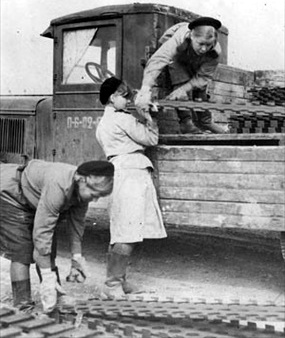
Left: Initially the Americans proposed 6 shuttle bombing air bases on Ukrainian soil and a ground crew of 2,000. They settled for 3 sites and half the number of ground crewmen. With Ukrainian labor and virtually all American materiel and supplies, Poltava’s existing concrete airstrip was lengthened by over a mile/1.6 kilometers to accommodate long-range bombers (the Soviets had none) using pierced-steel matting as shown in this photograph. The air base was cramped, making it hard to disperse the aircraft after arrival.
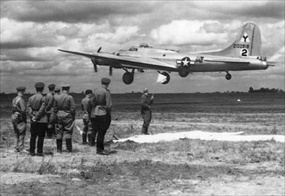
Right: A U.S. Fifteenth Air Force B‑17 Flying Fortress is guided to a safe landing by a flag-waving soldier (center) as other soldiers watch, Poltava Airfield, June 2, 1944. B‑17s squadrons were split between Poltava and Mirgorod airfields, while escort fighters took up residence at Pyriatyn Airfield. Security at all 3 air bases was provided by the Red Army, which promised round-the-clock fighter protection but instead delivered truck-mounted machine guns. Air-raid shelters consisted of twisting earthen trenches. The U.S. communications center was overseen by the Soviets.
 |
 |
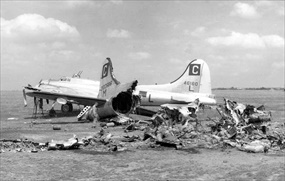
Left: On June 22, 1944, beginning at 12:35 a.m., dozens of Luftwaffe bombers, mostly twin-engine Heinkel He 111s and Junkers Ju 88s, plastered the Poltava air base with more than 110 tons of high explosives and fragmentation and incendiary bombs. After a brief lull, broken by exploding aircraft and munitions, another wave of Luftwaffe planes swooped in at low level, machine guns blazing. Their loads included thousands of small antipersonnel mines called Butterflies for their stubby wings, which opened and armed the mines. At 2:20 a.m. flash bombs lit up the airfield anew for a reconnaissance plane to photograph the damage done. Soviet antiaircraft guns continued firing for 15 minutes after the last German planes left for their base near German-occupied Minsk in Belarus, roughly 400 miles/644 kilometers to the northwest. Neither Soviet nor American fighters rose to challenge the Axis warbirds—the Americans would have needed Soviet permission anyway. Intense Soviet truck-mounted 50‑caliber antiaircraft cannon fire had no effect on wave after wave of enemy planes dropping their loads on the airfield.
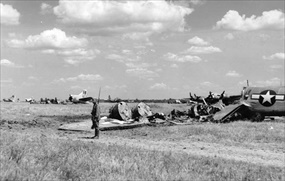
Right: A lone Soviet soldier guards the twisted carcasses of U.S. Eighth Air Force B‑17s that were sitting ducks for the surprise June 22 Luftwaffe nighttime air raid. According to Eastern Command’s damage report, 47 B‑17s, 2 Douglas C‑47 transports, and a Lockheed F‑5 (photo-reconnaissance version of the P‑38 Lightning fighter) were “destroyed or damaged beyond economical repair.” Every other Fortress and 2 F‑5s received some form of damage. It was the worst drubbing inflicted by the enemy on the U.S. Army Air Forces since Japanese airmen wiped out Gen. Douglas MacArthur’s Far East Air Force on December 8, 1941. Three days later just 9 Poltava aircraft were operational thanks partly to salvaged parts. Eighth Air Force B‑17s at Mirgorod and P‑51s at Pyriatyn fled to Soviet air bases farther to the east, which saved them from destruction when German bombers hit the 2 air bases on June 22/23 and 23/24 in nighttime enactments of Poltava right down to the nonappearance of Soviet fighter interceptors. Mirgorod’s fuel and ammunition stores were set ablaze. Aircrews rendered redundant by the Poltava disaster were ferried back to England. On June 26 the Mirgorod- and Pyriatyn-based aircraft were serviced, rearmed, and refueled for a bomb run on an oil refinery and rail yard at Drohobycz, Poland (now part of Ukraine). The squadrons landed in Foggia, Italy, where they joined the Fifteenth Air Force on several missions before returning to their English bases.
Operation Frantic’s Shuttle Bombing Focuses Primarily on Axis Targets in Path of Soviet Army

World War II was the single most devastating and horrific event in the history of the world, causing the death of some 70 million people, reshaping the political map of the twentieth century and ushering in a new era of world history. Every day The Daily Chronicles brings you a new story from the annals of World War II with a vision to preserve the memory of those who suffered in the greatest military conflict the world has ever seen.