

GERMANS ABANDON DEMYANSK POCKET
Moscow, Soviet Union • February 28, 1942
On this date in 1943 the 13-day Battle of Demyansk ended with the evacuation of the last batch of German armed forces from the Demyansk salient. Beginning the previous February 96,000 (eventually 131,000) German troops and auxiliary service personnel forced themselves into what was a relatively insignificant village that lay a little over 200 miles/322 km southeast of the German-besieged city of Leningrad (present-day St. Petersburg, Russia) in the Soviet Union. Demyansk’s importance at the time was both its location on high ground surrounded by forested marshland and its proximity, 20 miles/19 km away, to the strategic Staraya Russa-Valdai railway and points east, including the Soviet capital, Moscow.
The fighting in the Demyansk salient stretched back to early 1942 following the German defeat after the Battle of Moscow (October 2, 1941, to January 7, 1942). At 13 months Demyansk was one of the longest encirclement battles of the European Theater. Originally the German 16th Army, deployed as part of Army Group North operating to the south of Leningrad, occupied Demyansk in the fall of 1941 in support of Operation Barbarossa, Adolf Hitler’s ill-fated attempt to liquidate the Soviet Union, Germany’s powerful neighbor to the east. The Red Army’s winter campaign (December 5, 1941, to May 7, 1942), intended to drive the invaders away from Moscow, witnessed the Soviets’ Northwestern Front (army group) enclosing tens of thousands of German fighters in what became known as the Demyansk Pocket in February 1942 (see map below). A tiny pocket of 5,500 Germans was isolated separately at Kholm (Cholm) to the southwest. Emphasizing the importance of the Demyansk bridgehead to the success of his war in the East, Hitler designated the Soviet village a “Festung” (fortress) on February 22, 1942, to be held against all opposition.
It was a costly conversion, pocket to fortress. Sustaining the entrapped garrisons required Hermann Goering’s Luftwaffe to conduct months of never-before-tried airlift operations (in Kholm’s case, gliders and parachute drops). Each day the Luftwaffe flew over 100 flights of Junkers Ju 52 transport aircraft, carrying a daily average of 300 tons of food and matériel to sustain the defenders and evacuate the critically wounded and sick to field hospitals in the rear. On April 22, 1942, a task force of Demyansk defenders broke the siege of 5 Soviet armies by reopening a land corridor to the north, for a loss of 11,777 dead (thousands simply frozen to death), 40,000 wounded, and 2,739 missing. Kholm’s forlorn defenders held out till May 5, 1942, when it was relieved, for a loss of 1,500 defenders dead and 2,000 wounded. Soviet losses during this period (January 7 to May 20, 1942) were nearly 89,000 dead and missing and 156,603 wounded.
But this was not the end of the Demyansk tragedy. As part of Operation Polar Star, the Soviet offensive early the next year (February 10 to April 1, 1943), the Northwestern Front, in a joint operation with two other Soviet army groups, tried for the fifth time to cut the land route to Demyansk. On February 17, after receiving Hitler’s authorization 2½ weeks earlier in the wake of the Stalingrad disaster, the main Demyansk garrison began withdrawing westward. Five days later the Germans had completely abandoned the salient for a loss of nearly 7,000 killed, wounded, and missing versus 33,663 killed, wounded, and missing on the Soviet side. The Red Army called off its offensive on February 28, 1943. The threat of another enemy attack in the Moscow area also ended. Not until February 21, 1944, did the Red Army liberate Kholm.
Demyansk Pocket: Tragedy on the Eastern Front, 1941–1943
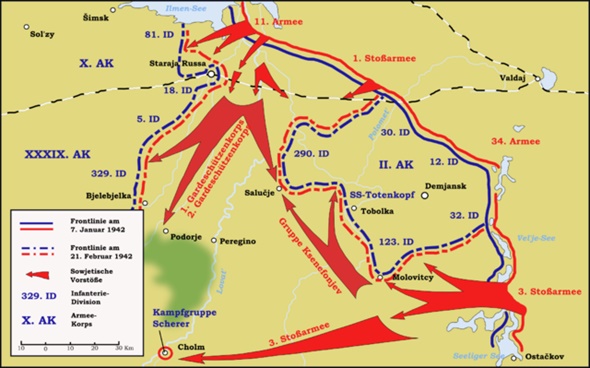 |
Above: German map showing the encirclement of Demyansk and Kholm (Cholm), 2 German garrisons south of Lake Ilmen, February to April 1942. (Demyansk and Kholm are now in Novgorod Oblast in Western Russia.) Opposing Soviet forces are indicated by broad red arrows. The broken black line represents the east-west Staraya Russa-Valday rail line. The Demyansk Pocket (German, Kessel von Demjansk) was roughly 1,150 sq miles/2,978 sq km in size, with a porous front line of 187 miles/301 km. The tiny Kholm (Cholm) pocket was only 1.24 miles/1.9 km wide. The “II. AK” inside the Demyansk Pocket stands for II (2nd) Army Corps (II Armeekorps), a constituent of the German 16th Army. Also trapped in the pocket were men from the X Army Corps and auxiliary units, among them police services, Reich Labor Service, SS Freikorps Danmark, and Waffen-SS Division “Totenkopf.” The siege of Demyansk was second in length to the 872‑day siege of Leningrad.
 |
 |
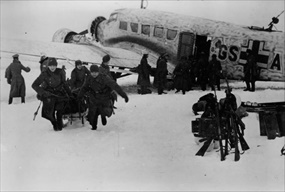
Left: Taken in January 1942, this photo shows a 3-engine Junkers Ju 52 emptying its cargo. The Demyansk Pocket had 2 viable airfields capable of receiving the garrison’s daily requirements of 300 short tons of food, medicine, munitions, weapons, fuel, replacement troops, etc., and evacuating the wounded and sick to field hospitals in the rear. One airfield with a 2,600 ft./792 m runway could service 20 planes at a time. Despite freezing and snowy and foggy weather much of the time, the aerial resupply lifeline was modestly successful. The Luftwaffe flew 33,086 sorties, bringing in 64,880 tons of supplies and evacuating 35,400 wounded. The air bridge definitely kept the pocket from dying of attrition. That said, 387 airmen and 265 aircraft were lost in the course of the airlift and Soviet air strikes on the airfields. Among the lost aircraft were 106 Junkers Ju 52s, 17 Heinkel He 111s, and 2 Junkers Ju 86s, which added together represented over half of Germany’s annual production of transports. By contrast, the failed Stalingrad airlift in late 1942–early 1943 cost the Luftwaffe well over twice the aircraft lost in Demyansk’s airlift, and it only supplied a fraction of what the trapped German Sixth Army needed to survive the siege of Stalingrad (today’s Volgograd).
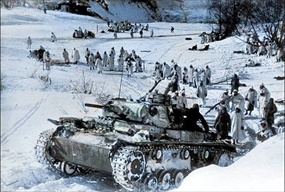
Right: Colorized photo titled “Opening the Demyansk Pocket. Panzers in snow and German soldiers in winter camouflage.” Photo taken on March 21, 1942, by a relief force (Group Seydlitz) pushing south along the Staraya Russa-Ramushevo road. Exactly 1 month later a task force from Demyansk moving north linked up with the rescue party in the face of stiff Soviet counterattacks. On May 1 Demyansk was declared “liberated.” Soviet troops tried 5 times between May 1942 and February 1943 to cut the Demyansk-Ramushevo corridor, but their attempts were fiercely rebuffed. Between February 17 and 28, 1943, the beleaguered Germans emptied their Demyansk bridgehead (but not Kholm) just as the Red Army was set to launch a renewed offensive to annihilate the enemy garrison.
Undated Silent German Footage of Horrific Conditions Inside the Damyansk Pocket (Suggest muting the audio)

World War II was the single most devastating and horrific event in the history of the world, causing the death of some 70 million people, reshaping the political map of the twentieth century and ushering in a new era of world history. Every day The Daily Chronicles brings you a new story from the annals of World War II with a vision to preserve the memory of those who suffered in the greatest military conflict the world has ever seen.