

GERMAN TROOPS TO AID ROMANIA
Berlin, Germany · September 20, 1940
On this date in 1940 the chief of the German high command, Field Marshal Wilhelm Keitel, announced that Wehrmacht troops were being dispatched to Romania “in case a war with Soviet Russia is forced upon us.” The next month German troops entered the country ostensibly to train and rebuild the Romanian military after King Carol II abdicated in favor of his 19‑year-old son Michael following political upheavals occasioned by a series of territorial disputes that were resolved to Romania’s disadvantage. In reality the Nazi presence in Romania protected that country’s Ploesti (Ploieşti) oil fields, which would become increasingly vital to the German war effort and eventually supply more than a third of Germany’s oil needs.
In late November 1940 Romanian strongman Marshal Ion Antonescu initialed the Axis Tripartite treaty, joining Hungary and Slovakia in the military pact, notwithstanding that the leading Axis power, Germany, had engineered the whittling away of Romanian territory to the gain of neighboring Hungary, Bulgaria, and the Soviet Union. As Hitler’s political and military triumphs increased in number in the early 1940s, Antonescu was drawn more and more into the German orbit, supplying Germany not only with oil and lubricants but also grain, military and industrial products, and more troops to the Eastern Front than all of Germany’s other allies combined.
Becoming Hitler’s chief spear carrier had devastating consequences for Romania. In the fighting around Stalingrad alone (November 1942 to January 1943), Romanian losses were over 160,000 dead, wounded, missing, or captured. In the fall of 1944 a resurgent Red Army overran Romania and its southern neighbor Bulgaria, eventually pulling both countries into the Soviet orbit. Romanian casualties fighting Nazi Germany on the Soviets’ side (August 1944 to May 1945) amounted to some 167,000 killed, wounded, or missing.
The postwar Soviet occupation of Romania facilitated the rise of Communism as Romania’s main political force, leading to the removal of King Michael I and the establishment of a single-party people’s republic. It also led to further territorial losses (see second map). Escape from the Soviet Union’s constellation of satellite states came in the form of the Revolutions of 1989, also known as the Fall of Communism, which ended Soviet-backed regimes all across Central and Eastern Europe.
Romania During and Immediately After World War II
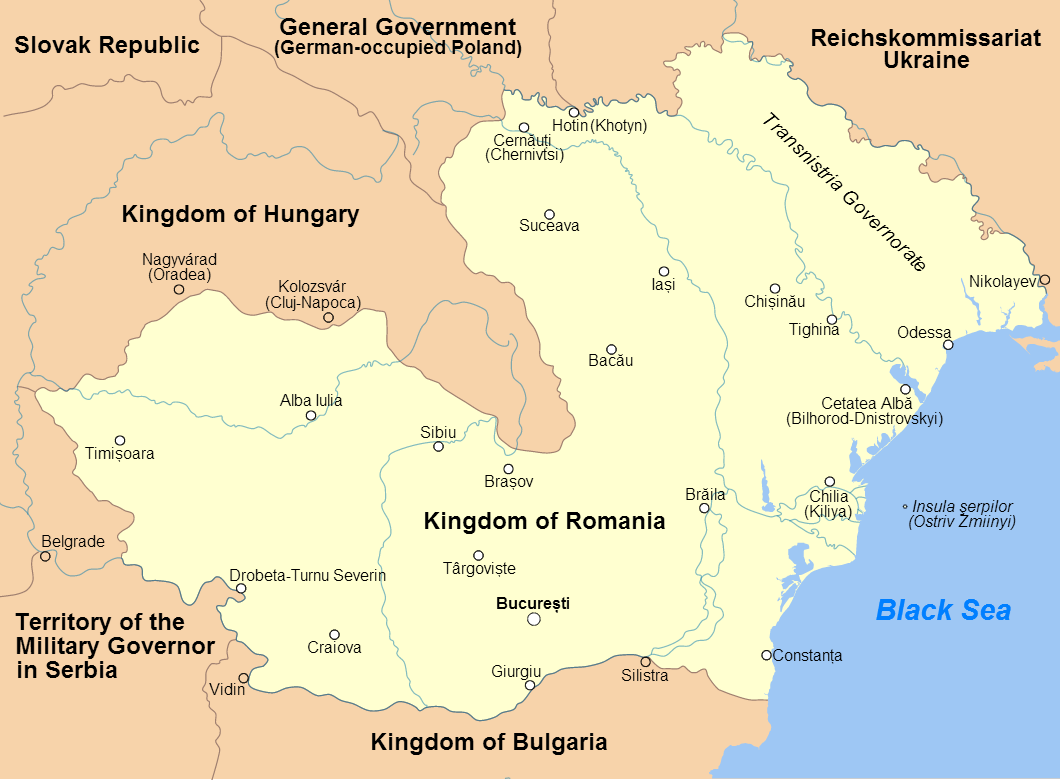 |
Above: Romania in 1942. The large intrusion into the middle of Romania represents that portion of Northern Transylvania that was awarded to Hungary by Germany and Italy in the Second Vienna Award, August 30, 1940.
 |
 |
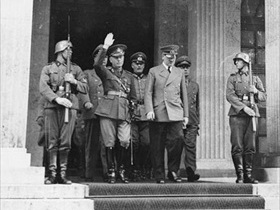
Left: On June 10, 1941, less than two weeks before unleashing Operation Barbarossa on the unsuspecting Soviets, Hitler conferred with Romanian leader Gen. Ion Antonescu. As the two national leaders exit the Fuehrerbau, where the Munich Agreement was signed in September 1938, they are followed by Field Marshal Wilhelm Keitel and to his left German Foreign Minister Joachim von Ribbentrop.
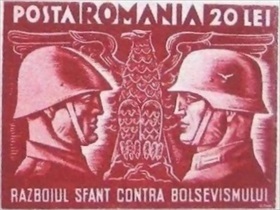
Right: Romanian stamp design from 1941 celebrating the common participation of Romania and Germany on the Eastern Front. Profiles of a Romanian soldier (left) and his German counterpart are imposed over an eagle that represents both countries’ national seals. The caption on the bottom of the stamp reads: “The Holy War on Bolshevism.”
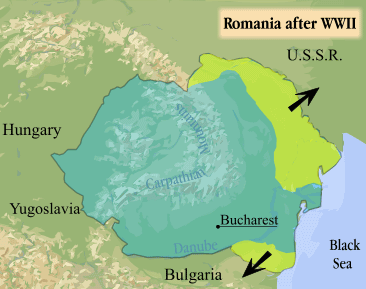 |
Above: Postwar Romania, 1947, showing the territorial losses to the Soviet Union and Bulgaria. On the other hand, Northern Transylvania, which had been lost to Hungary in 1940 (see earlier map), was once again recognized as an integral part of Romania.
Romanian Military on the Eastern Front, 1941–1943: Period Newsreels Set to Martial Music (English Subtitles)

World War II was the single most devastating and horrific event in the history of the world, causing the death of some 70 million people, reshaping the political map of the twentieth century and ushering in a new era of world history. Every day The Daily Chronicles brings you a new story from the annals of World War II with a vision to preserve the memory of those who suffered in the greatest military conflict the world has ever seen.