

GERMAN NAVAL, LAND, AIR UNITS ASSAULT POLAND
Warsaw, Poland · September 1, 1939
World War II in Europe began on this date in 1939 in Danzig (present-day Gdańsk), Poland, when the German training ship Schleswig-Holstein bombarded the Polish naval base in Danzig harbor. After a fierce day-long fight, Danzig fell and was annexed by the Reich the next day. Meanwhile, Hermann Goering’s Luftwaffe, with its large fleet of modern aircraft, had no difficulty in achieving control of Poland’s airspace. The Luftwaffe first attacked the Polish town of Wieluń, deep inside Poland, destroying 75 percent of the town and killing close to 1,200 people, most of them civilians. Warsaw, Poland’s capital—under heavy aerial bombardment since the first hours of the war—was attacked on September 9, besieged on September 13, and pummeled by 1,150 German aircraft on September 24. On the ground all six panzer (armored) divisions and ten mechanized infantry divisions thundered across the 1,400‑mile border, accompanied by some 40 divisions of more conventional infantry. As German ground units advanced from the north (Danzig and East Prussia), the south (German-allied Slovakia), and the west (see map), with their goal of converging on Warsaw, Polish forces withdrew from their forward bases near the Polish-German frontier to more established lines of defense in the east. The Polish defense plan called for an encirclement strategy: Germans were permitted to advance in between two Polish Army groups in the line between Berlin and Warsaw-Łódź, at which point a Polish reserve army would move in and trap them. Polish military strategists, however, failed to predict the fast pace of German panzer and motorized units, a miscalculation that led to the September 8 capture of Łódź in Central Poland, the country’s third-largest city. This proved to be a major setback to the Poles’ plan to defend the country west of the Vistula, the river that bisects Poland south to north as well as Warsaw itself. Although the British and French had declared war on Germany on September 3, pledging to guarantee Poland’s independence and borders, they made no promises that they would come to Poland’s aid immediately. Luftwaffe chief Goering hoped that the conflict would be over quickly, avoiding a world war. That all seemed likely when the last Polish army in the field surrendered on October 6, 1939.
[fblike]
[amazon_carousel widget_type=”ASINList” width=”600″ height=”200″ title=”Recommended Reading” market_place=”US” shuffle_products=”False” show_border=”False” asin=”1844158462,0143120069,1781592276,1848843356,0811708284,0674284003,0700613927,0811707245,1841764086,1849084793″ /]
German Blitzkrieg Against Poland, September 1 to October 6, 1939
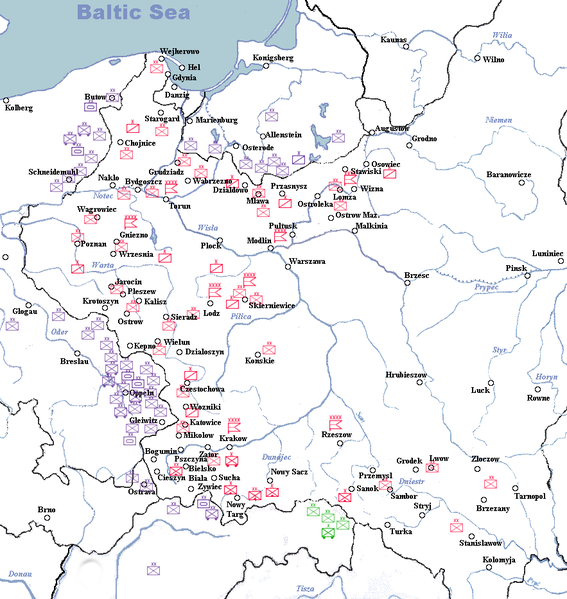 |
Above: German and Polish deployment of land forces on September 1, 1939. The last engagement between the two armies took place between October 2 and 5. Hitler was convinced that once Poland was defeated and divided between Germany and the Soviet Union, which had entered the conflict against the Poles on September 17, 1939, Britain and France would not seriously continue the war.
 |
 |
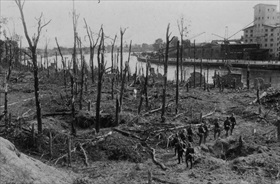
Left: The Battle of Westerplatte was the first battle in the German invasion of Poland. Beginning on September 1, 1939, German naval and land forces assaulted the Polish Military Transit Depot on the Westerplatte peninsula in Danzig’s harbor. Manned by fewer than 200 Polish soldiers, the depot held out for seven days in the face of heavy attacks that included dive bombers. In this photo German soldiers make a sweep of the area on September 8.
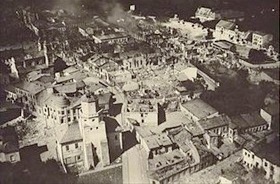
Right: Wieluń city center after three German air raids on September 1, 1939. The bombing of Wieluń, which held no military value, is considered to be one of the first terror bombings in history and maybe the second in Europe. The church, synagogue, hospital, and most of the town’s other buildings were destroyed by 70 tons of bombs. The casualty rate was more than twice as high as the Basque town of Guernica, Spain, bombed by German and Italian air forces in 1937.
 |
 |
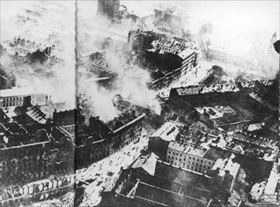
Left: Burning Warsaw, September 1939. The Luftwaffe opened the German attack on Poland’s capital on September 1, 1939, deploying 1,750 bombers and 1,200 fighters during the invasion. As the German Army approached Warsaw on September 8, Junkers Ju‑87 Stukas and other bombers attacked the city. On the 13th, Luftwaffe bombers caused widespread fires. Finally, on September 25 Luftwaffe bombers, in coordination with heavy artillery shelling by army units, badly damaged Warsaw’s city center. The next day the Polish garrison surrendered, and on September 27 German troops entered the city.
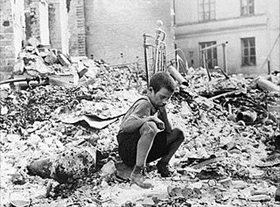
Right: From the first hours of the war, Warsaw—called the “Paris of the North” owing to the splendor of the city—was a target of unrestricted aerial bombardment. In addition to military facilities such as infantry barracks, the airport, and an aircraft factory, German pilots targeted civilian facilities such as water works, hospitals, market places, and schools. Between air and ground assaults, Warsaw suffered approximately 40,000 civilian deaths. Forty percent of its buildings were damaged and 10 percent were destroyed in the first month of war. In this photo a nine-year-old boy rests in the rubble during a search for food for his family.
Silent German Propaganda Film “Liberation” of Danzig and Wehrmacht’s Assault on Poland, September 1939

World War II was the single most devastating and horrific event in the history of the world, causing the death of some 70 million people, reshaping the political map of the twentieth century and ushering in a new era of world history. Every day The Daily Chronicles brings you a new story from the annals of World War II with a vision to preserve the memory of those who suffered in the greatest military conflict the world has ever seen.