

GEN. EISENHOWER DISSOLVES NAZI GOVERNMENT
Muerwik, near Flensburg, Northern Germany • May 23, 1945
Twenty-three days after German dictator Adolf Hitler had committed suicide under the rubble of his Reich capital, and 16 days after military emissaries from Reich President Grand Admiral Karl Doenitz’s government agreed to the unconditional surrender of all German armed forces, a telephone call reached the admiral’s headquarters at the Muerwik naval academy in the Baltic Sea port of Flensburg. Doenitz, Admiral Hans-Georg von Friedeburg, and Col. Gen. Alfred Jodl were requested to report to the Allied Control Commission precisely at 9:45 a.m. the next day. On this date, May 23, 1945, the 3 Germans faced an American general, a British general, and a Soviet general. From them they heard the order from Gen. Dwight D. Eisenhower, Supreme Commander Allied Expeditionary Force, dissolving Doenitz’s Nazi government and the arrest of all its cabinet members. Dissolved also was the German Military High Command, the Oberkommando der Wehrmacht, or OKW.
Doenitz & Co. had hoped the Allied coalition would recognize their government as the provisional government of postwar Germany, but the Soviets would have nothing to do with the “Fascist gang around Doenitz.” For that matter, the Western Allies never considered the Doenitz regime in Flensburg to be anything other than the remnant of the German Military High Command. Interestingly, although the German armed forces had surrendered unconditionally in Reims, France, on May 7, 1945, and in Berlin the next day, the civilian government Hitler had invoked into being in his April 29, 1945, political testament (i.e., the vestigial Nazi government under Adm. Doenitz), had not been included in the German Instrument of Surrender. The “Act of Military Surrender,” the document that Chief of Operations Staff of the Wehrmacht Col. Gen. Alfred Jodl signed (and Jodl’s was the sole German signature on the surrender document), stated only that “All forces under German control [were] to cease active operations at 23:01 hours Central European Time on 8 May 1945.” Given the Allies’ suspicions that the hardboiled Nazi admiral had surrounded himself with other dangerous Nazis and war criminals in Flensburg (OKW chief Field Marshal Wilhelm Keitel had been taken into custody on May 13), it is probably pointless to speculate what implications there may have been later on had the signature of a civilian representative from the rump Nazi government of Doenitz, such as Chancellor Lutz Graf Schwerin von Krosigk, been included on the surrender document.
The power vacuum that ensued between the arrest of Doenitz and his cabinet ministers and the dissolution of the Third Reich ended on June 5, 1945, when Allied representatives signed a 4‑power document. The Declaration Regarding the Defeat of Germany formally abolished any German governance over the vanquished nation and gave the victors legal cover for assuming political control of Germany. Although the country continued to exist, it was placed under the authority of the Allied Military Occupation Government, whose supreme authority was discharged by the Four Powers jointly for all 4 occupation zones (U.S., Soviet, British, and French) via the Allied Control Council (ACC) based in Berlin.
The ACC—pretty much a toothless body because all decisions were made by consensus, of which there was practically none—ceased operations in March 1948, its functions in Western Germany turned over to the Allied High Commission until the West German Federal Republic gained sovereignty in 1949. The Soviet occupation zone (Eastern Germany) was administered by a High Commissioner until the German Democratic Republic gained sovereignty the same year.
Grand Admiral Karl Doenitz’s Flensburg Government, May 2–23, 1945
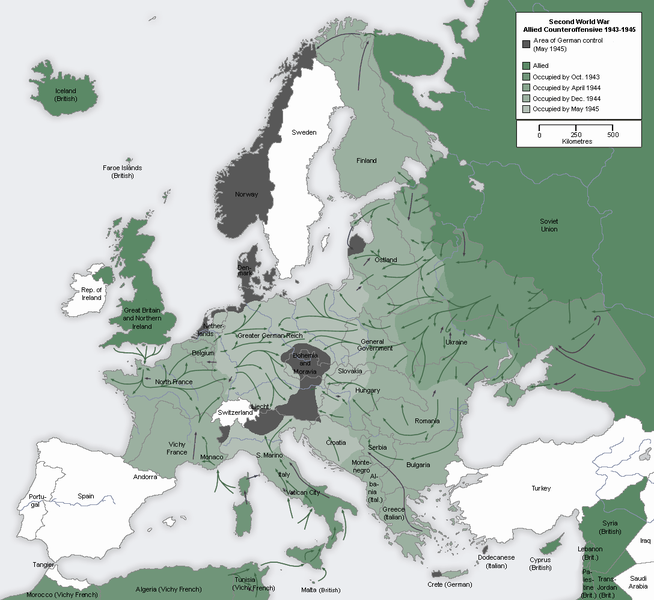 |
Above: Map showing extent of Flensburg Government control (dark gray), May 2–23, 1945. Headed by Grand Admiral Karl Doenitz, the Flensburg Government had de jure but little if any de facto control over the remnants of Hitler’s Third Reich, and none over the areas shown in shades of green. One American newspaper called the Flensburg Government (sometimes referred to as the Northern Government) a “fake government.” Named after Doenitz’s headquarters on the Schleswig-Holstein coast, the fledgling Flensburg Government attempted to rule the country following Hitler’s suicide (a “hero’s death,” Doenitz called it). The Doenitz “administration” (the label Winston Churchill chose to use)—unwilling to make a clean break from its Nazi past—was dissolved by order of Gen. Dwight D. Eisenhower. The prescient Nazi Armaments Minister Albert Speer (pronounced “spare”), as soon as he learned that Jodl had signed the German Instrument of Surrender in Reims, France, on May 7, prophesied correctly when he told Doenitz that “the sovereign rights of the German people have ceased to exist,” and that “the fate of the German people will be decided exclusively by the enemy.” On May 11 the Joint Chiefs of Staff Directive Number 1067 held nothing back when explaining how the victors would treat their former foe: “Germany is not to be occupied for the purpose of liberation but as a defeated enemy nation.”
 |
 |
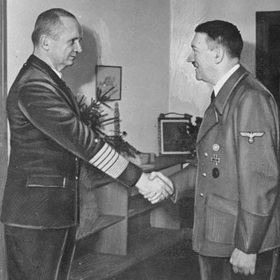
Left: Adolf Hitler receives Adm. Karl Doenitz in this photograph likely taken in 1944. Shortly before the military and political collapse of Nazi Germany and his suicide on April 30, 1945, Hitler transferred the leadership of the German state to the Admiral. Doenitz did not become Fuehrer (a post Hitler abolished in his political testament), but rather President (Reichspraesident) and head of the Germany’s armed services. Contrary to a 1941 decree that Reichsmarschall Hermann Goering would succeed him, Hitler had turned hours earlier on Goering and Reichsfuerher-SS Heinrich Himmler, the second most powerful person in the country, for angling separately to make peace with the Western Allies. Propaganda Minister Joseph Goebbels would have become German Chancellor (Reichskanzler) in the post-Hitler government but for his own suicide hours after Hitler’s.
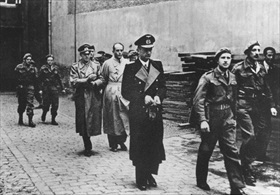
Right: Three members of the Flensburg Government—Doenitz (dark coat), Reich President and Minister of War; trailing him Field Marshal Wilhelm Keitel’s replacement as head of the Oberkommando der Wehrmacht Col. Gen. Alfred Jodl, Doenitz’s delegate who signed the “Act of Military Surrender” for the OKW on May 7, 1945, at the headquarters of SHAEF (Supreme Headquarters of the Allied Expeditionary Force) in Reims, France; and to Jodl’s left (in civilian attire) Albert Speer, Minister for Economics—following their arrest by British Royal Hussars carrying out Operation Blackout, May 23, 1945. Shortly after the men were taken into custody, Flensburg’s main street swarmed with British tanks and troops rounding up the remaining members of Doenitz’s administration and staff. In all, between 5,000 and 6,000 Germans, including hundreds of high-ranking military officers, were taken into custody. Most officers below the rank of colonel were released after a brief captivity. Doenitz and his cabinet were flown to England and imprisoned to await trial on war crimes charges. Tried by the 4‑power International Military Tribunal in Nuremberg (November 20, 1945, to October 1, 1946) Jodl was convicted and executed as a war criminal; Doenitz and Speer received prison terms of 10 and 20 years, respectively.
Contemporary Newsreel Account of Arrest of Flensburg (Doenitz) Regime Members

World War II was the single most devastating and horrific event in the history of the world, causing the death of some 70 million people, reshaping the political map of the twentieth century and ushering in a new era of world history. Every day The Daily Chronicles brings you a new story from the annals of World War II with a vision to preserve the memory of those who suffered in the greatest military conflict the world has ever seen.