

FRENCH FLYER SAINT-EXUPÉRY DISAPPEARS
Marseille, Occupied France • July 31, 1944
On this date in 1944 French poet, writer, and pioneering aviator Antoine de Saint-Exupéry vanished on a reconnaissance flight off the Mediterranean coast near Marseille, France. Best known for his novella The Little Prince (Le Petit Prince), and to a lesser extent for books about his aviation adventures, including Night Flight (1931) and Wind, Sand and Stars (1939), the 44-year-old Saint-Exupéry flew for Gen. Charles de Gaulle’s Armée de l’Air (Free French Air Force).
A successful commercial pilot before the German invasion of his country, Saint-Exupéry joined the French Air Force, flying reconnaissance missions until France’s armistice with Nazi Germany in June 1940. Like de Gaulle, Saint-Exupéry fled France, the author traveling to America to persuade the U.S. government to enter the war against Germany, and where he wrote pieces and lectured audiences in the U.S. and Canada in support of the French Resistance. It was during his 27‑month stay in the States that he wrote and illustrated the 104‑page children’s classic, The Little Prince.
In the spring of 1943 Saint-Exupéry left for North Africa in an American military convoy to fly with the Algiers-based Armée de l’Air. Grounded for 8 months for wrecking a Lockheed P‑38 Lightning through engine failure on his second mission in North Africa, he was reinstated to flight duty on the personal intervention of the Deputy Commander of the U.S. Army Air Forces, Gen. Ira Eaker.
Despite being overage for flying (he was over 40) and in poor health (he suffered from depression and increasingly drank heavily), Saint-Exupéry flew 9 missions for the Allies. His final mission was to fly his unarmed reconnaissance version P‑38 Lightning from the island of Corsica over the French Rhône Valley to collect intelligence on German troop movements in support of opening a second French front in the south of France in mid‑August 1944 (Operation Dragoon). He never returned.
Word of his disappearance spread across the literary world and then into international headlines. Several days following his disappearance an unidentifiable body wearing French military colors was found in a bay near the small Provençal port town of Carqueiranne and was buried there that September. In 1998 a fisherman found Saint-Exupéry’s silver identity bracelet, and 2 years later the partial remains of the author-pilot’s P‑38 Lightning were found in the seabed near Marseille. The cause of Saint-Exupéry’s death remains unknown, though several Luftwaffe pilots have alleged they were the agents of the P‑38’s shoot-down.
Antoine de Saint-Exupéry (1900–1944) and His “Little Prince”
 |
 |
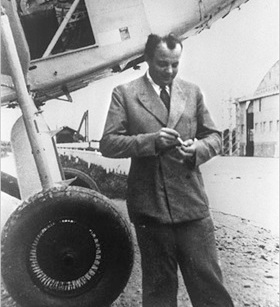
Left: Antoine de Saint-Exupéry (1900–1944), French writer, poet, and pioneering aviator in Toulouse, France, 1933. Saint-Exupéry was twelve when flew for the first time. In the early 1920s, while stationed in Strasbourg with the military, Saint-Exupéry earned his flying wings and became a pilot. In 1926 he signed on as a pilot for Aéropostale, a private airline that flew mail from Toulouse, France, to Dakar, Senegal. The next year Saint-Exupéry, in Southern Morocco, began writing his first book, a memoir called Southern Mail, which was published in 1929. In 1931 he published Night Flight, which won instant success and the prestigious Prix Femina. His next novel, Wind, Sand and Stars, was published in 1939. A great success, the book won the Académie Française’s Grand Prix du Roman and the National Book Award in the United States.
Right: First published in the United States in French and English in early 1943, Le Petit Prince (The Little Prince) is the tale of a small interplanetary traveler and his friendships with a pilot, a rose, and a fox. The children’s classic has been translated into more than 250 languages and dialects—it is most widely translated book in the French language—and is among the top three selling books in the world. The Little Prince has been made into movies and TV films in a number of languages as well.
Saint-Exupéry’s The Little Prince Read by Kenneth Branagh

World War II was the single most devastating and horrific event in the history of the world, causing the death of some 70 million people, reshaping the political map of the twentieth century and ushering in a new era of world history. Every day The Daily Chronicles brings you a new story from the annals of World War II with a vision to preserve the memory of those who suffered in the greatest military conflict the world has ever seen.