

FIRST U.S. RAID ON JAPAN SINCE DOOLITTLE’S
Chengtu, China · June 15, 1944
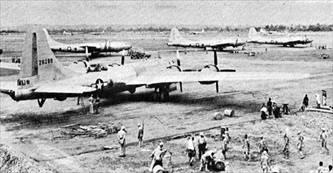
On this date in 1944 67 B-29 Superfortresses took off from their base in Chengtu, mainland China, to release 221 tons of bombs on the Imperial Iron and Steel Works at Yawata on the southernmost Japanese home island of Kyūshū. This was the first attack on the Japanese homeland since Col. James Doolittle and his Raiders famously launched themselves off the carrier deck of the USS Hornet more than 2 years earlier.
The June 15 attack inflicted marginal damage on Yawata—only one bomb struck the steelworks. But more than that, the Yawata raid demonstrated to U.S. Army Air Forces Maj. Gen. Curtis LeMay, head of the XX Bomber Command in China, that Chinese bases, which had to be supplied with fuel flown over “The Hump” (the Himalayan “Aluminum Trail,” named for the number of planes lost), could not deliver the knockout blows to Honshū, the main island north of Kyūshū, where Tokyo, the nation’s capital, lay. Raids from Chinese airfields against industrial targets continued at relatively low intensity through early January 1945.
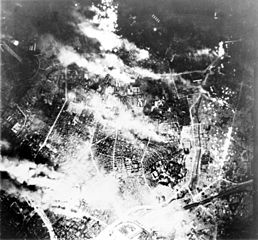
The first wave of B-29s attacked Tokyo from their new base in the Marianas in the Central Pacific on November 24, 1944, when 111 B‑29s hit an aircraft factory on the edge of the city. More B‑29 raids continued through the end of the month, when LeMay gave his bomber team a respite. In mid-February Tokyo’s aircraft works were badly hit by carrier-based aircraft. The second of these carrier-based raids was accompanied by nearly 230 B‑29s.
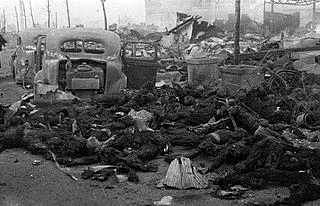
At month’s end the B-29s took over the show. On the night of March 9/10, in a fiery display called Operation Meetinghouse (Meetinghouse being code for Tokyo), 334 B‑29s dropped incendiaries that destroyed 267,000 buildings, roughly 25 percent of the city (nearly 16 sq. miles/41 sq. kilometers), killed close to 84,000 residents while wounding over 41,000, and cut the city’s industrial capacity in half. The Japanese Imperial Palace was heavily damaged in the firestorm. Emperor Hirohito’s tour of his firebombed capital is often cited as the beginning of his personal involvement in the peace process, culminating in Japan’s surrender 6 months later. Tokyo continued to be bombed through August 15, when the Japanese government announced its acceptance of the Allies’ July 26 Potsdam Declaration and its willingness to capitulate provided the emperor’s sovereignty was maintained.
Noriko Kawamura’s Emperor Hirohito and the Pacific War provides a convincing reappraisal of Japan’s Hirohito few Westerners would recognize whenever they are reminded of Pearl Harbor and the Pacific conflict. This owes largely to Kawamura drawing on a huge number of primary and secondary Japanese-language sources—some of them only recently available to scholars. Mining them Kawamura draws a portrait of an emperor personally against waging war with the West, all the while officially sanctioning (as required by the Japanese constitution) state decisions that led to the events of December 7, 1941. Once Japan’s leaders launched their nation’s high-risk campaign to seize Western colonial interests, Hirohito assumed the mantle of supreme commander in chief (daigensui) of all Japanese armed forces, again as required under the constitution. Kawamura portrays Hirohito growing ever more skeptical of a favorable military outcome as Japanese victories over the enemy proved more elusive by the month. Terrified by the prospect of “Japan’s annihilation,” as Hirohito himself put it, the emperor at last flexed his moral muscles in a set of imperial prerogatives (seidans), intervening on the side of the “peace faction” to end the conflict he never wanted. To his dying days in January 1989 the Hirohito of Kawamura’s account privately agonized over his not nipping in the bud the calamity that the fire-breathers in his military were poised to inflict both on his loyal subjects and on tens of millions more who would suffer, be injured or maimed, or lose their lives in the Pacific War.—Norm Haskett
The Bombing of Japan, 1944–1945
 |
 |
Left: B-29 Superfortresses photographed at Chengtu, China, shortly before they participated in the bombing of Yawata, Japan, on June 15, 1944. Boeing built 3,970 of these 4‑engine, propeller-driven heavy bombers between 1943 and 1946. B‑29s carried out around 33,000 sorties in World War II mainly against Japan. B‑29s carried out the atomic bombings that destroyed Hiroshima and Nagasaki on August 6 and 9, 1945, respectively. On August 14, 1945, the last day of combat in World War II, B‑29s targeted the Japanese naval arsenal at Hikari on the southern tip of Japan’s main island, Honshū. Former Japanese Prime Minister Fumimaro Konoe, who left office 7 weeks before his country’s surprise attack on the U.S. Pacific Fleet at Pearl Harbor, Hawaii, said: “The determination to make peace was the prolonged bombing” by U.S. warplanes.
Right: Tokyo burns under a B-29 firebomb assault, May 26, 1945. B‑29 raids on Tokyo began on November 24, 1944, and lasted until August 15, 1945, the day Japan capitulated. Twin-engine bombers and fighter-bombers carried out additional attacks on Tokyo.
 |
 |
Left: The charred remains of Japanese civilians after the almost unimaginable carnage and destruction wrought by Operation Meetinghouse, the March 9–10, 1945, firebombing of Tokyo. Operation Meetinghouse was the deadliest firebombing of World War II.
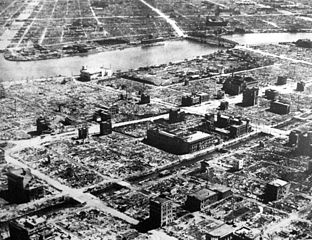
Right: A virtually destroyed Tokyo residential section. Over 50 percent of Tokyo, or 97 sq. miles/251 sq. kilometers of the city, was reduced to ashes by the end of the war. In all, an estimated 40 percent of Japan’s built-up cities were destroyed in U.S. air attacks in 1944–1945.
March 1945 “Blitz Week” Targets: Tokyo, Nagoya, Osaka, and Kobe (Four Consecutive Videos)

World War II was the single most devastating and horrific event in the history of the world, causing the death of some 70 million people, reshaping the political map of the twentieth century and ushering in a new era of world history. Every day The Daily Chronicles brings you a new story from the annals of World War II with a vision to preserve the memory of those who suffered in the greatest military conflict the world has ever seen.