

1926 LIQUID-FUEL ROCKET LAUNCHED, FORERUNNER OF V-2 TERROR WEAPON
Auburn, Massachusetts • March 16, 1926
On this date in 1926 in Auburn, Massachusetts, Dr. Robert Goddard (1882–1945) conducted his first successful rocket flight. His liquid-propellant rocket rose 41 ft./12.5 m, traveled 184 ft./56 m, and burned no more than 3 seconds, but it proved the concept of rocket flight worked. Goddard, who received limited support for his research and development work (and quite of bit of ridicule from skeptics), was among a handful of rocket enthusiasts in the Soviet Union (Russia), France, the U.S., and Germany.
German amateur rocketry enthusiasts, among them a young Wernher von Braun, began testing rockets at what was once Berlin’s Tegel Airport. Because rockets were not addressed in the 1919 Treaty of Versailles, which demilitarized post-World War I Germany, they attracted in the early thirties, perhaps quite naturally, the attention of the German Army, which allowed doctoral candidate von Braun to use its proving grounds to conduct experiments on rocket propulsion.
As Adolf Hitler’s Nazi Germany began to move to a warlike posture in the late 1930s, von Braun became a professional rocket developer. (He also became a Nazi Party member and a major in the SS (short for Schutzstaffel), a major paramilitary organization of Hitler’s Nazi Party and the foremost agency of surveillance and terror within Germany and Nazi-occupied Europe.) It was under von Braun’s direction that the most destructive weapon of the European conflict, the 12‑ton V‑2 combat rocket, was developed on the isolated island of Peenemuende, a secretive site off the North German Baltic coast replete with research laboratories, testing sites, power plants, and factory complexes. The Vergeltungswaffe 2 (retaliation weapon 2) was a 46‑ft./14‑m-tall, single-stage, gyro-stabilized, liquid-fuel ballistic missile produced in 2 damp, cold, poorly ventilated underground facilities by as many as 60,000 prisoners from Mittelbau-Dora, the concentration camp in the eastern half of Germany where an estimated 20,000 prisoners died. (Mittelbau-Dora, also known as Nordhausen-Dora, was a subcamp of the Buchenwald concentration camp.) Missile testing commenced in March 1942.
From September 8, 1944, to early 1945, V-2 launch teams fired more than 3,200 V‑2 rockets at targets in England (where they killed 2,500 Londoners 4 minutes later), France, Belgium, the Netherlands, and even inside Germany itself—at Remagen, whose Ludendorff Bridge over the Rhine River had recently been captured intact by the U.S. 9th Armored Division. At a speed of 3,600 miles/5,794 kilometers per hour, V‑2s delivered a high-explosive, one-ton warhead without warning. Many rockets were launched from mobile platforms in urban areas and concealed forests, using fleets of specially built transporters (“Meillerwagen”) and sophisticated support vehicles. It took about an hour to prepare and fire the rocket on its Meillerwagen. The last V‑2 rocket was launched from The Hague in the Netherlands on March 27, 1945, exploding in London, where it killed 134 people and injured 94. The V‑2 had no effect on the outcome of the war; its value as a weapon of terror and mass destruction lay in its novelty.
V-2 Short-Range Ballistic Missile
 |
 |
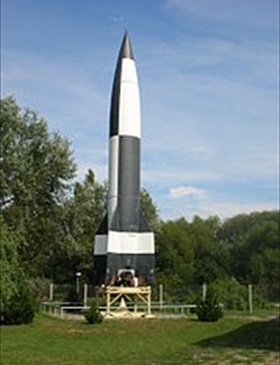
Left: A V-2 rocket in the Peenemuende Museum. RAF air raids on Peenemuende’s V‑2 research and production facilities caused the Germans to move production to the Mittelwerk location inside the Harz Mountains of Thueringen (Thuringia), Eastern Germany, where slave labor built 5,200 V‑2 rockets in cold, dank underground caverns and tunnels without running water or proper sanitation. Wernher von Braun admitted occasionally visiting the Mittelwerk rocket factory (but not the notorious Mittelbau-Dora concentration camp that provided the factory with its labor), and called conditions there “repulsive.”
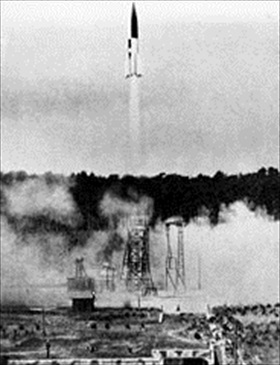
Right: A V‑2 test rocket 4 seconds after liftoff at Peenemuende, June 21, 1943. Meant as payback for British and American bombing of German cities, the V‑2 (its technical name was Aggregat‑4, or A4) is perhaps the only weapon system to have caused more deaths by its production—estimated at 12,000–20,000 forced laborers and concentration camp prisoners—than by its deployment: 2,754 civilian and military deaths, 6,523 wounded.
 |
 |
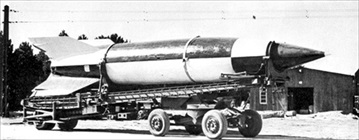
Left: A V‑2 rocket on a Meillerwagen transport trailer near Cuxhaven on the North German coast in 1945. Meillerwagen were one of several vehicles in a V‑2 launch battery. It brought the V‑2 to its launch site, mounted the missile on its firing stand, and served as the service gantry for fueling and launch preparation. Meillerwagen were assembled using Italian and Soviet prison laborers some 16 miles/26 kilometers south of the Rhine city of Bonn in former railway tunnels below vineyards and forests along the Ahr River.
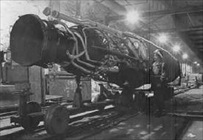
Right: A V‑2 propulsion unit on a dolly inside the underground assembly facility at Niedersachswerfen near Nordhausen, Germany. About 250 V‑2 missiles were found in various stages of “in”-completion on the Mittelwerk assembly line after the war, when this photo was taken. Allied bombing had so disrupted the Nazis’ transportation network and supply chain of the more than 40,000 parts that went into a V‑2 that many of the missiles at the Mittelwerk assembly plant would never, ever have been ready to launch much less been able to reach a launch site.
Footage of Peenemuende Army Research Center and Dr. Wernher von Braun, the Site’s Technical Director

World War II was the single most devastating and horrific event in the history of the world, causing the death of some 70 million people, reshaping the political map of the twentieth century and ushering in a new era of world history. Every day The Daily Chronicles brings you a new story from the annals of World War II with a vision to preserve the memory of those who suffered in the greatest military conflict the world has ever seen.