

FIRST BLACK FIGHTER SQUADRON FORMED
Chanute Field, Rantoul, Illinois • March 19, 1941
Pressed on one side by Black news media and civil rights groups demanding that pilot training be opened up to African Americans and on the other by an upcoming re-election, President Franklin D. Roosevelt in 1940 authorized the creation of a segregated flight school and an all-Black fighter squadron. On this date, March 19, 1941, in Illinois, the U.S. Army Air Corps’ 99th Pursuit Squadron (“pursuit” being the pre-World War II term for “fighter”) was activated without a single pilot for the purpose of training an officer corps and ground support personnel (e.g., aircraft mechanics, supply clerks, armorers, and weather forecasters). Over 270 African American enlisted men became the pioneering core of Black squadrons forming at Moton and Maxwell Fields in Macon County, Alabama.
In June 1941 the pilot-training phase of the program officially began with the formation, at Alabama’s Tuskegee Institute, of the 99th Fighter Squadron, the first flying unit for African Americans, earning program participants their nickname—Tuskegee Airmen. The segregated airmen and ground crew, initially consisting of 47 officers and 429 enlisted men, were placed under the command of Capt. Benjamin O. Davis, Jr., only the fourth black American to graduate from West Point Military Academy in New York state, which he accomplished despite being ignored and ostracized by faculty and white cadets at the academy.
Tentatively scheduled to fly air defense over Liberia, the combat-ready 99th was diverted to Tunis, North Africa, to support the Allied invasion of Sicily in July 1943 (Operation Husky). The following year the squadron provided close air support for Lt. Gen. Mark Clark’s U.S. Fifth Army in Italy during its assaults on Foggia and Anzio and for French and Polish armies in their attack on the historic hilltop abbey, Monte Cassino. For its missions over Sicily and again for shooting down 13 enemy aircraft while covering the Allied invasion of the Italian mainland during the Anzio campaign (Operation Shingle) the 99th Fighter Squadron received two Distinguished Unit Citations.
In mid-1944 the 99th, joined by three other squadrons out of Tuskegee to form the 332nd Fighter Group, was assigned to conduct bomber escort missions over Romania, France, Austria, Czechoslovakia, Poland, Yugoslavia, Greece, and Germany. In all, Tuskegee aviators, who eventually numbered close to 1,000, flew more than 15,000 mis¬sions, shot down 111 en¬e¬my air¬craft, and destroyed or damaged 273 on the ground at a cost of 66 of their own planes. More than 10,000 African American men and women served as their vital support personnel. For its wartime efforts Tuskegee Airmen earned a total of three Distinguished Unit Citations. Additionally, the all-black aviators earned more than 850 awards, including 95 Distinguished Flying Crosses, eight Purple Hearts, one Silver Star, and 744 Air Medals.
The unquestionable excellence and commitment of the Tuskegee Airmen drove home to military and civilian authorities alike the illogic and inefficiency of racial segregation in the U.S. military. The record of the airmen helped persuade the Air Force—largely for reasons of operational self-interest—and President Harry S. Truman to move to desegregate the armed services after the war. Benjamin Davis, by then a colonel, helped draft the Air Force plan for implementing Truman’s order.
In Standing Up Against Hate: How Black Women in the Army Helped Change the Course of WWII award-winning young-readers author Mary Cronk Farrell tells the remarkable, little-known story of how the only all-women, all-black unit of the Women’s Army Corps (WACs) ever deployed overseas brought speed, efficiency, and order to a chronically chaotic mail processing and delivery system in the last 6 months of the war in Europe. Letters and packages from the States were stacked floor to ceiling in 6 aircraft hangers in England. Under the plucky leadership of Major (later Lt. Col.) Charity Adams, a former high school math teacher from South Carolina, the 6888th Central Postal Directory Battalion began the process of sorting and delivering mail to over 7 million GIs, civilians, and Red Cross workers during the remainder of the war, first from Birmingham, England, and later from outposts in Rouen and Paris, France. The motto of the 6888th: “No mail, low morale.” Farrell’s book is a must-read addition to the canon of coming-of-age books that saw the U.S. armed forces transformed from a racially segregated force into a desegregated one where the color of one’s skin slowly but eventually mattered far less than a person’s talent, ability, positive attitude, and hard work.—Norm Haskett
Tuskegee Airmen, the First African American Military Aviators in the U.S. Armed Forces
 |
 |
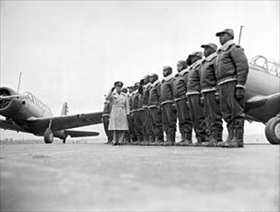
Left: Maj. James A. Ellison reviews the first class of Tuskegee cadets and the flight line at the U.S. Army Air Corps basic and advanced flying school, Tuskegee, Alabama, 1941. During its five-year history the flying school trained almost 1,000 avi¬a¬tors who filled the ranks of the 99th Fighter Squadron, the 332nd Fighter Group, and the 477th Bombardment Group. Nearly half served in combat during the war, compiling an impressive record flying 15,000 sorties in North Africa, Sicily, and Italy.
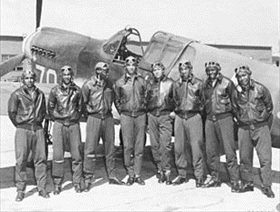
Right: Tuskegee Airmen, circa May 1942 to August 1943. Location unknown but likely Southern Italy or North Africa.
 |
 |
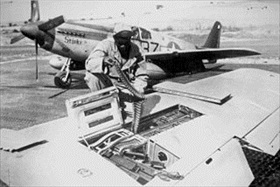
Left: 99th Fighter Squadron mechanic reloading a P 51 Mustang, September 1944.
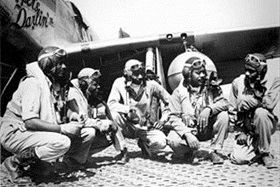
Right: Five members of the Fifteenth Air Force 332nd Fighter Group at Italy’s Ramitelli Airfield in Foggia, Calabria, circa August 1944. Formally, the 99th Fighter Squadron formed the 332nd Fighter Group and the 477th Bombardment Group of the U.S. Army Air Forces (successor to the Army Air Corps). They were known as “Red Tails” for the distinctive crimson tails adorning their P 51 Mustangs; they earned their affectionate nickname “Red Tail Angels” for staying close to the B 17 and B 24 heavy bombers they escorted over Central and Southern Europe, a task that would make the Tuskegee Airmen famous. Over the course of 179 escort missions, enemy pilots only shot down 27 Allied bombers—far fewer than the average fighter escort. By some reports, bomber crews would specifically request the Tuskegee Airmen as their escorts. In their longest escort mission of the war they flew all the way to Berlin, the German capital, shooting down three German Me 262 jets during the raid and earning the airmen their third Distinguished Unit Citation. German adversaries both feared and respected the African American pilots, calling them “Schwarze Vogelmenschen” (“Black birdmen”).
U.S. Army Air Forces’ Tribute to Tuskegee Airmen

World War II was the single most devastating and horrific event in the history of the world, causing the death of some 70 million people, reshaping the political map of the twentieth century and ushering in a new era of world history. Every day The Daily Chronicles brings you a new story from the annals of World War II with a vision to preserve the memory of those who suffered in the greatest military conflict the world has ever seen.