

FIRST B-29 BOMBER SETTLES IN ON SAIPAN
Northern Mariana Islands · October 12, 1944
The Pacific Theater was the largest theater of World War II. Because of its watery expanse, Army aviation engineers and Seabees had to build more than 100 airfields on islands that dotted the Pacific, from New Guinea in the south, up through Guam, the Marianas, Iwo Jima, to Okinawa. On this date in 1944 on Saipan in the Marianas, an island chain seized from the Japanese only that summer, XXI Bomber Command welcomed its first long-range, heavy-bomber B‑29 Superfortress, though no bomber fields were yet fully operational. Later in the month photoreconnaissance versions of the B‑29 began arriving on the island. On October 27 eighteen bombers launched a warm-up mission to a Japanese submarine base on Truk Atoll, 600 miles away. The first 15‑hour, 3,000‑mile roundtrip to the Japanese capital, Tokyo, occurred on November 7—a B‑29 (F‑13) reconnaissance intruder at 32,000 feet, the first American aircraft over Tokyo since the Doolittle Raid thirty-one months before. On November 24 XXI Bomber Command, led by Maj. Gen. Curtis LeMay, sent the real thing: 111 B‑29s from Guam, which targeted an aircraft factory, port facilities, and urban-industrial areas. Damage was minor but the primary B‑29 mission had begun: destroy Japan’s industrial capacity to continue the war. Only later, following a large-scale test of an incendiary bombing raid on Tokyo on February 25, 1945, did the mission shift to destroying Japanese population centers. By war’s end, 50 percent of Tokyo’s urban area had been destroyed by fire and over three million residents were homeless. Other cities suffered to a greater degree: Toyama, a center for aluminum, ball-bearing, and special steel production, was 99.5 percent destroyed on the night of August 1–2, 1945, when 173 B‑29s dropped incendiary bombs on the city; Kofu, was 77 percent destroyed; Hitachi, 72 percent; Okayama, Nara, and Tsu, 69 percent; Shizuoka, 66 percent; Kagoshima, 63 percent; Yokohama, 58 percent; and Kobe, 55 percent. The attack on these and 57 other major Japanese cities caused as many as a half-million deaths, while displacing as many as five million people. LeMay’s air force dropped millions of leaflets over Japan warning its citizens “in accordance with America’s humanitarian policies” to evacuate their homes and businesses and save their lives.
[fblike]
[amazon_carousel widget_type=”ASINList” width=”600″ height=”200″ title=”Recommended Reading” market_place=”US” shuffle_products=”False” show_border=”False” asin=”0230613969,0307275361,0742554805,1416584404,0802715656,1475997132,0141001461,1594160392,0760341222,0312010729″ /]
Bombing of Tokyo, 1944–1945
 |
 |
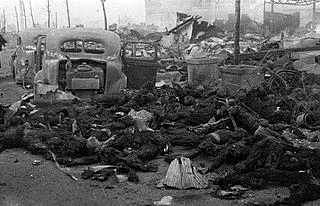
Left: Charred remains of Japanese civilians after the March 9–10, 1945, firebombing of Tokyo (Operation Meetinghouse). Around 1,700 tons of bombs were dropped by 279 B‑29s and roughly 16 sq. miles of the city were destroyed. The U.S. Strategic Bombing Survey estimated that nearly 88,000 people died in this one air raid and resulting firestorm, 41,000 were injured, and over a million residents lost their homes. Another estimate is that the Japanese capital suffered more immediate deaths than either Hiroshima or Nagasaki, which were targets of atomic bombings in August 1945.
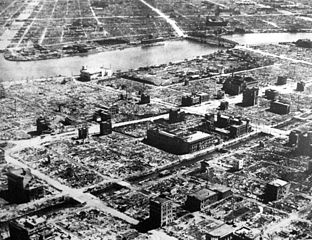
Right: A virtually destroyed Tokyo residential section. Because over 50 percent of Tokyo’s industry was spread out among residential and commercial neighborhoods, the Tokyo firebombings cut the whole city’s output in half.
 |
 |
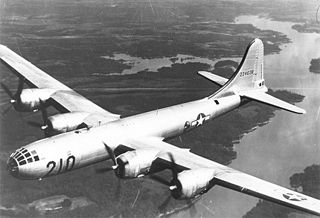
Left: Boeing built 3,970 of these four-engine, propeller-driven B‑29 behemoths between 1943 and 1946. B‑29s carried out the atomic bombings that destroyed Hiroshima and Nagasaki in August 1945.
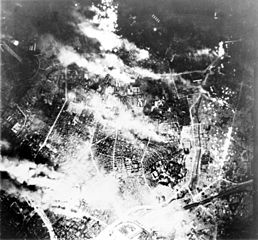
Right: Tokyo burns under a B‑29 firebomb assault, May 26, 1945. B‑29 raids on Tokyo began on November 17, 1944, and lasted until August 15, 1945, the day Japan capitulated. Interestingly, in the six days between dropping the second attention-grabbing atomic bomb on August 9—this on Nagasaki—and the day of Japan’s capitulation, August 15, B‑29s carried out an additional 1,000 individual sorties.
March 1945 “Blitz Week” Targets: Tokyo, Nagoya, Osaka, and Kobe (Four Consecutive Videos)

World War II was the single most devastating and horrific event in the history of the world, causing the death of some 70 million people, reshaping the political map of the twentieth century and ushering in a new era of world history. Every day The Daily Chronicles brings you a new story from the annals of World War II with a vision to preserve the memory of those who suffered in the greatest military conflict the world has ever seen.