

FDR—U-BOATS ARE “RATTLESNAKES OF THE ATLANTIC”
Washington, D.C. · September 11, 1941
Starting on September 1, 1941, two years into the Battle of the Atlantic, U.S. warships began escorting convoys of British-bound merchantmen from the North American coast. Convoys departed from Newfoundland, Canada, and ended in the mid-Atlantic at Iceland. Four days after initiating the escort service, the U.S. destroyer Greer was attached by a German sub 175 miles southwest of Iceland and, in responding to the attack, damaged it. On this date in 1941 in Washington, D.C., President Franklin D. Roosevelt called Nazi submarines and merchant raiders “rattlesnakes of the Atlantic” and issued a “shoot on sight” order. German or Italian ships entering American defensive waters did so at their own risk, and any of their ships that threatened the free passage of U.S. merchant ships and U.S.-escorted ships risked attack. Grand Admiral Erich Raeder, head of the Kriegsmarine, told Adolf Hitler that the U.S., though technically still a neutral nation, had declared war on Germany: “There is no longer any difference between British and American ships.” Hitler stayed his hand for the moment against the U.S. Just over a month later a U-boat wolf pack managed to torpedo six out of 50 eastbound merchantmen being escorted by U.S. and Canadian warships. On October 17, 1941, the U.S. destroyer Kearny, which had been summoned to assist the beleaguered convoy, was attacked by U‑568 northwest of Iceland and damaged. Twenty-two American sailors were wounded and 11 killed, the first to die under their own flag in the European Theater since World War I. Roosevelt’s response was prophetic: “We have wished to avoid shooting. But the shooting has started. And history has recorded who fired the first shot. In the long run, however, all that will matter is who fires the last shot.” But FDR kept his pistol holstered, even when U‑552 sank the first U.S. Navy vessel, the USS Reuben James, west of Iceland with a loss of 115 crewmen. And that’s where things stood between the two powers until the December 7, 1941, attack on Pearl Harbor. Without technically being forced or even obligated by treaty to do so, Hitler declared war on the United States on December 11 as a gesture of solidarity with Japan, a country on the other side of the world. The declaration was, Hitler told his foreign minister, Joachim von Ribbentrop, the “politically correct” thing to do.
[fblike]
[amazon_carousel widget_type=”ASINList” width=”600″ height=”200″ title=”Recommended Reading” market_place=”US” shuffle_products=”False” show_border=”False” asin=”0752461885,B0076TOW0W,0465029612,1906783403,0679640320,0711029288,0465091563,1591149584,1628737271,1849081735″ /]
The U.S. Navy on the Eve of War with Germany, 1941
 |
 |
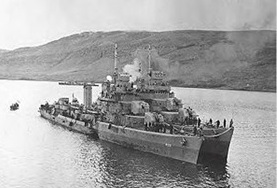
Right: USS Kearny at Reykjavík, Iceland, two days after she had been torpedoed by the U‑568. The USS Monssen is alongside. The torpedo hole is visible in the middle of Kearny’s starboard side. The Kearny, assisting three other U.S. destroyers, came to the rescue of a beleaguered convoy whose Canadian escorts were being mauled by a U-boat wolf pack when it came under attack. Casualties among Kearny’s crew included 11 dead and 22 injured. In FDR’s Navy Day speech on October 27, 1941, the former Undersecretary of the Navy and now president announced, “The shooting has started and we Americans have taken our battle stations.”
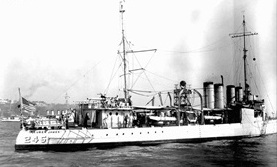
Left: The USS Reuben James—a four-funnel, post-World War I destroyer—was sunk by U-552 west of Iceland as she escorted an eastbound convoy sailing from Newfoundland. A torpedo hit the forward section of the Reuben James. When a magazine exploded it blew off the ship’s entire bow, which sank immediately; the aft section sank five minutes later. Of the 159‑man crew, only 44 survived. Counting the conflict in China, the Reuben James was the second U.S. Navy ship sunk by hostile action in World War II. The river gunboat USS Panay, serving on the Yangtze Patrol in China, was bombed, strafed, and sunk by Japanese aircraft on December 12, 1937, with a loss of 4 dead and 43 sailors and 5 civilians wounded.
American Merchant Marine and Singer-Songwriter Woody Guthrie Performing His “Sinking of the Reuben James” to a Collage of Reuben James Photographs

World War II was the single most devastating and horrific event in the history of the world, causing the death of some 70 million people, reshaping the political map of the twentieth century and ushering in a new era of world history. Every day The Daily Chronicles brings you a new story from the annals of World War II with a vision to preserve the memory of those who suffered in the greatest military conflict the world has ever seen.