

DUTCH SURRENDER EAST INDIES
Batavia (Jakarta), Dutch East Indies • March 8, 1942
The mineral- and oil-rich Dutch East Indies (today’s Indonesia) was Japan’s next colonial target in the Pacific Theater—this after Allied resistance had collapsed in the British Crown colony of Singapore (February 15, 1942) and all but did so in the U.S. Philippines with Gen. Douglas MacArthur’s forces holed up on the rocky, jungle-covered Bataan Peninsula opposite Manila, the Philippine capital. Darwin in Northern Australia, an Allied supply and naval base that had the potential of supporting operations in the East Indies, was rendered useless on February 19, 1942, by two Japanese air raids, one launched from the same carrier decks that brought horrific devastation to the American fleet and army facilities at Pearl Harbor, Hawaii, only ten weeks earlier, the other from land-based planes flying out of Kendari on the Dutch East Indies island of Celebes (modern name, Sulawesi).
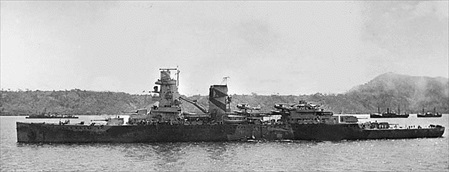
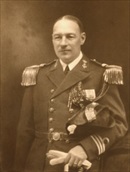
A hastily assembled multinational flotilla of American, British, Dutch, and Australian (ABDA) warships, many of World War I vintage, confronted a superior Japanese invasion force comprising one light aircraft carrier, two heavy cruisers, two light cruisers, fourteen destroyers, and ten transports. In the seven-hour, on-and-off Battle of the Java Sea on February 27, 1942, the Allies lost two heavy cruisers, three destroyers, and 2,300 men, including Dutch Rear Adm. Karel Doorman, ABDA Strike Force commander, when his light cruiser and flagship HNLMS De Ruyter went down. The 52‑year-old Doorman, a navy officer since 1910, had days earlier received his commission as ABDA strike force commander. He intended his polyglot force to somehow halt the Japanese naval invasion of his Dutch East Indies, yet he had had no time to train the men under his new command much less work out tactics for the upcoming battle. The Japanese, suffering damage to one destroyer and the loss of four transports, succeeded in landing an invasion force on the populous island of Java, site of the colony’s capital, on February 28.
Japan’s decisive naval victory and follow-up engagements over the next two days accelerated its conquest of the Dutch East Indies, whose civilian administration surrendered unconditionally on this date in 1942. In the weeklong land campaign Dutch troops, aided by British and American remnants, fought fiercely, and when it was over the Japanese executed many captured Allied soldiers and sympathizing Indonesians. Not until later in the year would Japan’s air and naval superiority in the Pacific be tested again.
Two naval encounters in the Coral Sea (May 4–8, 1942) and at the Battle of Midway (June 4–7, 1942) restored the balance of power in the Pacific that had been lost at Pearl Harbor on December 7, 1941. Over the next two years, U.S. naval and air power relentlessly chewed up Japan’s overseas empire. When the war came to an end, the former Dutch colony unilaterally declared its independence, and the Republic of Indonesia was born on August 17, 1945, in a simple flag-raising ceremony in Jakarta.
Japan’s Takeover of the Dutch East Indies, February and March 1942
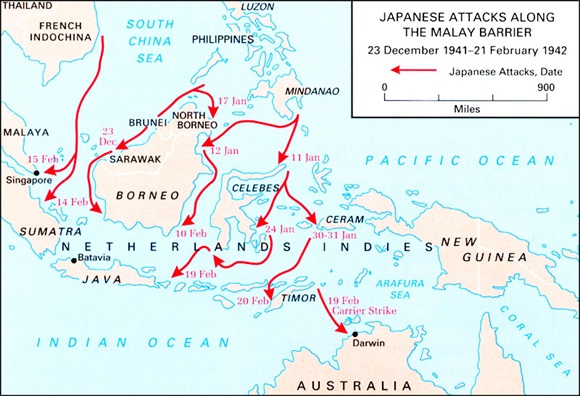 |
Above: Map of Japanese assault on the Dutch (or Netherlands) East Indies and Darwin, Australia, January–February 1942. The “Malay Barrier” in the legend (aka “East Indies Barrier”) refers to a notional chain of defenses across Southeast Asia and the Pacific that the Japanese breached in early 1942 by capturing the rubber-and-tin-rich Malayan Peninsula and Singapore (both British dependencies) and the rich oil fields of Dutch East Indies and Borneo. When the Dutch-held island of Java fell on March 8, 1942, it opened up the Indian Ocean to the Japanese Navy.
 |
 |
Left: Adm. Karel Doorman’s flagship HNLMS De Ruyter at anchor shortly before it was torpedoed and sunk with the loss of Doorman and 344 of his crew. The aging, vastly outnumbered warships of the four regional allies (U.S., Great Britain, the Netherlands, and Australia) were no match for Japan’s huge fleet of top-of-the-line warships, which soundly defeated the ABDA fleet in four sea battles between February and March 1942. After the Battle of the Java Sea (February 27, 1942), ABDACOM effectively ceased to exist, along with the U.S. Asiatic Fleet, and Japanese land forces rapidly overran the Dutch East Indies with little further opposition. (The U.S. Asiatic Fleet would be incorporated into the U.S. Seventh Fleet when it was formed on March 15, 1943, in Brisbane, Australia.)
Right: Following navy tradition, Adm. Doorman chose to go down with his ship early on the morning of February 28, 1942.
 |
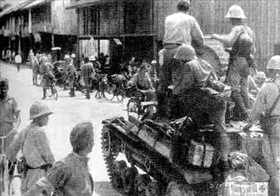 |
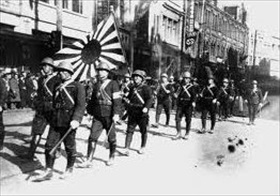
Above: Initially Indonesians welcomed the Japanese as liberators and were impressed by Japanese propaganda that stressed Asian solidarity against European colonial regimes—slogans like “Japan—Light of Asia” and the radio rollout of Japan’s “Greater East Asia Co-Prosperity Sphere” in June 1940. Soon, however, the Japanese imposed an oppressive occupation. They exploited the islands’ fuel sources (primarily oil, which the Dutch had cut off the year before), cut down large tracts of forests to plant cash crops for export back to the Home Islands, and forced all able-bodied males to provide free labor for their war effort (romusha labor program). Hundreds of thousands were sent overseas to work on the construction of the Thai-Burma railway and Japanese projects elsewhere in Southeast Asia.
Contemporary Japanese Footage of Japan’s Invasion of the Dutch East Indies

World War II was the single most devastating and horrific event in the history of the world, causing the death of some 70 million people, reshaping the political map of the twentieth century and ushering in a new era of world history. Every day The Daily Chronicles brings you a new story from the annals of World War II with a vision to preserve the memory of those who suffered in the greatest military conflict the world has ever seen.