

DRONES TO DESTROY NAZI ROCKET, SUB BASES
London, England · August 4, 1944
The British had begun deploying the first of several bunker-buster bombs (Tallboy and its successor Grand Slam) in 1944 while the Americans had nothing similar to deploy. On this date in 1944 the U.S. Eighth Air Force kicked off Operation Aphrodite, a program developed in total secrecy and designed to deliver precision-guided, bunker-busting munitions using a pilotless delivery system. Aphrodite and the U.S. Navy’s equivalent, Anvil, were experimental methods for destroying high-priority targets that were heavily defended and hardened, such as V‑weapon sites and U‑boat pens, and simultaneously disposing of B‑17 Flying Fortresses, B‑24 Liberators, and Navy PB4Y‑1 Liberators that had outlived their operational usefulness.
The war-weary bombers were stripped of all nonessentials right down to the canopy and packed to capacity with explosives in England. Then they were flown by a volunteer pilot and a co-pilot, eventually descending to an altitude of 2,000 ft./620 m, at which time the payload would be armed followed by the two aviators bailing out of the aircraft. Guided by a mother ship using TV cameras and radio-controlled equipment, the pilotless drones would fly into their bomb-resistant targets on the continent and explode.
In this first mission, four B‑17 drones flew to the Pas-de-Calais region in occupied Northern France to destroy cruise missile or ballistic rocket storage facilities and a hardened bunker. Neither this nor the other 12 missions were successful. They were expensive and very dangerous. On the fifth mission to the Pas-de-Calais—this on August 12 against the Fortress of Mimoyecques near the hamlet of the same name that was to house a battery of V‑3 cannons aimed at London—Navy Lt. Joseph P. Kennedy, Jr’s plane detonated prematurely off the North Sea coast of England, killing both pilot and co-pilot and causing widespread damage and small fires, but no injuries, when their wreckage fell onto a nearby village. (Joseph Kennedy was the elder brother of future U.S. President John Kennedy.)
Operation Aphrodite/Anvil effectively ended on January 1, 1945, when both explosive-laden B‑17 drones were shot down by flak batteries over Oldenburg, Northern Germany. The program was terminated on January 27, 1945, when Gen. Carl Spaatz, commander of Strategic Air Forces in Europe, banned any further drone operations. In the Pacific Theater a version of Operation Aphrodite was in the initial stages—a few surplus B‑24D/J Liberators had been converted into radio-controlled flying bombs for use against fortified installations on Japanese-occupied islands—but the Japanese campaign was scrubbed before launch date.
Operation Aphrodite, 1944
 |
 |
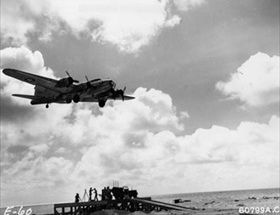
Left: An Aphrodite assault drone at takeoff from a relatively remote airfield in Norfolk, England. The drone carried a payload of 30,000 lb./13.6 metric tons of Torpex, an explosive used in the British Tallboy bombs that was 50 percent more powerful than TNT by mass. Drones required a pilot and a co-pilot because the remote control system was insufficient for safe takeoff.
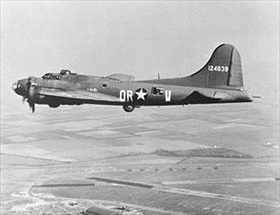
Right: After completing 80 missions, this Aphrodite B‑17F (The Careful Virgin) was used on August 4, 1944, against Mimoyecques, near Calais, France. (The site is very close to the French end of the present-day Channel tunnel.) Dug into a limestone hill, the site was to fire dart-like explosive projectiles from V‑3 “supergun” cannons (gun tubes) on London at a rate of 600 every hour. Without knowing the exact purpose of the site, the U.S. Eighth Air Force and the Royal Air Force bombed Mimoyecques twice in November 1943, 6 times in March and April 1944, and 6 times between May and July. The Aphrodite mission against Mimoyecques on August 4, the first using a remote-controlled aircraft, failed when the worn-out B‑17 spun out of control and impacted short of its target.
 |
 |
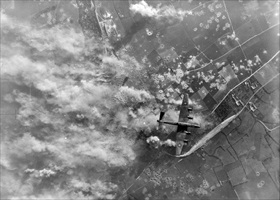
Left: A four-engine RAF Halifax flies over Mimoyecques on July 6, 1944, as exploding bombs send smoke and dust into the air. Mimoyecques was put out of commission on this date when RAF heavy bombers dropped three deep-penetration Tallboy M earthquake bombs to collapse underground railway tunnels, elevator shafts, storage areas, and inclined gun tubes, leaving enormous craters. Two of the 12,000 lb/5.44 metric ton bombs were direct hits, entombing and drowning hundreds of workers, among them engineers and miners from the German Ruhr Valley and forced laborers from 18 nations. The July 6 raid was in response to the Germans test firing Mimoyecques V‑3 cannons that delivered seven shells 32 miles from London 4½ weeks earlier. An RAF squadron of 226 bombers made a final appearance over Mimoyecques on August 26, 1944, without losing a single plane. Shortly after that the Germans abandoned the V‑3 site, which the Canadians captured on September 5.
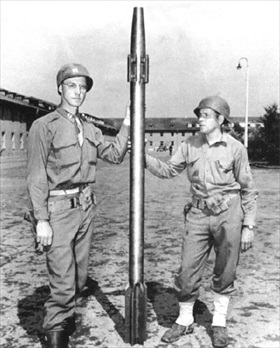
Right: Two U.S. Army soldiers with a captured 150mm/5.9 in finned projectile “Sprenggranate 4481,” a very-long-range shell similar in design to one that had been test fired on June 13, 1944, from Mimoyecques’ V‑3 cannon. (The V‑3 cannon was also known as the Hochdruckpumpe, “High Pressure Pump,” HDP for short; aka London Gun and Busy Lizzie.) The 150mm/5.9 in shell for London was designed to have an explosive charge of 25 kilos/55 lb. The projectile pictured here was the kind fired on Luxembourg, where 142 rounds fell, killing 10 and wounding 35. The U.S. Army disassembled captured gun tubes, spare parts, and ammunition and shipped them to the Aberdeen Proving Ground in Maryland for testing and evaluation.
Operation Aphrodite, a Dangerous Weapon for Its Users

World War II was the single most devastating and horrific event in the history of the world, causing the death of some 70 million people, reshaping the political map of the twentieth century and ushering in a new era of world history. Every day The Daily Chronicles brings you a new story from the annals of World War II with a vision to preserve the memory of those who suffered in the greatest military conflict the world has ever seen.